Fitted with telescopes, the plane did our longest imaging of the Sun’s corona. //
The Concorde Prototype 001 at the National Air and Space Museum of France in Le Bourget, with a map of Africa painted on it. The map depicts the aircraft’s path in the shadow of the total solar eclipse of June 30, 1973. //
“In 1970, the Concorde 001 prototype flew supersonic for the first time,” Léna told Ars. “The newspapers were full of these results. By 1972, I thought it was worth trying to approach André Turcat, the chief of test flights at Aerospatiale in Toulouse, and ask him about the possibility of using the 001 prototype to follow the June 1973 eclipse. He was very interested.”
With his plan accepted, Léna began organizing experiments for the historic flight. Flying at nearly 17 km above the Earth’s surface had many benefits. “Flying very high in the stratosphere had several advantages, including no humidity, which meant an excellent infrared transmission of the solar light.” //
With the shadow moving east at a slightly higher speed than the Concorde’s Mach 2.2, the scientists had 80 minutes of observation time in the totality before the aircraft fell behind the eclipse’s shadow. However, due to headwinds, that was reduced to 74 minutes, which was and still continues to be an astonishing achievement. “No one has achieved even half of it during the past 53 years,” Léna said.
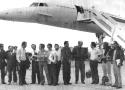
Following this remarkable eclipse chase, the Concorde 001 landed in the Chadian capital of N’Djamena (then Fort-Lamy). “After we landed, a partial solar eclipse went on for an hour and a half or so. There were people (celebrating) on the streets with music as they were very happy to see us. It was a very special moment in my life,” Léna said.

