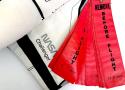
The advertisement on the auction website was titled “Space Shuttle Remove Before Flight Flags Lot of 18.” They were listed with an opening bid of $3.99. On January 12, 2010, I paid $5.50 as the winner.
At that point, my interest in the 3-inch-wide by 12-inch-long (7.6 by 30.5 cm) tags was as handouts for kids and other attendees at future events. Whether it was at an astronaut autograph convention, a space memorabilia show, a classroom visit, or a conference talk, having “swag” was a great way to foster interest in space history. At first glance, these flags seemed to be a perfect fit.
So I didn’t pay much attention when they first arrived. The eBay listing had promoted them only as generic examples of “KSC Form 4-226 (6/77)"—the ID the Kennedy Space Center assigned to the tags. //
It was about a year later when I first noticed the ink stamps at the bottom of each tag. They were marked “ET-26” followed by a number. For example, the first tag in the clipped-together stack was stamped “ET-26-000006.” //
A fact sheet prepared by Lockheed Martin provided the answer. The company operated at the Michoud Assembly Facility near New Orleans, where the external tanks were built before being barged to the Kennedy Space Center for launch. Part of the sheet listed each launch with its date and numbered external tank. As my finger traced down the page, it came to STS 61-B, 11/26/85, ET-22; STS 61-C, 1/12/86, ET-30; and then STS 51-L, 1/28/86… ET-26. //
Once the tags’ association with STS-51L was confirmed, it no longer felt right to use them as giveaways. At least, not to individuals.
There are very few items directly connected to Challenger‘s last flight that museums and other public centers can use to connect their visitors to what transpired 40 years ago. NASA has placed only one piece of Challenger on public display, and that is in the exhibition “Forever Remembered” at the Kennedy Space Center Visitor Complex. //
digital.rain Smack-Fu Master, in training
2y
34
Sarty said:
It is such an extremely NASA thing to do to mark items so mundane and interchangeable as remove-before-flight tags with individually traceable serial numbers.
It has to be one of the quality control check points … you know you placed, say, 56 tags for a specific mission. After removal, you can check that all the 56 tags for that mission have been properly removed.

