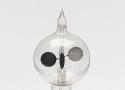
Most people would recognize the device in the image above, although they probably wouldn't know it by its formal name: the Crookes radiometer. As its name implies, placing the radiometer in light produces a measurable change: the blades start spinning. //
It's quite common—and quite wrong—to see explanations of the Crookes radiometer that involve radiation pressure. Supposedly, the dark sides of the blades absorb more photons, each of which carries a tiny bit of momentum, giving the dark side of the blades a consistent push. The problem with this explanation is that photons are bouncing off the silvery side, which imparts even more momentum. If the device were spinning due to radiation pressure, it would be turning in the opposite direction than it actually does.
An excess of the absorbed photons on the dark side is key to understanding how it works, though. Photophoresis operates through the temperature difference that develops between the warm, light-absorbing dark side of the blade and the cooler silvered side. //
But a Crookes radiometer is in a sealed glass container with a far lower air pressure. This allows the gas molecules to speed off much farther from the dark surface of the blade before they run into anything, creating an area of somewhat lower pressure at its surface. That causes gas near the surface of the shiny side to rush around and fill this lower-pressure area, imparting the force that starts the blades turning.

