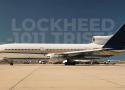
The Lockheed L-1011 competed primarily with the DC-10. Whereas McDonnell Douglas had produced two successful jet airliners and built an extensive customer base, this was Lockheed's first jet-powered airliner. However, while McDonnell Douglas was able to get its aircraft out the door in a swift fashion, Lockheed faced several delays with its program, primarily centered around issues with the Rolls-Royce RB211.
Both aircraft were largely developed out of a request from American Airlines for a twin-engine widebody smaller than the Boeing 747. Both companies developed trijets due to restrictions on twin-engine operations over water, and Lockheed put extra effort into the Tristar's technology. It featured an advanced autopilot, an autoland system, and an automated emergency descent function. This was undoubtedly the most advanced subsonic airliner of its time. //
Charles
I think when the 767 came on the scene, that's what really killed the tristar. //
TJCrewChief
I had a friend that was a 747 and L1011 pilot for TWA. He just loved the Lockheed L1011.
He extolled the fly ability and called it a " Pilots Airplane."

