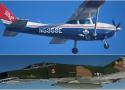
In a couple of ways, a Cessna is more difficult to fly than a fighter jet! The first has to do with mass. A typical Phantom configuration tips the scales at about 50,000 pounds. It takes about 36,000 pounds of afterburning thrust to get it going fast enough (175 knots) to generate enough lift to overcome the 50,000 pounds of gravitational resistance; chewing up about 2,000 feet of concrete. Once airborne, it was an incredibly stable platform because of that mass; trimmed up, it pretty much flew itself—-minimally affected by wind, speed changes, or even turbulence. Speed up? Push the throttle forward. Climb? Pull back on the stick. Turn? Push the stick right or left. Roll out? Push the stick in the opposite direction from starting the turn. Easy Peasy!
‘My son’s Cessna 182 has a maximum weight of 2,950 pounds driven by a 230 horsepower gasoline engine. It takes about the same 2,000 feet of runway to overcome gravity, but at around 55 knots (63 MPH). In order to takeoff at that speed, it has a massive airfoil. Combined with its light weight, it’s affected by every gust of wind, every change in speed, and every change in temperature. Level flight requires continuous trimming (sans auto pilot). Speed up? Throttle up, adjust prop (RPM), manifold pressure, fuel mixture, carburetor heating, cowl flaps, pitch trim. Continue to adjust all of the above according to variations in EGT (Exhaust Gas Temperature), cylinder head temperature, carburetor temperature; hoping to get minimum fuel flow as you don’t have a gauge.

