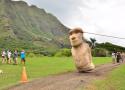
Workers with ropes could make the moai "walk" in zig-zag motion along roads tailor-made for the purpose. //
In 2012, Lipo and his colleague, Terry Hunt of the University of Arizona, showed that you could transport a 10-foot, 5-ton moai a few hundred yards with just 18 people and three strong ropes by employing a rocking motion. //
Lipo was not the first to test the walking hypothesis. Earlier work includes that of Czech experimental archaeologist Pavel Pavel, who conducted similar practical experiments on Easter Island in the 1980s after being inspired by Thor Heyerdahl's Kon Tiki. (Heyerdahl even participated in the experiments.) Pavel's team was able to demonstrate a kind of "shuffling" motion, and he concluded that just 16 men and one leader were sufficient to transport the statues. //
"Pavel deserves recognition for taking oral traditions seriously and challenging the dominant assumption of horizontal transport, a move that invited ridicule from established scholars," Lipo and Hunt wrote. "His experiments suggested that vertical transport was feasible and consistent with cultural memory. Our contribution builds on this by showing that ancestral engineers intentionally designed statues for walking. Those statues were later modified to stand erect on ceremonial platforms, a transformation that effectively erased the morphological features essential for movement."

