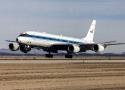
When Samaritan’s Purse retired its McDonnell Douglas DC-8 freighter N782SP after a final humanitarian mission to Jamaica in late 2025, aviation lost more than just another aging cargo aircraft. The retirement marked the near-complete end of the first-generation jetliner era, a period when four-engine aircraft symbolized the future of global aviation.
Built on December 24, 1968, the aircraft accumulated nearly 99,000 flight hours across a 57-year lifespan. Its career included service with Finnair, the French Air Force, and eventually one of the world’s best-known humanitarian organizations. Instead of heading for the scrapyard, the jet now lives on as a static display and educational platform at Liberty University.
While its rival, the Boeing 707, largely disappeared from civilian skies decades ago, the DC-8 continued hauling cargo well into the 2020s.
The reasons were deeply technical: an overbuilt airframe, extraordinary structural durability, and one of the most successful re-engining programs in aviation history. In many ways, the DC-8 became the ultimate example of how smart engineering and adaptability can extend the life of an aircraft far beyond what its designers ever imagined. //
Boeing was heavily committed to developing its next-generation narrow and widebody aircraft, including the 757 and 767, which represented the future of its commercial lineup.
A modernized 707 risked prolonging the life of an older platform that could compete internally with these newer, more profitable designs. In contrast, Douglas had fewer competing priorities and a greater incentive to extend the DC-8's life, making the Super 70 program a central part of its survival strategy.
The DC-8 also held a subtle but important physical advantage that made its conversion more practical. Its main landing gear sat higher relative to the wing and fuselage. This provided better ground clearance for the larger-diameter CFM56 engines. This reduced the amount of structural modification required when compared to the 707.
It also lowered engineering complexity and overall conversion cost. In the end, this seemingly small design difference helped tip the balance in favor of the DC-8, allowing it to successfully transition into a long-lived, economically viable cargo aircraft while its rival faded from the skies. //
The DC-8 became particularly popular for routes where acquisition cost mattered more than maximum fuel efficiency. Even as aviation technology advanced, the aircraft continued proving itself as a reliable workhorse. //
Humanitarian organization Samaritan's Purse gave the aircraft one of its most meaningful final chapters. After being rescued from storage in Roswell in 2015, N782SP flew more than 200 relief missions worldwide, transporting millions of pounds of humanitarian cargo into disaster zones and crisis areas.

