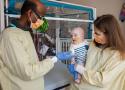
The N-of-1 accomplishment provides a template for swift, personalized genetic therapies. //
News broke yesterday that researchers in Philadelphia appear to have successfully treated a 6-month-old baby boy, called KJ, with a personalized CRISPR gene-editing therapy. The treatment corrects an ultra-rare mutation in KJ that breaks a liver enzyme. That enzyme is required to convert ammonia, a byproduct of metabolism, to urea, a waste product released in urine. Without treatment, ammonia would build up to dangerous levels in KJ—and he would have a 50 percent chance of dying in infancy.
While the gene-editing treatment isn't a complete cure, and long-term success is still uncertain, KJ's condition has improved and stabilized. And the treatment's positive results appear to be a first for personalizing gene editing. //
KJ's treatment was presented this week at the American Society of Gene & Cell Therapy Annual Meeting in New Orleans. It was also simultaneously published in the New England Journal of Medicine.
In an accompanying editorial, Peter Marks—a former top regulator at the FDA—called KJ's treatment a "platform technology" that could be used as a template for treating millions of others with rare genetic conditions. "The development of gene-editing products to address N-of-1 disorders with the use of mRNA encapsulated in lipid nanoparticles represents one of the most obvious opportunities for the application of a platform-technology approach that could be transformational," he wrote.
In all, KJ's treatment "shows the potential strength of the application of cutting-edge science and technology with a forward-leaning regulatory approach to safely expedite the development and availability of life-saving medicines," Marks wrote.

