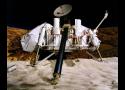
Launched in 1975, the probe outlived its 90-day mission by years and set the standard for Mars landings //
It's been 50 years since NASA sent Viking 1 on a mission to Mars.
Launched on a Titan-Centaur rocket from Complex 41 at Cape Canaveral Air Force Station on August 20, 1975, Viking 1 was one of a pair of probes sent to land on Mars.
Viking 1 consisted of an orbiter and a lander and followed earlier US missions to Mars that had begun with Mariner 4 in 1964, continuing with the Mariner 6 and 7 flybys, and the Mariner 9 Mars orbital mission. //
The Viking 1 spacecraft arrived in orbit around Mars on June 19, 1976.
Power came from a pair of 35 W radioisotope thermoelectric generators (RTGs), connected in series on top of the lander. According to NASA [PDF], "the computer was one of the greatest technical challenges of Viking." There were two general-purpose computer channels, each with a storage capacity of 18,000 words. One was active while the other was in reserve. There was also a tape recorder.
Viking 1 was an unparalleled success. The orbiter and lander lasted far longer than initial expectations. The orbiter was eventually shut down in August 1980 after it ran out of attitude control propellant. It had begun to run low in 1978, but engineers were able to eke it out for a further two years. The lander kept on going until its final transmission on November 11, 1982.
Unfortunately, the lander's failure wasn't due to its hardware or the harsh environment of Mars. It was instead "a faulty command sent from Earth," according to NASA. The command resulted in loss of communication. Controllers spent the next six and a half months attempting to regain contact with the lander before the overall mission came to an end on May 21, 1983.
It is debatable how much longer the lander could have lasted. Viking 2's lander transmitted data until April 12, 1980, but its batteries eventually failed. Both landers and their respective orbiters had operated far beyond their planned mission lifetimes.

