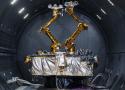
A spacecraft fitted with two flexible robotic arms is on the way to geosynchronous orbit after launching earlier this week on a SpaceX Falcon 9 rocket, kicking off a planned decade-long mission to open new frontiers in satellite servicing.
The Mission Robotic Vehicle, owned and built by Northrop Grumman, rocketed into orbit from Cape Canaveral Space Force Station in Florida on Tuesday. Three small propulsion pods, each functioning as standalone spacecraft, accompanied the MRV aboard the Falcon 9 rocket.
The Falcon 9 deployed all four payloads within about an hour of liftoff. It will take about a year for the satellites to maneuver from their initial elliptical drop-off orbit into a circular orbit more than 22,000 miles (nearly 36,000 kilometers) over the equator. At this altitude, the MRV and the three Mission Extension Pods (MEPs) will travel in lockstep with Earth’s rotation, //
Northrop Grumman’s first three Mission Extension Pods launched on the same rocket as the MRV, but they are flying separately up to geosynchronous orbit using electric propulsion. The pods, each about the size of a dishwasher unit, will loiter there for retrieval by the MRV’s robotic arms. After picking up the first pod, the servicing spacecraft will rendezvous with its first client satellite, lining up precisely with the client to install the pod into its engine compartment. The MEP will latch onto the satellite and take over propulsion for up to eight years, acting as a jetpack, or a smaller version of the MEV, to move the client around geosynchronous orbit as needed. //
This isn’t refueling, but the MRV serves the same end. The Space Force has a separate contract with a company named Astroscale to demonstrate refueling in geosynchronous orbit next year, something no US company has done before. The MRV can also do more than life extension. It can inspect, service, upgrade, or repair satellites that were never designed for it. //
“RSGS has full seven-degree-of-freedom robotic arms, heavily instrumented. The ends of the arms can attach multiple tools as hands, and they also have a good deal of autonomous control,” Shoemaker said. “It’s general-purpose, high-dexterity robotics.”
Ground teams could build and launch more jetpacks to meet up with the MRV in geosynchronous orbit after the spacecraft uses the three pods already in space. Future launches could carry new tools, such as a knife, a cutter, or a robotic screwdriver for more invasive servicing or repairs. And the MRV itself is designed to be refueled in orbit. Northrop Grumman doesn’t plan to immediately build a second MRV, but it will continue upgrading and augmenting the vehicle it just launched. //
These companies and more are taking distinct paths toward satellite servicing, orbital refueling, in-space depots, and what the military likes to call dynamic space operations. But the trend is unmistakable: to fully utilize the domain of space, the throwaway mentality must go.

