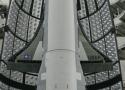
The space plane will also advance the development of a new navigation technology based on electromagnetic wave interference. The Space Force news release characterizes this as the "highest-performing quantum inertial sensor ever tested in space."
Boeing has previously tested a quantum inertial measurement unit, which detects rotation and acceleration using atom interferometry, on conventional aircraft. Now, an advanced version of the technology is being taken to space to demonstrate its viability. The goal of the in-space test is to demonstrate precise positioning, navigation, and timing in an environment where GPS services are not available.
"Bottom line: testing this tech will be helpful for navigation in contested environments where GPS may be degraded or denied," Saltzman said in a social media post Monday, describing the flight.
Quantum inertial sensors could also be used near the Moon, where there is no comparable GPS capability, or for exploration further into the Solar System. //
Albino_Boo Ars Praefectus
7y
8,162
The reason why GPS is provide correction in drift on the laser ring gyros on Trident D5 boats. The key thing, which understandably isn't in the public domain, is the drift on quantum gyros. The other thing which I would be interested in is how they keep it cool enough for quantum effect to be in place. That must give the gyro in space a finite life because you can't top up the Helium. //
Lexus Lunar Lorry Ars Praetorian
7y
572
Subscriptor++
Quantum inertial sensors could also be used near the Moon, where there is no comparable GPS capability, or for exploration further into the Solar System.
One advantage of accurate inertial sensors is that they can be used underwater by submarines. This will be useful for our inevitable upcoming war with the Europan Fish People. There will be no GPS (or other satellite navigation or points of reference) under the mile-thick ice sheets. //
dmsilev Ars Tribunus Angusticlavius
15y
6,364
Subscriptor
wagnerrp said:
Well it needs to be a superfluid.... That means just letting the helium boil off isn't even an option.
Atom interferometry doesn't need conventional cryogenics. It uses laser cooling to trap and manipulate the atoms, so the essential requirements are very stable and precise lasers and other optics that are compatible with all the rigors of launch and spaceflight. At the proof-of-concept level, that's been done before; things like laser-cooled Bose-Einstein Condensates have been demoed on ISS, but obviously going from that to a high-precision navigation instrument entailed a lot of engineering development.

