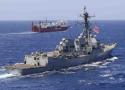
Trump has already said the Navy will escort ships through Hormuz “if necessary.” If the same reflagging requirement applies, every European and Asian tanker that wants a U.S. escort would need to fly the American flag.
Think about what that means for the SHIPS Act, the Jones Act, the U.S. flag fleet, and CMA CGM’s unfulfilled promise to triple its U.S.-flag vessels, Greenland. Hormuz becomes the forcing function for everything Trump’s maritime agenda could not achieve through legislation or diplomacy.
Meanwhile, Iran is selectively letting ships through. Turkish, Indian, Chinese, and some Saudi tankers have been permitted to transit via Iranian territorial waters. About eighteen tankers, mostly Chinese, have done so according to Lloyd’s. Western-allied ships are blocked.
The “closure” is really a sorting mechanism. Iran decides who trades and who does not. Unless the U.S. Navy reopens it for everyone. On America’s terms.
That’s the decision the world has to make, let Iran pull up a tollbooth or stop blocking Trump’s maritime plans. //
While TV oil analysts focus on the global price of oil, the real experts in Houston are watching something different: the fracturing of the global energy market.
The real threat is not $200 oil. It’s a fracture of the system. It is cheap energy in export nations and ruinous energy costs in places far from reserves. It’s $2 oil in the Persain Gulf, $20 dollar oil in the Gulf of America and $2,000 oil in the UK. //
One global price only works if there is a surplus of tankers to arbitrage differentials. Before the Iran strikes, that surplus was razor-thin. Now, with supertankers stuck in the Gulf, it is gone. //
Meanwhile, California has been closing refineries and blocking pipelines, forcing gasoline imports from South Korea on ships with dayrates that are skyrocketing. Govenor Newsom, the leading canidate for President in 2028, is irrate. New England imports LNG and diesel by ship. If Hormuz stays closed, prices spike in those states. Deep blue states. Red state energy costs fall. Blue state costs rise. Europe capitulates on major policy disputes between now and the midterms. //
The strongest version of this thesis is not “Trump is playing 4D chess.” It is that the administration holds more options than anyone realizes, and the insurance mechanism, not the Navy, is the real lever of power.

