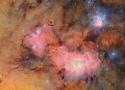
A powerful new observatory has unveiled its first images to the public, showing off what it can do as it gets ready to start its main mission: making a vivid time-lapse video of the night sky that will let astronomers study all the cosmic events that occur over ten years. //
Named after an astronomer famous for her research related to dark matter, the Vera C. Rubin Observatory is perched on a mountaintop in Chile. It's equipped with a specially-designed large telescope, as well as a car-sized digital camera that's the biggest such camera in the world.
The camera is controlled by an automated system that moves and points the telescope, snapping pictures again and again, to cover the entire sky every few days. Each image is so detailed, displaying it would take 400 ultra high-definition television screens.
By constantly comparing new images to ones taken before, the facility's computer systems will be able to spot anything in the sky that changes or moves or goes boom.
"It will be capable of really detecting things that actually change very rapidly," says Sandrine Thomas, deputy director of Rubin Observatory and the observatory's telescope and site project scientist. "That, in itself, will be unique to the world. No other telescope would be able to do that."
"It has such a wide field of view and such a rapid cadence that we do have that movie-like aspect to the night sky," she says.

