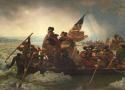
On Christmas morning, General Washington issued orders that the Continental Army was going across that river to kick some Hessian butts. He ordered rations cooked for three days, fresh flints to be put in every musket, and he also ordered that even the musicians and officers were to arm themselves, not with the usual swords and pistols, but with muskets. The Continental Army was betting everything. Bear in mind that in 1776, most of these men couldn't even swim; further, when this happened, the North American continent was in the throes of the Little Ice Age.
General Washington crossed with the first wave. He was leading his men, as a good commander should. By daybreak, the crossing was complete. //
When it was all over, the Hessians had suffered 22 killed, including the commander, Colonel Johann Rall, along with 83 wounded and almost 900 captured. The Americans suffered two killed and five wounded. By noon on the 26th, Washington's forces, with the Hessian prisoners, had crossed safely back across the Delaware into Pennsylvania.
Historian David Hackett Fischer later wrote of this event:
Until Washington crossed the Delaware, the triumph of the old order seemed inevitable. Thereafter, things would never be the same again.
Unlike the battle of Midway, the attack on Trenton wasn't the turning point - but it was a turning point. After Trenton, after that nighttime crossing of an icy river, in the depths of one of the coldest winters in written history, American determination and capability were never again in doubt. General Washington had established himself as a dangerous foe to the British, ... //
We're Americans. If you mess with us, we will cross a frozen river at night to kill you in your sleep. On Christmas.

