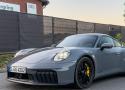
having spent several days behind the wheel, I can report it might just be one of the best-driving, too. //
This is not just one of Porsche's existing flat-six engines with an electric motor bolted on; it's an all-new 3.6 L engine designed to comply with new European legislation that no longer lets automakers rich out a fuel mixture under high load to improve engine cooling. Instead, the engine has to maintain the same 14.7:1 stoichiometric air-to-fuel ratio (also known as lambda = 1) across the entire operating range, thus allowing the car's catalytic converters to work most efficiently. //
for the first time in several decades, there's now only a single turbocharger. Normally, a larger-capacity engine and a single big turbo should be a recipe for plenty of lag, versus a smaller displacement and a turbocharger for each cylinder bank, as the former has larger components with more mass that needs to be moved.
That's where one of the two electric motors comes in. This one is found between the compressor and the turbine wheel, and it's only capable of 15 hp (11 kW), but it uses that to spin the turbine up to 120,000 rpm, hitting peak boost in 0.8 seconds. For comparison, the twin turbos you find in the current 3.0 L 911s take three times as long. Since the turbine is electrically controlled and the electric motor can regulate boost pressure, there's no need for a wastegate.
The electrically powered turbocharger is essentially the same as the MGU-H used in Formula 1, as it can drive the turbine and also regenerate energy to the car's traction battery. //

