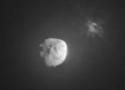
On September 26, 2022, NASA’s Double Asteroid Redirection Test (DART) spacecraft crashed into a binary asteroid system. By intentionally ramming a probe into the 160-meter-wide moonlet named Dimorphos, the smaller of the two asteroids, humanity demonstrated that the kinetic impact method of planetary defense actually works. The immediate result was that Dimorphos’ orbital period around Didymos, its larger parent body, was slashed by 33 minutes.
Of course, altering a moonlet’s local orbit doesn’t seem like enough to safeguard Earth from civilization-ending impacts. But now, as long-term observational data has come in, it seems we accomplished more than that. DART actually changed the trajectory of the entire Didymos binary system, altering its orbit around the Sun. //
Because Dimorphos orbits Didymos, some of the ejecta remained trapped in the system, where it altered the mutual orbit between the two rocks. But a crucial fraction of the ejecta achieved escape velocity from the entire binary system. The momentum carried away by the system-escaping debris is what ultimately contributed to shoving the center of mass of the whole Didymos-Dimorphos pair. “In our case, we found that the beta parameter due to DART impact was around two,” Makadia explained.
The debris blasted completely out of the Didymos system gave the asteroids a push roughly equal to the initial impact of the spacecraft itself. //
The goal of DART was primarily to take our planetary defense out of the realm of computer models and get us some hands-on, practical experience, and Makadia thinks we succeeded in doing that. “Our work proves that hitting the secondary asteroid is a viable path for deflecting a binary system away as long as the push is large enough,” he said. “This wasn’t the goal of DART, but we can always design a bigger spacecraft.”

