The Earth may not be that massive, but it still distorts space-time. //
Albert Einstein’s general theory of relativity predicts that a rotating mass like the Earth pulls the fabric of space and time around with it in a perpetual swirl. This phenomenon is known as frame dragging or the Lense-Thirring effect, after the two physicists who modeled it back in 1918. Frame dragging becomes more significant with larger masses and faster rotation, so we’ve mainly observed it around huge black holes.
Measuring how much the Earth twists spacetime as it rotates has been much more challenging because our pale blue dot of a planet is millions of times lighter than a typical black hole and rotates rather slowly.
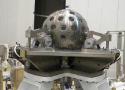
But now, a team of astronomers led by Ignazio Ciufolini, a physicist at the Wuhan Institute of Physics and Mathematics in China, reports the most accurate measurement of the terrestrial Lense-Thirring effect to date. Their work brings our uncertainty down from a few percentage points to just 0.2 percent. And they did it with a satellite that looks like a cross between a golf ball and a disco globe. //
The disco globe satellite that Ciufolini and his colleagues use in their experiment is called LARES-2 (Laser Relativity Satellite 2) and has been developed by the Italian Space Agency. It’s a solid sphere of Inconel 718, a dense nickel-chromium alloy, covered with 303 corner-cube retroreflectors and measuring a bit over 40 centimeters across. It has no thrusters, no solar panels, and no electronics of any kind. It weighs 294.8 kilos. That combination of small size and large mass gives it the lowest area-to-mass ratio of any satellite in medium-Earth orbit.
This was exactly what the scientists needed, since it helped them minimize the impact of other forces.
“The idea is that we want to measure gravitation,” Ciufolini said. “We have non-gravitational effects like photons impinging on the satellite and pushing it. So, the mass must be very large and the cross-section of the satellite very small, so the acceleration induced by photons is very, very small.” In theoretical physics, satellites of this kind are called test particles, meaning an object whose motion is governed almost entirely by the gravitational field. LARES-2 was placed in orbit at an altitude of roughly 12,265 kilometers by a Vega-C rocket in July 2022. //
The measurement confirmed general relativity once more, but Ciufolini thinks its true value lies in what it rules out. General relativity is incompatible with quantum mechanics, despite our best efforts to reconcile the two, and does not explain dark energy. The Chern-Simons theory, one of the leading alternatives that emerged from quantum gravity frameworks, modifies Einstein’s equations and introduces mathematical corrections expected to make them work at ultra-small scales where quantum mechanics and gravity must coexist.
While it does not fully reconcile Einstein’s physics with quantum mechanics and does not offer a universally accepted solution to the dark energy issue, many physicists think Chern-Simons brings us one step closer to the complete Theory of Everything. The problem, though, is that it predicts a different magnitude for frame dragging. //
“These laser-ranged satellites have a peculiar characteristic: They last for hundreds of years,” Ciufolini said. “The more you wait, the more data you accumulate, and the better the results of frame dragging measurements will be. So, we can wait maybe 100 years, and they’ll become even more useful for theoretical physics.”

