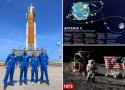
It’s a playbook that closely mirrors the missions that preceded Apollo 11’s historic first moon steps in 1969 — Apollo 7 and 9 tested systems in Earth orbit, while Apollo 8 flew its own figure-eight around the moon with a series of lunar orbits to test the Saturn V rocket’s ability to send a capsule across huge distances.
But Artemis II’s figure-eight will differ from Apollo 8’s and nearly every manned mission in history — it will skip the lunar orbits, but give humans the first extensive look at the far side of the moon through their own eyes.
All previous manned missions routinely flew around the far side of the moon — which perpetually faces away from Earth — but were planned so that the sun constantly shone on the nearside to allow for safe landings and productive moonwalks.
That meant the far side was almost entirely hidden in shadow throughout Apollo — and that most of it has only ever been seen through photographs from unmanned probes.
Artemis II will change that. The mission will pass over the far side in full sunlight and allow for direct observation of the moon’s hidden surface by the astronauts onboard.

