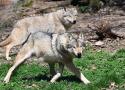
In May 2025, the European Parliament changed the status of wolves in the EU from “strictly protected” to “protected,” which opened the way for its member states to allow hunting under certain conditions, such as protecting livestock. One of the arguments behind this change was that the “tolerance of modern society towards wolves” led to the emergence of “fearless wolves” that are no longer afraid of people.
“Regulators made it clear, though, that there is no scientific evidence to back this up,” says Michael Clinchy, a zoologist at Western University in London, Canada. “So we did the first-of-its-kind study to find out if wolves have really lost their fear of humans. We proved there is no such thing as a fearless wolf.” //
To figure out if wolves really were no longer afraid of humans, Zanette, Clinchy, and their colleagues set up 24 camera traps in the Tuchola Forest. //
When sensors in the traps detected an animal nearby, the system took a photo and played one of three sounds, chosen at random.
The first sound was chirping birds, which the team used as a control. “We chose birds because this is a typical part of forest soundscape and we assumed wolves would not find this threatening,” Clinchy says. The next sound was barking dogs. The team picked this one because a dog is another large carnivore living in the same ecosystem, so it was expected to scare wolves. The third sound was just people talking calmly in Polish. Zanette, Clinchy, and their colleagues quantified the level of fear each sound caused in wolves by measuring how quickly they vacated the area upon hearing it. //
Compared to the control sound of birds, hearing people was twice as likely to make wolves run, and it made them run twice as fast. Comparison to dogs also ended up in our favor: The wolves found humans roughly 20 percent more threatening. The same pattern held true for deer and wild boars, typical prey of wolves, which also got caught in the camera traps.
“These results track with basically the same experiment we did in Africa, where we tested the entire savannah mammal community,” Clinchy says. In that work, Clinchy and Zanette found that leopards, hyenas, and many other animals feared humans more than lions. //
The question, though, is whether we really have reasons to fear such encounters just as much as wolves fear them. “There have been no fatal wolf attacks in Europe in the last 40 years or so,” Clinchy says. In Poland, a wolf bit an 8-year-old girl and a 10-year-old boy playing outside in 2018, and a pack of wolves circled two forest workers for about 20 minutes in 2021 without attacking them. That’s about all there is in the Polish big bad wolf files. //
nooneofconsequence Smack-Fu Master, in training
11y
66
Subscriptor
It's 10 year old data but USDA says vultures kill more calves than wolves do. Purdue data says over 2% die in feedlots before slaughter. Last year in Colorado lightning killed more cattle than wolves. https://www.independent.co.uk/news/world/americas/colorado-cattle-death-lightning-jackson-county-b2552447.html //
rhavenn Ars Tribunus Militum
23y
1,721
Subscriptor++
Moose kill more people yearly, but because they're "delicious", not "scary", and don't predate on farm animals no one gives a shit. Bears and wolves want nothing to do with you, the human. 90%+ of the time you won't even know they're there unless they want you to if you're out hiking or they don't care.

