I remember a lawyer friend about two decades ago comparing-and-contrasting Thomas and then-Court-mate and conservative icon – the late Antonin Scalia.
My friend pointed out that when Thomas and Scalia disagreed on a case? Thomas was correct – and Scalia incorrect.
Of course, their disagreeing didn’t happen a whole lot. But when it did? My friend called it: Thomas was right – Scalia was wrong. By that I mean: Thomas’ were the more Constitutional and conservative opinions.
These last 35 years, the real sardonic fun is when Thomas is outvoted on a case X-to-1. (X is usually 8, but there are occasional vacancies and recusals.)
As someone who wants DC to be drastically smaller and less offensive? I feel like an X-to-1 all the time. So I admire Thomas’ perpetual adherence to principle – the popularity of his opinion amongst his colleagues be darned.
Elon Musk’s Grok tells me there have been 52 cases where Thomas was just such a party of one. But I’m not sure if Grok caught last Thursday’s ruling. If not? This is #53…..
SCOTUS Delivers 8-1 Blow to AT&T, Verizon in $100M FCC Case:


The distinction among the several types of federal courts in the United States has gone almost unremarked in the academic literature. Instead, attention focuses on Article III “constitutional” courts with occasional discussion of how they differ from what are referred to as “non-constitutional” or “legislative” courts. At best, these labels are misleading: all federal courts have a constitutional locus. Most (but not all) are brought into being via legislation. The binary approach ignores the full range of adjudicatory bodies, which find root in different constitutional provisions: Article III, Section 1, Article I, Section 8; Article IV, Section 3; Article II, Section 2/Article I, Section 8, Clause 3; and Article II, Section 1. These distinctions matter for defining jurisdiction and understanding the scope of the authorities—and constitutional protections—that apply. The failure of scholars to take into account the panoply contributes to inaccurate analyses and cabins debates. This Article takes a significant step forward, providing a conceptual framework for each type of court and delineating, based on their legal and historical underpinning, which entities constitute each category. It details the courts’ constitutive elements and their jurisdiction as supported by doctrine, statutory law, and scholarly literature, providing the first, comprehensive taxonomy of federal courts in the United States.
Recommended Citation
Laura K. Donohue & Jeremy McCabe, Federal Courts: Article I, II, III, and IV Adjudication, 71 Cath. U. L. Rev. 543 (2022).
Available at: https://scholarship.law.edu/lawreview/vol71/iss3/9

At the heart of the issue, at least in the case itself, is that Montana's permitless carry law basically says that everyone who isn't expressly forbidden from carrying a gun is considered licensed, and the federal law says people with licenses can carry in the buffer area around a school. The Biden administration argued that no, the licensing had to be explicit--something the law doesn't seem to actually state, for the record--and so he was in violation of federal law.
Metcalf's defense is that he literally had no reason to believe any such thing, which is fair.
However, a bigger issue is the existence of this area outside of the school grounds themselves.
See, the federal law doesn't account for permitless carry as most states have it, nor does it account for things like reciprocity. You have to be licensed in that state in order to just walk past a school on the sidewalk, which is a problem.
This is something most people are going to be unaware of when traveling, for one thing, just as they're not going to be aware of where all the schools in a given city might be. Just following Google Maps could land you a felony charge, simply because Google didn't know you needed to be so many feet away from a school because you're lawfully carrying a firearm.
It's ridiculous. //
California Curmudgeon
7 hours ago
Wasn’t he also within his own yard when he was arrested? Living within 1000 feet of a school should not override your rights.

Dieter Schultz DaveMac
3 hours ago edited
Yeah, doesn't seem right, does it?
Months ago... before Trump took office, streiff had a great piece on the whole issue of birthright citizenship, it was well worth the read.
Honestly, I don't see how with what's he brought up and referenced in that article that anyone can rule that Trump's order is unconstitutional.
There were examples of the US government having to get positive affirmation via a law to grant citizenship to Indians, the author of the 14th clarifying its intentions, and the need to recognize the limits of the 'seminal' case with extending citizenship to legal permanent foreign residents, explicit denial of citizenship to babies of foreign diplomats... all feeding into the State Department making a unilateral decision to grant 'birthright citizenship' without any grant of legal authority.
The best I can tell is that these judges are ruling on the constitutionality of the issue based on the length of time that the State Department's unilateral decision has remained unchallenged and then finding it unconstitutional. //
Az-Mt
4 hours ago
“And subject to the jurisdiction” must mean someone approved by the govt to be here. Otherwise the words are simply meaningless and being ignored as inconvenient.
mopani Az-Mt
a few minutes ago
If you came here illegally you are excluding yourself from the jurisdiction of this nation. Therefore your children born here cannot be born citizens.
If you came here on a visa you are not subject to United States' jurisdiction either, your country of citizenship still has jurisdiction -- for conscription or draft, for example.
The trial court declined to appoint counsel for Gideon. As a result, he was forced to act as his own counsel and conduct his own defense in court, emphasizing his innocence in the case. At the conclusion of the trial, the jury returned a guilty verdict. The court sentenced Gideon to serve five years in the state prison.
Gideon first filed a petition for a writ of habeas corpus in the Supreme Court of Florida. In his petition, he claimed his Sixth Amendment right had been violated because the judge refused to appoint counsel. The Florida Supreme Court denied Gideon's petition.[3] Later, from his cell at the Florida State Prison in Raiford, making use of the prison library and writing in pencil on prison stationery,[4] Gideon appealed to the United States Supreme Court in a suit against the Secretary of the Florida Department of Corrections, H. G. Cochran. Cochran retired and was replaced by Louie L. Wainwright before the Supreme Court heard the case. Gideon argued in his appeal that he had been denied counsel and therefore that his Sixth Amendment rights, as applied to the states by the Fourteenth Amendment, had been violated.
The Supreme Court assigned Gideon a prominent Washington, D.C. attorney, future Supreme Court justice Abe Fortas of the law firm Arnold, Fortas & Porter. //
As a second point, Fortas presented during oral argument that it was widely accepted in the legal community that the first thing any reputable lawyer does when accused of a crime is hire an attorney. As an example, Fortas noted that when Clarence Darrow, who was widely known as the greatest criminal attorney in the United States, was charged with jury tampering and suborning perjury, the first thing he did was get an attorney to represent him.[7] Since Gideon had only an eighth-grade education, Fortas suggested that if a lawyer as prominent as Darrow needed an attorney to represent him in criminal proceedings, then a man without a legal education, or any education for that matter, needed a lawyer too.[7] Fortas's former Yale Law School professor, longtime friend and future Supreme Court colleague Justice William O. Douglas praised his argument as "probably the best single legal argument" in his 36 years on the court.[8]
Writing for the majority, Associate Justice Amy Coney Barrett did not mince words when criticizing the lack of legal rationale behind the Biden appointee’s emotionally-charged dissent. //
While noting how the principal dissent authored by Associate Justice Sonia Sotomayor “focuses on conventional legal terrain, like the Judiciary Act of 1789 and our cases on equity,” Barrett highlighted how Jackson’s dissent “chooses a startling line of attack that is tethered neither to these sources nor, frankly, to any doctrine whatsoever.” More specifically, she underscored how her Democrat-appointed colleague’s expressed views on the power of courts go beyond those of judicial supremacists — those who believe the judiciary is superior to the other branches of government. //
“Waving away attention to the limits on judicial power as a ‘mind-numbingly technical query,’ post, at 3 (dissenting opinion), [Jackson] offers a vision of the judicial role that would make even the most ardent defender of judicial supremacy blush. In her telling, the fundamental role of courts is to ‘order everyone (including the Executive) to follow the law—full stop.'” //
“We will not dwell on JUSTICE JACKSON’s argument, which is at odds with more than two centuries’ worth of precedent, not to mention the Constitution itself. We observe only this: JUSTICE JACKSON decries an imperial Executive while embracing an imperial Judiciary.“ //
While agreeing that the executive has an obligation to follow the law, Barrett chastised Jackson for “skip[ping] over” the fact that the judiciary must do so as well, and that separation of powers must be upheld.
“JUSTICE JACKSON would do well to heed her own admonition: ‘[E]veryone, from the President on down, is bound by law.’ … That goes for judges too.”
‘When a court concludes that the Executive Branch has acted unlawfully, the answer is not for the court to exceed its power, too.’. //
On Friday, the U.S. Supreme Court declared rogue lower courts’ universal injunctions against President Donald Trump’s birthright citizenship order to be unlawful.
“[F]ederal courts do not exercise general oversight of the Executive Branch; they resolve cases and controversies consistent with the authority Congress has given them. When a court concludes that the Executive Branch has acted unlawfully, the answer is not for the court to exceed its power, too,” Associate Justice Amy Coney Barrett wrote.
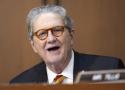
Anybody who knows a law book from an LL Bean catalog knows that federal judges just made up this concept of universal injunctions. There's no basis in statute, no basis in Supreme Court precedent. There's no basis in English common law.
They just made it up because they don't agree with what a president or Congress has done. You know, if they disagree, you know, I'm sorry—fill out a hurt feelings support. Buy a comfort rock.
But they can't just say, "I disagree and I'm putting the entire action by another branch of government on hold, because I don't like it," and that's what they've been doing…. //
They're not the superior branch of government. They're an equal branch of government. //
RocketGeezer NorCalGC
a day ago
That’s largely true for SCOTUS too, since Article 3 defines it’s jurisdiction, but doesn’t really define it role. SCOTUS has done a pretty good job of defining its role since the founding.
The lower federal courts, whose establishment, funding, role and jurisdiction were to be done by Congress, have been established and funded by Congress, but have essentially defined their own role and jurisdiction. Naturally, they’ve gone far afield from what the founders likely envisioned, especially in the last 30 or 40 years.
The lower federal judiciary now boils down to small, insecure people in minor roles trying to make themselves way more important than they were intended to be. I’d say that most of the lower federal judiciary has a bad case of SCOTUS envy! //
camd83 Marek76
5 hours ago
Excellent point! The President is the only person elected by the whole country - how can an unelected, single district judge, override action for the USA taken by the country-wide elected official? Wish SCOTUS was more definitive in their decision. Looks like the Left will just switch from injunctions to class-action lawsuits which will be approved by these same judges.
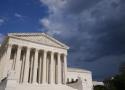
This Supreme Court term may well be remembered as a turning point. Not because the justices dismantled the administrative state in one dramatic move, but because they took important steps to rein in its excesses.
A string of rulings issued Friday—from McLaughlin Chiropractic Associates v. McKesson Corp. to Diamond Alternative Energy v. EPA to FDA v. R.J. Reynolds Vapor Co.—shows the Court is serious about restoring balance between unelected regulators and the courts tasked with holding them accountable.
What ties these decisions together is not a single ideological agenda. It is a shared recognition that when agencies act like legislative bodies or try to wall themselves off from judicial review, they go beyond their constitutional limits. The Court’s recent work reminds us that regulatory power must remain subject to oversight and correction when needed. //
District judges must independently interpret statutes, even when an agency has already spoken. As Justice Kavanaugh put it, “When a statute is clear, it is the law—not the agency’s interpretation—that governs.”. //
In FDA v. R.J. Reynolds, the Court pushed back on the FDA’s attempt to control who could challenge its decisions. The agency argued that only manufacturers could challenge its denial of premarket approvals. The Court disagreed and ruled that retailers, who are also harmed by these decisions, have every right to challenge them.
This ruling matters because it keeps agencies from deciding who gets to take them to court. When regulators pick their critics, there is no real oversight. //
None of these decisions dismantles the administrative state. Nor should they. What they do is draw clearer boundaries. Regulators should not act as lawmakers. They should not decide who can challenge them. They should not expect courts to accept their interpretations of the law automatically.
These rulings stand out because they are not driven by ideology. In fact, in some of these cases, Justice Elena Kagan, one of the Court’s more progressive voices, joined the conservative majority. That tells us something important. It suggests that Kagan recognizes, as the majority does, that unchecked regulatory power is dangerous no matter who holds it. If a progressive agency can go too far, so can a conservative one. The Constitution’s checks and balances are there to protect everyone.
Together, these rulings mark a shift toward restoring that balance. In our system, laws should come from legislators, be applied by judges, and not be dictated by unelected bureaucrats. That is a balance worth defending. //
Warren Pease
8 hours ago
“None of these decisions dismantles the administrative state. Nor should they.”
I must disagree with this premise. The administrative state is prima facie unconstitutional. Laws must be passed by both houses of congress and signed by the president. Having unelected bureaucrats make “regulations” with the force of law (these people can jail you and ruin you) is antithetical to a representative republic. SCOTUS should stop screwing around and remove the authority of anyone but congress to do things with the force of law.
“Our democracy cannot very well function if individual judges issue extraordinary relief to every plaintiff who clamors to object to executive action,” U.S. District Judge Mary Kay Vyskocil said in her ruling on Monday. “It is not the role of a district court judge to direct the policies of the Executive Branch first and ask questions later.”
Those are the words many observers of the ongoing judicial coup have wanted to hear from a federal judge since the first wave of injunctions from tyrannical district court judges started coming down early in the Trump administration’s tenure, blocking the president elected by the American people to do what they elected him to do.
They finally came from Vyskocil, a Trump appointee serving in New York, when she dismissed a case from teachers unions attempting to get the court to “commandeer,” as she put it, $400 million in federal grants and contracts to Columbia University. The Trump administration canceled the funding because of the school’s inability to handle pro-Palestine protests and violence on its campus.
“With no apparent sense of irony, lawyers for an organization called ‘Protect Democracy’ insist that a district court judge should order the Executive Branch immediately to restore the flow of taxpayer dollars to an elite university, which funding Defendants represent is inconsistent with the priorities of the duly elected President of the United States,” Vyskocil added. //
Vyskocil dismissed the case because the unions had no standing to sue, and Columbia University is “conspicuously absent” from the case as a plaintiff. //
She then went through the litany of bizarre counts against the Trump administration from the unions that did not describe any more than a tenuous relationship to the funding cuts at best. The unions even argued that the fact that they chose to spend money to oppose potential (yes, potential, not real) action from the Trump administration meant they had standing.
An organization “cannot spend its way into standing simply by expending money to gather information and advocate against the defendant’s action,” the judge wrote, quoting the Supreme Court.
Teachers unions, and universities for that matter, apparently believe they are entitled to federal funding and that any cut is a constitutional impossibility representing some kind of free speech violation. But as Vyskocil soberly pointed out in her second appeal to the fact that elections have consequences, the cuts are often made simply because the president — and the people who elected him — have priorities that differ from those of the unions and universities.
Deploying the National Guard is not an overreach but a measured response to a crisis that local leaders have failed to address. //
Labeling riotous behavior as “peaceful protest” is a deliberate misrepresentation that erodes trust in governance. Protesters who attack federal agents, destroy property, and endanger lives are not champions of justice; they are obstructing the rule of law. To paint Trump as the villain for responding to this chaos is to invert reality and excuse lawlessness under the guise of political posturing. //
The rule of law is not negotiable, and no state can opt out of federal authority when it comes to immigration enforcement. Other communities across the country must take heed: excusing violence as protest and obstructing federal law enforcement sets a dangerous precedent. As a nation, we must stand united in supporting the lawful execution of federal duties and reject the narrative that casts law enforcement as the enemy. The safety of our communities and the integrity of our laws depend on it.
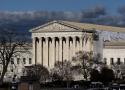
In a unanimous decision that restores sanity and reaffirms the true meaning of civil rights, the Supreme Court on Thursday struck down a misguided judicial doctrine that had, for decades, warped Title VII protections into a one-sided tool of “equity.”
Ames v. Ohio Dept. of Youth Services is not just a technical correction of legal doctrine, it is a resounding declaration that equality under the law still matters more than identity-based scorekeeping.
For years, some federal courts imposed what was known as the “background circumstances” test, a requirement that majority-group plaintiffs (read: white, male, heterosexual, or Christian employees) provide extra proof that their employer was the rare kind that discriminated against the majority. //
Writing for a unanimous Court, Justice Ketanji Brown Jackson said plainly what constitutional conservatives have argued all along: “Title VII’s disparate-treatment provision draws no distinctions between majority-group plaintiffs and minority-group plaintiffs.” The law, she explained, “makes it unlawful to discriminate against any individual… because of such individual’s race, color, religion, sex, or national origin.” //
Justice Clarence Thomas, joined by Justice Neil Gorsuch, filed a separate concurring opinion that went even further, calling out the root cause: judge-made doctrines that create unequal burdens under the guise of helping the marginalized. “Such a rule is undoubtedly contrary to Title VII, and likely violates the Constitution,” Thomas wrote. “[T]here can be no such thing as either a creditor or a debtor race.” //
Equality > Equity
This case is more than just a victory for a woman who was passed over and demoted in favor of candidates who checked more fashionable demographic boxes. It’s a victory over the growing trend of replacing equality with equity.
Equity, as practiced in far too many corporate HR departments and public institutions, demands unequal treatment to engineer equal outcomes. That’s not fairness, that’s retribution disguised as justice. In this case, it meant denying Marlean Ames the same legal protections everyone else enjoys, simply because of her orientation and perceived privilege.
The Ames decision, by contrast, restores the foundational principle that every American, regardless of background, deserves to be judged on the content of their character and qualifications, not on their demographic label.
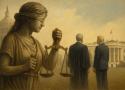
SCOTUS Takes Up the Power of Nationwide Injunctions and the Threat to Executive Authority.
May 16, 2025
Mark Twain once used the word, Podunk to describe a small, unimportant town. Today, a Podunk pettifogger from just such a place thinks he is David taking on Goliath. But this time, Goliath is the duly elected President of the United States. //
The Presidential Executive Order (EO) has become the way to govern Washington at a time when Congress is entirely dysfunctional. However, the vast network of federal district judges, who are, by definition, supposed to be apolitical and neutral, often rule against the EO. They do so increasingly on a "nationwide" basis, far beyond the districts their courtrooms oversee.
It has become a pressing and multifaceted issue. The United States federal judiciary has 677 district court judges (across 94 districts, including territorial courts like those in Puerto Rico and Guam). These are lifetime appointments under Article III of the Constitution. When an activist federal judge deems the underlying challenge to an EO from a plaintiff noteworthy, the judge sets out to ensure "uniform relief" across the entire country through a nationwide injunction. Even the nine Appeals Courts do not have such a reach. Even the Supreme Court doesn't have the same power unless at least five justices agree! //
Expectedly, Justice Clarence Thomas expressed his displeasure again at nationwide injunctions, pointing out that the U.S. judicial system operated without them until the 1960s, so why were they necessary now? Justice Samuel Alito, who has previously been a skeptic, hinted that he would vote to scale them back.
Chief Justice John Roberts focused on the procedural aspects of nationwide injunctions, suggesting that the Supreme Court has become more efficient at handling emergency cases expeditiously. He undercut the concerns of Justices Barrett, Gorsuch, and Sotomayor.
Justice Brett Kavanaugh had the best legal solution by suggesting that class-action lawsuits could serve as an alternative to nationwide injunctions. His questioning was a rare demonstration of principled legal analysis, not tainted by politics.
"Federal district judges are appointed by the president, confirmed by the Senate, and serve lifetime terms. There are currently 677 such judges in the U.S. Do you support or oppose individual district judges having the authority to block or halt a president’s policy nationwide?"
A solid majority of Americans say yes. Specifically, 56% said they either support such powers "strongly" (31%) or "somewhat" (26%), while just 28% said they oppose it either "somewhat" (13%) or "strongly" (15%). A sizeable 16% said they weren't sure. //
Democrats are most supportive, with 71% saying the support the judges, just 14% saying they oppose them. Among independents, that majority falls to 54% support, and rises to 30% opposition. The surprise comes among Republicans, where a plurality of 48% support judges over presidents, while 40% support it. //
But the numbers shifted somewhat with our second question: "Do you agree or disagree that federal judges should serve for a limited term rather than a lifetime appointment?"
The answer was even more overwhelming, this time not in favor of the judges. Overall, 71% said they either agree "strongly" (41%) or "somewhat" (30%), while the disagree category mustered only 16% for disagree "somewhat" (9%) or "strongly" (7%). //
Overall, 64% said they supported arresting judges who break laws either "strongly" (43%) or "somewhat" (21%). Just 22% opposed the idea, 10% "strongly" and 12% "somewhat." //
According to the Congressional Research Service, federal judges issued 17 separate injunctions against Trump from the time he re-entered office on Jan. 20 through March 27.
This is nothing new. In 2019, William Barr, Trump's second attorney general, complained about judicial injunctions directed at Trump.
"Since President Trump took office, federal district courts have issued 37 nationwide injunctions against the executive branch," Barr said. "That’s more than one a month."
"By comparison," the nation's former top lawyer added, "during President Obama’s first two years, district courts issued two nationwide injunctions against the executive branch, both of which were vacated by the Ninth Circuit. And according to the Department’s best estimates, courts issued only 27 nationwide injunctions in all of the 20th century (emphasis ours)." //
Americans' appetite for enabling federal judges to halt presidential actions willy-nilly may soon be tempered by a Supreme Court decision that limits those powers. If so, it should not be politics. It should be because the Constitution does not allow it.
///
That's democracy. But what is consistent with Constitutional Law? Districts should not have jurisdiction beyond their district.

Margot Cleveland
@ProfMJCleveland
·
Follow
🚨🚨🚨BREAKING: Obama appointee Allison Dale Burroughs enters TRO against Trump Administration in Harvard case WITHOUT a Trump attorney even appearing in case. Yes, TROs can be ex parte BUT THIS IS NUTS because . . .
Margot Cleveland
@ProfMJCleveland
Harvard's lawsuit against Trump Administration was predictable, as was its request for a TRO. Will a court blindly issue a TRO, given there is no immediate harm per the letter? Probably. 1/
12:24 PM · May 23, 2025 //
Josh Blackman, constitutional law professor at the South Texas College of Law Houston and President of the Harlan Institute, wrote Friday:
[We do] …not have time stamps, but the case could not have been on her docket for more than a few hours.
I have a serious question: did Judge Burroughs even read the 72-page complaint and 59-page motion for a TRO? What about all of the pages of exhibits? Did she have any time to reflect upon it or consider countervailing arguments? //
RSB
4 hours ago edited
This is one the administration should openly defy. Not only is there zero legal basis for the TRO and the judge violated multiple TRO rules but SEVP is explicitly not covered under APA (it is just an internal program of INS) and the executive has sole, nonjudiciable authority on issuing and withdrawing visas. They CANNOT be compelled to do so.
Senate Guts Radical California Vehicle Emissions Regulations and Leaves Democrats Furious – RedState
Thursday, the Senate voted to block a package of vehicle emissions regulations issued by California, including a highly controversial rule that would have banned the sale of gasoline-powered (aka real) cars by 2035. In the process, tears were shed, threats were issues, and knickers became tightly knotted by leftist Democrats out to cripple the US economy. //
Only a month before leaving office, the [Biden administration] approved a California regulation that banned the sale of new cars and trucks in California in 2035. This was a decision of earthshaking import. Given the size of its market, unilateral economic actions affect the entire country as businesses adjust their processes to accommodate California regulations. Making matters worse, 11 other states were in the process of enacting similar bans. All told, this would have reduced the market for new gasoline-powered automobiles in the US by 40%. This approval was an obviously malicious act by the outgoing EPA management. The EPA had been sitting on the approvals since 2022 but dumped this burning bag of ordure on the front porch of the Trump White House for political points.
The House teed up the action with a bipartisan vote of 246-164 to disapprove three EPA waivers granted to California: a "zero emissions" standard for trucks, a regulation that would have essentially banned heavy-duty off-road vehicles, and the 2035 ban on real cars and trucks.
When the resolution of disapproval arrived in the Senate, its fate was in question. The General Accounting Office had rendered a "legal opinion" (funny how that phrase has become synonymous with "anti-Trump mischief-making") that a mere waiver of an existing law did not rise to the level of being a regulation that the mere collective vote of Congress could override. In this assertion, the GAO was joined by the Senate parliamentarian. //
Neither the GAO nor the parliamentarian has binding authority over the will of the Senate, but what Republicans wanted to avoid was the appearance of steamrolling the parliamentarian. This is where the solid leadership of South Dakota's John Thune came into play in a clear contrast to the "failure theater" directed by Mitch McConnell whenever he was majority leader. //
Thune decided to go around the bureaucratic obstacle. “What I didn’t want to do was vote to overturn the parliamentarian," said Sen. Susan Collins (R-Maine), "and with help from a lot of experts the leader came up with an approach that avoids that outcome, and I’m glad.” //
What Thune did was get a ruling from the floor that the situation was not as cut and dried as the GAO and parliamentarian had claimed and that the waivers did, indeed, fall under the provisions of the Congressional Review Act. //
DaveM
8 hours ago
"[Schumer]: This Senate vote is illegal,"
Apparently we have more than a few Senators sworn to uphold the Constitution that have never bothered to read it.
Article II Section 5 Paragraph 2:
"Each House may determine the Rules of its Proceedings..." //
Romeg
7 hours ago
After carefully scouring my copy of The Constitution of The United States of America I have to report that I was unable to find that article, clause, paragraph or amendment that grants California the power to regulate interstate commerce. Perhaps someone reading this can help me out. //
anon-hlc8 streiff
7 hours ago
Sometimes the problem is that whomever is prosecuting the case does not bring that point of law up in their briefing. If they do not bring up that states may not regulate or impede interstate commerce, the judge is not going to help them out. //
Romeg streiff
5 hours ago
I cannot avoid the conclusion that such rulings utterly negate the commerce clause of the U.S. Constitution. Wickard v Filburn went in the completely opposite direction making ALL commerce, in effect, Interstate Commerce and thus subject to congressional regulation. The ruling you cite along with past failures to challenge CA's high-handedness seem to be judicial nullification of at least certain aspects of that clause in the Constitution.
Josh Gerstein @joshgerstein
·
BREAKING: #SCOTUS allows Trump to fire labor board members. Apparent 6-3 decision with all liberal justices in dissent. Court says more harm from denying POTUS right to remove officials than from those officials staying in office. Doc: https://documentcloud.org/documents/25951855-24a966-order/
4:44 PM · May 22, 2025. //
Tom Fitton @TomFitton
·
In a massive blow to the permanent administrative state, the Supreme Court, in 6-3 order, lifts stay on @RealDonaldTrump firings of Democratic appointees to "independent agencies." Key majority finding does not augur well for the future of constitutionally suspect agencies that protect appointees from being fired by the Chief Executive:
6:21 PM · May 22, 2025
The stay reflects our judgment that the Government is likely to show that both the NLRB and MSPB exercise considerable executive power. But we do not ultimately decide in this posture whether the NLRB or MSPB falls within such a recognized exception; that question is better left for resolution after full briefing and argument. The stay also reflects our judgment that the Government faces greater risk of harm from an order allowing a removed officer to continue exercising the executive power than a wrongfully removed officer faces from being unable to perform her statutory duty.
Judge Illston’s ruling exemplifies a growing trend where district judges are using temporary restraining orders and nationwide injunctions as tools to block executive actions they disagree with. This is judicial activism, plain and simple. It’s one thing to hear a case and rule on it within the confines of a specific district. It’s another to issue a nationwide injunction that overrides the president’s authority across the entire country. //
The judiciary’s role is to interpret the law, not to decide what presidential directives are appropriate. If Congress disagrees with Trump’s restructuring plan, it has the power to pass legislation to counter it. But a single district judge should not have that power. //
The president’s authority to direct the federal workforce and implement agency restructuring must be upheld — otherwise, we’re looking at a future where unelected judges, not elected leaders, are the ones calling the shots.
The Constitution is clear: The president is the head of the executive branch. //
Outerlimitsfan
2 hours ago edited
We are witnessing the tyranny of the Judicial branch that Jefferson was concerned about.
The media is correct that a Constitutional Crisis is on the brink of occurring. The blame lies with the Judicial branch and in particular Roberts who refuses to stop the overreach by district courts.
So many leftist activist judges are angry that Trump got elected again and the lawfare failed to throw him in prison. //
Mrs. deWinter
2 hours ago
If previous Presidents and their administrations can add endless agencies and personnel and grow the government bigger and bigger without any complaint or judicial oversight, then another duly elected President can un-grow it! Period. HE'S the elected Executive. He's the one who makes those decisions about personnel and departments. And obviously, Trump was elected to do just that since the debt is out of control and the government has grown to mammoth proportions where the right hand doesn't know what the left hand is doing any longer, and the waste, fraud, and corruption are on steroids.
In 1949, Supreme Court Justice Robert Jackson, who had served as co-counsel at Nuremberg, wrote the following as it pertained to a free speech case he was involved in.
“[t]his Court has gone far toward accepting the doctrine that civil liberty means . . . that all local attempts to maintain order are impairments of the liberty of the citizen. The choice is not between order and liberty. It is between liberty with order and anarchy without either. There is danger that, if the Court does not temper its doctrine logic with a little practical wisdom, it will convert the constitutional Bill of Rights into a suicide pact.”
I could expand on what this means, but I think Thomas Jefferson does a better job than I ever could when he wrote to John Colvin in 1810:
Whether circumstances do not sometimes occur which make it a duty in officers of high trust to assume authorities beyond the law, is easy of solution in principle, but sometimes embarrassing in practice. A strict observance of the written laws is doubtless one of the high duties of a good citizen: but it is not the highest. The laws of necessity, of self-preservation, of saving our country when in danger, are of higher obligation. To lose our country by a scrupulous adherence to written law, would be to lose the law itself, with life, liberty, property & all those who are enjoying them with us; thus absurdly sacrificing the end to the means.
This is basically the "don't cut your nose off to spite your face" argument. If following the letter of the law is going to send the country over the cliff, apply some common sense and don't follow the letter. Lincoln said as much in 1861 when he suspended habeas corpus by executive order, telling Supreme Court Justice Roger Taney that he had empowered Gen. Winfield Scott to arrest, and detain, without resort to ordinary processes and forms of law, such individuals as he might deem dangerous to public safety because it served the public interest.
And later during a special session of Congress, he said, "In nearly one-third of the States had subverted the whole of the laws ... Are all the laws, but one, to go unexecuted, and the government itself go to pieces, lest that one be violated?" It's kind of a unique and odd argument that the left puts out there today. It wants strict adherence to constitutional law, and at the same time, it wants to violate current immigration law (which was, by the way, legally and constitutionally affirmed). And the fact that we have to grapple with this at all is due to the Democratic Party's practice of busting the law as they soar high above it like a drone. It might make them look like children stealing out of the cookie jar when one of their judges gets caught sneaking illegal aliens out the back door, and it's enjoyable to watch them beclown themselves, but all of this is really quite dangerous. //
One final thing I ran across while studying this matter was a couple of obscure passages in the SCOTUS ruling for the Shaughnessy v. United States case noted above.
a) The alien's right to enter the United States depends on the congressional will, and the courts cannot substitute their judgment for the legislative mandate....In the exercise of these powers, Congress expressly authorized the President to impose additional restrictions on aliens entering or leaving the United States during periods of international tension and strife. That authorization, originally enacted in the Passport Act of 1918, continues in effect during the present emergency. Under it, the Attorney General, acting for the President, may shut out aliens whose "entry would be prejudicial to the interest of the United States."
b) Courts have long recognized the power to expel or exclude aliens as a fundamental sovereign attribute exercised by the Government's political departments largely immune from judicial control.
This ruling effectively reins in district courts that have been sidestepping proper jurisdictional channels in cases challenging Trump administration actions. The decision serves as a clear reminder that courts themselves must operate within their prescribed legal boundaries. //
According to Margot Cleveland, senior legal correspondent for The Federalist, the D.C. Circuit’s ruling hinges on a critical point: jurisdiction, which has sweeping implications. As Cleveland explains, many of the legal challenges being hurled at the Trump administration involve employment decisions—precisely the kind of disputes Congress has explicitly said federal district courts have no authority to adjudicate.
The court’s decision also strikes at the heart of a broader legal strategy being used by leftist groups to stymie Trump’s reforms—namely, the claim that the administration is engaging in “wholesale dismantling” of agencies. But as the ruling makes clear, the Administrative Procedure Act was never designed to handle such broad-based political grievances, and Congress never waived sovereign immunity to allow them.
In another key point, the court found that the lower court also overstepped its bounds by trying to restore federal grants—something Congress assigned to the Court of Federal Claims, not the district courts. All told, the decision is a sharp rebuke to the legal overreach being used to obstruct the Trump administration’s agenda. //
The Dark Lord LBPA
20 hours ago
Even worse. This is such a powerful decision it will be appealed to the full DC Circuit for an “en banc” hearing.
Radical Leftists hold a 7 - 4 majority among active judges on the DC Circuit. So, we will lose decisively on appeal.
However, this was such a good opinion it could provide the framework for a sweeping successful decision from SCOTUS. If, …
If Roberts, Barrett, and Kavanaugh decide not to support the judicial coup attempt. //
Hominem Humilem Sum The Dark Lord
18 hours ago
Alas, diminishing the power of the judiciary may not be something Roberts, Barrett, and Kavanaugh are inclined to do: they may prefer to leave the power in the hands of the judiciary and claim the ultimate authority for themselves. Admittedly, that would be a dangerous game to play, since the Article III crew have no indigenous enforcement capability (and would have to rely on the Executive and Legislative Branches to "take their word for it"). //
Mrminwnc Hominem Humilem Sum
18 hours ago
This sounds glib, but respect for the judiciary branch is essentially a courtesy extended by the other two, in particular the executive branch. If the others simply get tired of judges overreaching they can just ignore them.