The conventional approach for radiation protection is based on the ICRP's linear, no threshold (LNT) model of radiation carcinogenesis, which implies that ionizing radiation is always harmful, no matter how small the dose. But a different approach can be derived from the observed health effects of the serendipitous contamination of 1700 apartments in Taiwan with cobalt-60 (T1/2 = 5.3 y). This experience indicates that chronic exposure of the whole body to low-dose-rate radiation, even accumulated to a high annual dose, may be beneficial to human health. Approximately 10,000 people occupied these buildings and received an average radiation dose of 0.4 Sv, unknowingly, during a 9–20 year period. They did not suffer a higher incidence of cancer mortality, as the LNT theory would predict. On the contrary, the incidence of cancer deaths in this population was greatly reduced—to about 3 per cent of the incidence of spontaneous cancer death in the general Taiwan public. In addition, the incidence of congenital malformations was also reduced—to about 7 per cent of the incidence in the general public. //


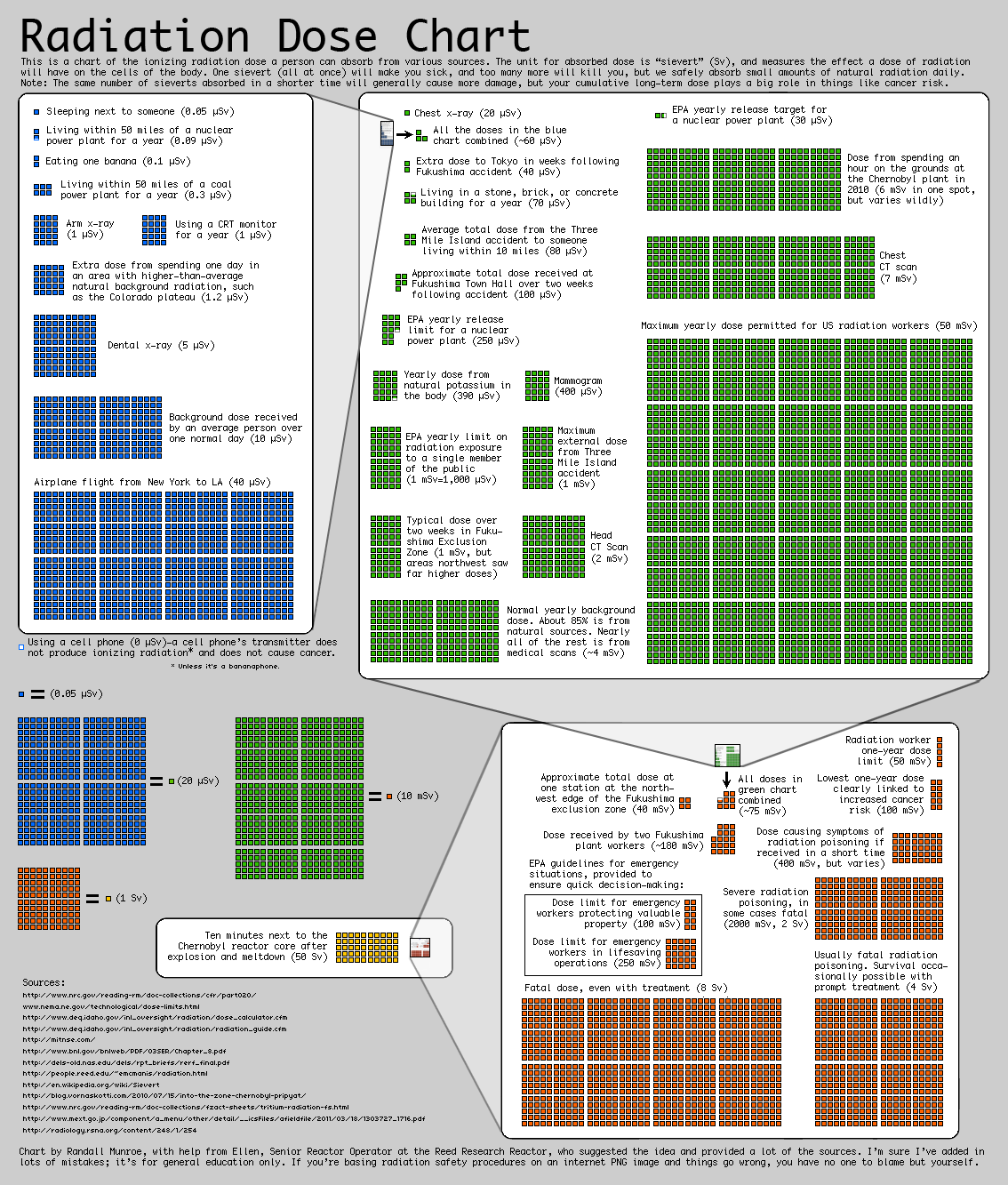
Note that there are different types of ionizing radiation; the “sievert” unit quantifies the degree to which each type (gamma rays, alpha particles, etc) affects the body. You can learn more from my sources list. If you’re looking for expert updates on the nuclear situation, try the MIT NSE Hub. Ellen’s page on radiation is here.

Fear campaigns have led to tight regulation of nuclear power plants and nuclear waste, which means that to see dry fuel casks you have to jump through hoops with security clearance, over-the-top security checks, supervised visits and so on.
I think we should normalise nuclear waste by putting it in public places that allow people to see it. In the Netherlands, COVRA (The Central Organisation For Radioactive Waste) stores all of the country’s high-level waste and is also a public museum and art gallery that hosts many exhibitions.
Inside COVRA: the art of preservation
On a panel in Paris last year, I called nuclear power plants national monuments, and I believe that they are, because they represent clean air, good jobs, and high-quality lifestyles. I think we should decorate nuclear power stations like the mural on the Cruas-Meysse cooling tower in France. We should celebrate what humankind can achieve with clean energy: a high quality of life for everybody, without the negative impacts of burning fossil fuels.
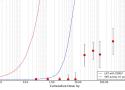
The Gordian Knot Group is pushing Sigmoid No Threshold (SNT) as a replacement to the Linear No Threshold (LNT) radiation harm model. SNT requires dividing an individual's dose rate profile into repair periods (currently set at a day), fitting an S-shaped response curve to the dose in each repair period, and treating each repair period as an independent event. Once you have an estimate of the daily dose rate profiles and a computer, SNT is as easy to implement as LNT.
In our last post, we pointed out LNT failed the Huxley one-ugly-fact test. LNT's prediction of bone cancer incidence in radium dial painters who had received massive doses over a ten year plus period is off by orders of magnitude. Therefore, LNT is wrong and must be rejected. It is only fair that we subject SNT to the same test.
Unlike LNT, SNT does not ignore how rapidly or slowly the dose was received. SNT requires a daily dose rate profile. Radium dial painting started about 1915. In the late 1920's, the ladies were advised to stop licking the tips of their brush. That pretty much put a stop to the bone cancers.
If we assume the ladies received their dose evenly over 10 years, which is almost certainly conservative, then we can add an SNT prediction to the picture, Figure 1. //
SNT claims we should have seen nearly no cancer up to about 2 mSv/day, but then the prediction turns sharply upward. The actual jump upward takes place at about 20 mSv/day. Moreover, at 20 mSv/d, SNT predicts a 99% incidence rate when the observed was less than 30%. However, unlike LNT, SNT avoids the absurdity of a cancer incidence greater than 1.0.
The charitable view of this is SNT is conservative by a factor of ten, in predicting the point at which dose rates become seriously harmful. This is close to a factor of 100 better than LNT. //
My takeaway is SNT is wrong; but it is a qualitatively different wrong than LNT. Furthermore, it is quantitatively acceptable at dose rates up to 1 mSv/day, even when that daily dose is repeated for years. Fortunately, the dose rates experienced by the public in a nuclear power plant release are almost never above 1 mSv/day and then only for a few weeks at most.
If we use SNT in a compensation scheme, the few people who do get hit with more than 1 mSv/day will be over-compensated. From a societal point on view, this is bad. Not only does this represent an inefficient allocation of resources; but it will cause unnecessary psychic trauma in the over-compensated. In the wrong hands, it could lead to unnecessary evacuations. But perhaps this is a price worth paying for SNT's simplicity and its multi-order of magnitude improvement over LNT. //
Jack Devanney 19 hrs ago Author
LNT (like SNT) bills itself as a model that works for ANY radiation exposure. But the BEIR7 fit is based mainly on the bomb survivor (RERF) data which is a single acute dose. It is not a good fit to the RERF data. No smooth curve could be since the RERF data bounces up and down in a very weird way., which should tell you something about the quality of that database.
But the point is that LNT it is off by orders of magnitude when you try to apply it to chronic doses received over protracted periods such as the dial painter data. A regulatory model cant change every time you get a new exposure data. We must have ONE model that does a reasonable job both on large acute doses and large chronic doses. LNT cant do that. SNT can.

The simple truth that a single solid counter-example destroys any scientific hypothesis has been phrased many ways, none more memorably than Thomas Huxley in 1870 talking about how Pasteur took down Buffon and Needham's theory of spontaneous generation with a single experiment.
But the great tragedy of Science --- the slaying of a beautiful hypothesis by an ugly fact --- which is constantly being enacted under the eyes of philosophers, was played, almost immediately, for the benefit of Buffon and Needham.
Pasteur himself put it more prosaicly, ``Never will the doctrine of spontaneous generation recover from the mortal blow of this simple experiment."
The Linear No Threshold (LNT) hypothesis of radiation harm is the theory upon which our radiation protection regulation is based. In its pure form, LNT could be called beautiful in its simplicity. LNT is the theory that harm is strictly additive in the dose, the joules of radioactive energy deposited in a kilogram of tissue. One of the guys who pushed this idea was Harold Gray. We use his name as a shorthand for joules absorbed per kg tissue. Under LNT, we don't have to know anything about how slowly or quickly the dose was received. The only thing that counts is total dose in grays. This requires that the harm be linear in the total dose. //
he deeper you go the messier LNT gets. LNT no longer looks beautiful in its simplicity. It looks more like an ad hoc kluge. But the real problem with LNT is not its ugliness. The real problem is it's flat wrong. Like Pasteur, we need only one experiment to demonstrate this.
Between 1915 and 1950, numerals on luminous watch dials were hand painted using radium paint for the most part by young women. Prior to the late 1920's, the ladies used their tongues to form the tip of the brush into a point, sipping radium into their bodies. Chemically radium is similar to calcium and accumulates in the bones, where it has a 40 year biological half-life. The total skeletal doses varied by over a factor of 1000. But the maximum cumulative dose was an incredible 280 Gy.\cite{henriksen-2013}[p 276]
The Argonne National Lab did an extensive study of the results. 64 bone cancers and 32 head carcinomas were diagnosed. Reliable dose measurements were available for 2,383 women. All the 64 bone cancers occurred in the 264 women with a bone dose of more than 10 Gy.\cite{rowland-1994}[page 107] No bone cancers were found in the 2,110 women with less than 10 Gy dose. //
At a total effective dose of 7 sieverts, LNT predicts every dial painter should have bone cancer. In fact, no cancers were observed in the 2,110 women who received up to 160 sieverts. If we asked the computer what are the ratios of the LNT cancer incidence to actual incidence, the answers would range from 168 to NaN (I don't have a number that large). In the rich history of bad predictions, this has to rank in the top ten.
64 preventable bone cancers is a terrible tragedy. But the ability of these women to handle massive amounts of radiation is a testament to our bodies' ability to repair radiation damage. That's a beautiful thing. I submit this is a case of an ugly theory being shot down by a beautiful fact. Regardless of the aesthetics, as soon as the dial painter data emerged, LNT, like spontaneous generation, should have been tossed immediately on the scrap heap of ideas that simply don't work. But that's not what happened.
We know why LNT does not work. The fundamental reason that LNT performs so abysmally for the dial painters is it denies the ladies' ability to repair radiation damage to their DNA. DNA repair takes time. But for LNT the time dimension is irrelevant. LNT claims whether these women received their dose in one day or spread over 15 years makes no difference. LNT squashes decade long exposures into a single day.
This is Flat Earther level nonsense. Search ``DNA repair" on google scholar and you will get more than three million hits. DNA repair has been studied in mind boggling detail. We know an enormous amount about how DNA is repaired and how long it takes. LNTers simply refuse to accept any of this. This raises the question: why?
Almost all LNTers fall into one of two groups.
1) Anti-nukes. //
2)The LNT dependents. These are people whose livelihood depends on people being scared of radiation. This group comprises not just the radiation protection establishment, including the regulatory bureaucracies; but also the multi-billion dollar radiation clean up industry, the massive national labs researching solutions to all the LNT-inspired dangers associated with radiation, and the government agencies charged with doling out taxpayer dollars to pay for those solutions. Most importantly, it includes the industry incumbents. //
The motives of the anti-nukes are obvious. Their claims automatically trigger scrutiny. But when an industry agrees with its opponents, case closed. LNT has no effective critics and survives, a triumph of self-preservation over Huxley's well deserved tragedy. //
Anton van der Merwe Dec 31, 2023
While I agree 100% with your views on the LNT model, it is noteworthy that even that model values a life lost to radioactivity at least 100 times more than a life lost to air pollution (PM2.5 and PM10 particles).
This is based on consensus data on the mortality rates and the regulatory ‘safe’ levels.
I have never been able to find any justification for this.
The purpose of the Oak Ridge Associated Universities (ORAU) Museum of Radiation and Radioactivity is to chronicle the scientific and commercial history of radioactivity and radiation. It has been deemed the official repository for historical radiological instruments by the Health Physics Society, and the Society has been generous in its financial support for the purchase of items.
The collection is the property of the not-for-profit ORAU Foundation, and it is located at the Professional Training Programs (PTP) training facility in Oak Ridge, Tennessee. Unless noted otherwise, this website only features items actually in the collection.

Gordian Knot News just turned two. The number of posts is over 100. Way too many. Our new subscribers need to understand that most of these posts are redundant detail. If they are truly interested in solving the Gordian Knot, they should focus on the A List.
The core argument is simple. Humanity needs cheap nuclear power. Cheap nuclear power is the only way the species can prosper. If and only if we have cheap nuclear power, can we lift billions of humans out of poverty. If and only if we have cheap nuclear power, can we stop polluting out planet's atmosphere and conserve its land.
It is a simple argument based on dispatchability, energy density, natural resources required, and the amount of CO2 and other pollutants generated. The numbers are so overwhelmingly obvious, they beg the question: why is nuclear not our totally dominant source of electricity? Why has nuclear power been such a tragic flop?
You do not need 100 posts to answer this question. I need twelve. Everything else is redundant detail.
A people's guide to our nuclear planet
An introduction to nuclear radiation and its impacts on human health and Earth’s environment.
By Ron Gester, retired geologist & physician, 2023.
Earth is a nuclear planet … and nuclear energy is essential for our existence on Earth.
Without Earth's molten core, life as we know it would not exist. Earth is protected from extreme levels of cosmic and solar radiation by a geomagnetic field generated by the rotation of Earth’s molten core. It rotates because of a combination of convection, due to heat, and Earth's rotation. The heat is generated in part from the radioactive decay of uranium, thorium, and potassium isotopes. [Johnston, 2011] This heat also contributes to convection in the mantle which drives plate tectonics and continental drift. Nuclear energy is a natural and essential force on Earth. Nuclear fission reactors have occurred naturally in Earth’s geologic past. Rock formations in Oklo, Gabon, W. Africa reveal that self-sustaining nuclear reactions ran in these formations for hundreds of thousands of years starting about 1.7 billion years ago.
Nuclear radiation is everywhere. What is it?
Nuclear radiation is a form of energy released from the decay of the nuclei of certain kinds of atoms. It is the same whether it is naturally occurring or man-made. It can be described as waves or particles and is part of the electromagnetic spectrum that includes light and radio waves. Ionizing radiation is radiation that has enough energy to remove electrons from their orbits, creating ions. Examples of ionizing radiation are high-level ultraviolet light, X-rays, and gamma rays. Natural uranium emits gamma rays. Uranium is not a scarce resource. As a result of its very wide range of geochemical behavior, it is present in most soil, rocks, and water. [Deffeyes, 1980]
Low-dose ionizing radiation is safe. How do we know this? Research in biology & epidemiology.
Life on Earth evolved in a radioactive environment. This background radiation comes from space and Earth. Life has adapted to it to survive. This is true in different ways for the many threats to life including heat, cold, sunshine, and oxygen.

Here's another example of a project you've probably never heard of (I hadn't), where USA taxpayers will spend something like a billion dollars to move slightly radioactive material from one place to another. Between 1956 and 1983, one of the major USA mills for converting uranium ore to yellow cake, U3O8, was located just outside Moab, Utah on the Colorado River. The mill was built by the uranium king, Charlie Steen. It made the town of Moab. //
In 2003, the dose rates on top of the Pile were 0.014 to 0.047 mSv/d for photons, and 0.041 to 0.052 mSv/d due to radon. Both are far below the tolerance dose of 1 mSv/d, and well below the background dose rates in parts of Kerala. The dose rates at the nearest residence, which is right on the edge of the mill property, were 0.0021 mSv/d photon and 0.0115 mSv/d radon. The background dose rates in the area are about 0.0022 mSv/d photon and 0.0044 mSv/d radon. In other words, at the edge of the mill the photon dose rate is background, and the radon dose rate is less than one-fourth the EPA action limit (8 mSv/y) for indoor radon.
all the tags from https://b.plas.ml
1st-amendment 2nd-amendment 4th-amendment 5th-amendment 9/11 a8 abortion acl adhd afghanistan africa a/i air-conditioning amateur-radio amazon america american android animals anti-americanism antifa anti-semitism antiv antivirus aoip apollo apple appliances archaeology architecture archive art astronomy audio automation avatar aviation backup bash batteries belleville bible biden bill-of-rights biology bookmarks books borg bush business calibre camping capitalism cellphone censorship chemistry children china christianity church cia clinton cloud coldwar communication communist composed computers congress conservatives constitution construction cooking copyleft copyright corruption cosmology counseling creation crime cron crypto culture culture-of-death cummins data database ddt dd-wrt defense democrats depression desantis development diagrams diamonds disinformation diy dns documentation dokuwiki domains dprk drm drm-tpm drugs dvd dysautonomia earth ebay ebola ebook economics education efficiency electricity electronics elements elwa email energy engineering english environment environmentalism epa ethernet ethics europe euthanasia evolution faa facebook family fbi fcc feminism finance firewall flightsim flowers fonts français france fraud freebsd free-speech fun games gardening genealogy generation generators geography geology gifts git global-warming google gop government gpl gps graphics green-energy grounding hdd-test healthcare help history hollywood homeschool hormones hosting houses hp html humor hunting hvac hymns hyper-v imap immigration india infosec infotech insects instruments interesting internet investing ip-addressing iran iraq irs islam israel itec j6 journalism jumpcloud justice kindle kodi language ldap leadership leftist leftists legal lego lgbt liberia liberty linguistics linux literature locks make malaria malware management maps markdown marriage mars math media medical meshcentral metatek metric microbit microsoft mikrotik military minecraft minidisc missions moon morality mothers motorola movies mp3 museum music mythtv names nasa nature navigation navy network news nextcloud ntp nuclear obama ocean omega opensource organizing ortlip osmc oxygen paint palemoon paper parents passwords patents patriotism pdf petroleum pets pews photography photo-mgmt physics piano picasa plesk podcast poetry police politics pollution pornography pots prayer pregnancy presentations press printers privacy programming progressive progressives prolife psychology purchasing python quotes rabbits rabies racism radiation radio railroad reagan recipes recording recycling reference regulations religion renewables republicans resume riots rockets r-pi russia russiagate safety samba satellites sbe science sci-fi scotus secularism security servers shipping ships shooting shortwave signal sjw slavery sleep snakes socialism social-media software solar space spacex spam spf spideroak sports ssh statistics steampowered streaming supplement surveillance sync tarsnap taxes tck tds technology telephones television terrorism tesla theology thorium thumbnail thunderbird time tls tools toyota trains transformers travel trump tsa twitter typography ukraine unions united.nations unix ups usa vaccinations vangelis vehicles veracrypt video virtualbox virus vitamin vivaldi vlc voting vpn w3w war water weather web whatsapp who wifi wikipedia windows wordpress wuflu ww2 xigmanas xkcd youtube zfs