
Robert F. Kennedy Jr. appeared on "Fox News Sunday" to talk about his plans to partner with Donald Trump to "Make America Healthy Again," and dropped some big truth bombs about the corruption and perverse incentives within the United States' public health agencies. //
"I wouldn't dismantle them. I would change the focus, and I would end the corruption. Right now, 75 percent of FDA’s budget is coming from pharmaceutical companies. That is a perverse incentive.
"In NIH, the - scientists and officials at NIH who work on drug development, incubate drugs for the pharmaceutical company, get to collect lifetime royalties from those products. These are regulators. They’re supposed to be looking for problems in those products.
"We have these agencies that have become sock puppets for the industries they’re supposed to regulate, so they're not really interested in public health.
"The most profitable thing today in America is a sick child. Everybody’s making money - the hospitals are making money, the pharmaceutical companies are making money; even the insurance companies make money.
"We need to end those perverse incentives, we need to get the corruption out of the FDA, out of NIH, out of the CDC, and make them function as they're supposed to function, which is to protect public health and to protect childrens' health.”


Clinical doctors smiled (actually, they grimaced) while reading two recent headlines. The first was “Wyden, Blackburn Introduce Bipartisan Legislation to Tackle Health Care Workforce Shortages.” This is one more demonstration of Ronald Reagan’s prescience when he said in his 1981 Inaugural Address, “Government is not the solution to our problem; government is the problem.”
Every direct care provider understands from painful daily experience that government regulations stemming from federal legislation are the real reason for shortages.
At first glance, vitamins and other dietary supplements seem like qualified medical expenses for health savings account (HSA) and flexible spending account (FSA) holders. They are designed to fill "gaps" in the average diet, offsetting nutritional deficiencies along the way — yes, even those deficiencies that can lead to larger health problems.
However, the IRS defines qualified medical expenses within the IRS Section 213(d) as “amounts paid for the diagnosis, cure, mitigation or treatment of a disease, and for treatments affecting any structure or function of the body.” The IRS has further specified that these expenses must be primarily to alleviate a physical or mental defect or illness.
So why are HSA users coming up empty when searching for HSA eligible vitamins and supplements? Learn which vitamins and supplements are HSA eligible. //
Currently, the only way to use a consumer-directed healthcare account to pay for most vitamins and supplements is if a specific vitamin or supplement is recommended by a medical professional to treat or mitigate a medical condition with a letter of medical necessity.
Many more people may be sickened in the outbreak than the current numbers indicate. For many infected people, the bacteria only cause relatively mild infections that don't require medical care. Even if they do seek medical care, laboratories don't routinely test for listeriosis in patients with mild gastrointestinal illnesses. Lastly, while many infected people develop symptoms within two weeks of an exposure, symptoms can develop up to 10 weeks after eating a contaminated food, and there are additional lag times in connecting cases to an outbreak.

Despite talk of ’emergency abortions,’ there is never a circumstance in which the mother’s health would benefit from the death of her unborn child. //
Recently the Association for American Physicians and Surgeons filed a suit after multiple doctors were targeted by credentialing boards and the U.S. government for their anti-abortion stance post-Dobbs. Public ignorance and confusion over a “necessary” abortion continues to permeate political language and Biden’s rule is yet another coercive attempt to install national abortion “must-haves.”
An anonymous Food and Drug Administration committee determines “arbitrary safety standards” and what defines “emergency use” and “necessity,” said John Seeds, former department chairman of obstetrics and gynecology at Virginia Commonwealth University, and can then utilize those standards to hide and mislead the public on the point of abortion.
Seeds testified in favor of a bill in Virginia that would change Health Department standards for abortionists, requiring providers to report any significant complication of an abortion. //
Since the legalization of abortion 50 years ago, huge strides have been made in maternal and perinatal care, with viability improving from 27 to 22 weeks gestation, said Dr. John Bruchalski, a former abortionist who now runs Tepeyac OB-GYN, the largest pro-life OB-GYN practice in the nation.
“What these ‘emergency abortion’ laws are saying is if there’s another medical approach to the situation, like real medical treatment or stabilization to closely follow the course of disease in the patients … you still have to provide an abortion if a woman wants it,” Bruchalski said.
The two primary situations when a pregnancy must be induced before viability to save the life of the mother, first-trimester hemorrhaging and ectopic pregnancy, have clear treatments that do not require an abortion, Bruchalski said.
“In [catastrophic uterine bleeding] you’re targeting the placenta and its removal because that is the cause of bleeding, the preborn child is not your target,” Bruchalski said.
In the case of an ectopic pregnancy, an OB-GYN removes the diseased segment of the fallopian tube containing the embryo.
“This is intellectually and scientifically not a direct abortion,” Bruchalski said. “The definition and the intent of an elective abortion is to terminate the life of the fetus. The intention and truth matter not only to the profession and the doctor but to the patient.”
In the vast majority of cases of ectopic pregnancies and miscarriages, the preborn child has already died due to the disease, Bruchalski said. In either situation, targeting the child is never the intent and is therefore not an abortion, but abortion practitioners deceive physicians and patients by saying ectopic pregnancies, miscarriages, and elective abortions are all the same.
“This coercion is based on fundamental lies and half-truths, from beginning to end,” Bruchalski said. //
“There are sometimes reasons for early induction that require additional support for the baby, as the baby is not ‘ready’ to be born, but it’s essential for the well-being of the mother,” Johnson said. “However, there is never a circumstance that the mother’s health would benefit from the death of her unborn child. Even in true crash C-sections where mom has to be in the OR [operating room] literally within minutes, there is never a reason to end the baby’s life in the hope of saving mom.”
“The whole discussion of ER abortion of a healthy pregnancy is bogus,” Seeds said.

The woman realized how serious her infection was once she was in custody.

"Ants are able to diagnose a wound, see if it's infected... and treat it accordingly." //
“When we're talking about amputation behavior, this is literally the only case in which a sophisticated and systematic amputation of an individual by another member of its species occurs in the animal kingdom,” said co-author Erik Frank, a behavioral ecologist at the University of Würzburg in Germany. “The fact that the ants are able to diagnose a wound, see if it's infected or sterile, and treat it accordingly over long periods of time by other individuals—the only medical system that can rival that would be the human one."

A new bill would encourage treating the underlying health conditions that result in fertility problems, before pushing women into trying IVF. //
In vitro fertilization (IVF) does not treat infertility.
The procedure has been in the news a lot lately. Democrats are trying to turn IVF into a campaign issue, which has Republicans panicking (as usual). Meanwhile, Southern Baptists have concluded that the IVF industry’s standard practices — creating “extra” human embryos, eugenically screening them, and indefinitely storing or outright destroying the leftover embryos — are wrong, and that Christians ought to reflect seriously on the ethics of IVF in itself.
Yet overlooked in all of this is that IVF is a workaround for infertility, rather than a real treatment for it. Sometimes IVF works. But despite the current hype, it also has a high failure rate, is expensive, has risks and potential complications, and, of course, comes with a bevy of ethical issues. Nonetheless, there is a tendency to quickly push women into trying IVF without treating the underlying health conditions that result in fertility problems.
This level of national obesity is new. In 1960, rates were about 10 percent for men and 15 percent for women. They drifted up a little for the next few years, then in the late 1970s inflected upward in a steady rise to their current levels. //
So what caused this national epidemic of obesity?
The most persuasive answer is that in the late 1970s, the U.S. government, acting under pressure from such senators as former Democratic presidential candidate George McGovern, launched a nutrition campaign that resulted in the 1980 Dietary Guidelines for Americans and, a decade later, the “Food Pyramid.” Bread, cereal, rice, and pasta were the base of the pyramid. Then in order upward were vegetables; fruits; milk, yogurt, and cheese; meat, poultry, fish, dry beans, eggs, and nuts; with fats, oils, and sweets in the small apex.
The guidelines are reviewed periodically, but the latest version (2015) continues the anti-fat, anti-meat, pro-carbohydrate basic philosophy. //
Philip Handler, president of the National Academy of Sciences, asked McGovern in 1977, “What right has the federal government to propose that the American people conduct a vast nutritional experiment, with themselves as subjects, on the strength of so very little evidence that it will do them any good?”
But the skeptics were drowned out and left stranded without research money or institutional support, and clinicians who tried a different approach, such as Dr. Robert Atkins, were traduced viciously. A huge body of respectable clinical observations that contradicted the guidelines — see, for example, “Treating Overweight Patients” from a premier medical journal in 1957 — went down the memory hole. Also unnoticed was the similarity between the guidelines and the recommendations in a 1930 Oregon pamphlet on “Fattening Pigs for Market.” //
The failure of the guidelines to improve public health was not bad news for everyone. The more the weight-challenged fail, the higher the rates of Type II diabetes, which is accompanied by a rise in blood sugar and consequent insulin prescriptions, and the more the money that can be made from substituting cheap vegetable oils for natural fats, from weight loss programs, and from drastic surgical remedies. Good times for Big Farm, Big Pharma, Big Medicine, and assorted other major players. //
In 2001, investigative journalist Gary Taubes published “The Soft Science of Dietary Fat” in the peer-reviewed and prestigious journal Science. The article, and his subsequent book “Good Calories, Bad Calories,” argued that the food pyramid was almost totally wrong.
Taubes cited both solid metabolic research, which was being ignored, and extensive medical history, which had been amnesia-ized, to the effect that overconsumption of carbohydrates eventually leads to insulin resistance, which skews appetite regulators and turns off the ability to burn fat. The eventual result is a cascade in which the body is taking in excessive amounts of food and storing it as fat, but cannot access the fat for energy. The lack of available energy then reduces metabolic rates, which makes losing weight still more difficult. The solution is to cut carbs to decrease insulin, and add fat. //
The rebels agree with the conventional wisdom on one crucial point: The refined-sugary fast foods that permeate the current American diet are terrible. Otherwise they conclude weight loss can be achieved by inverting the food pyramid, creating a diet of 70 percent healthy fats (not vegetable oil or saturated fats), 25 percent protein, and 5 percent or less carbohydrates, an approach abbreviated as “low-carb” or “ketogenic,” a term based on the fact that burning fat produces substances called “ketones.” Red meat is favored, the fattier the better.
The rebellion is reinforced by numerous clinicians who struggled with personal weight issues as well as with frustration over an inability to help patients. //
The moving force behind EAT-Lancet is a vegan Norwegian billionaire, but it is also a darling of the corporate world. Among its sponsors are 20 Big Food companies, 7 Big Pharma, and 14 Big Chemical. All of these have their own interests, which do not necessarily include our health. As Teicholz says about Big Food:
The vast majority of packaged foods sold on the inner aisles of supermarkets — cookies, crackers, chips (crisps), candy, cereals — are made up of the same basic ingredients: soy, corn, grains, sugars, and salt. This is vegan.
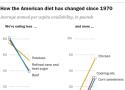
Americans eat more chicken and less beef than they used to. They drink less milk – especially whole milk – and eat less ice cream, but they consume way more cheese. Their diets include less sugar than in prior decades but a lot more corn-derived sweeteners. And while the average American eats the equivalent of 1.2 gallons of yogurt a year, he or she also consumes 36 pounds of cooking oils – more than three times as much as in the early 1970s. //
Broadly speaking, we eat a lot more than we used to: The average American consumed 2,481 calories a day in 2010, about 23% more than in 1970. That’s more than most adults need to maintain their current weight, according to the Mayo Clinic’s calorie calculator. (A 40-year-old man of average height and weight who’s moderately active, for instance, needs 2,400 calories; a 40-year-old woman with corresponding characteristics needs 1,850 calories.)
Nearly half of those calories come from just two food groups: flours and grains (581 calories, or 23.4%) and fats and oils (575, or 23.2%), up from a combined 37.3% in 1970. Meats, dairy and sweeteners provide smaller shares of our daily caloric intake than they did four decades ago; then again, so do fruits and vegetables (7.9% in 2010 versus 9.2% in 1970).

Nearly 60 years after tobacco companies were first required to print warning labels on cigarettes to reduce smoking, statists salivate at the opportunity to pull the lever for labels on any other behavior they wish to deter, such as eating meat.
Last fall, a coalition of scientists proposed cigarette-style caution labels be placed on meat products for alleged hazards to the climate and human health. A study examining 1,000 meat-eating adults found labels espousing hazards to climate, health, and pandemics were enough to convince participants to opt for a non-meat meal. Given the success of warning labels at reducing cigarette use, researchers expressed optimism at the potential for similar warnings for deter meat consumption.
A dramatic drop in meat at the center of the American diet, however, offers far worse implications for public health than appreciated by the statist class of academics determined to manipulate behavior. The federal government’s recommendations to embrace a low-fat diet, for example, planted the roots for the twin epidemics of obesity and chronic disease overwhelming the health care system today after three generations dutifully followed the dietary guidelines. Americans increased consumption of grains and processed oils at the behest of the “experts” and now live in a nation where nearly 42 percent of adults 20 and older are obese and 6 in 10 suffer from at least one chronic illness.
For people of a normal weight, fasting for long periods can cause health complications, including increased strain on the heart, even with nutritional supplementation.
Therefore, fasts of this length should not be attempted by anybody. They are from a time in the 1960s where long-term fasts were being studied with frequency, but there are other studies from this time where patients experienced heart failure and in some cases died of starvation.
However, people with and without diabetes can experience benefits from fasting. Intermittent fasting, in particular, has shown to help the body repair damage without entering starvation, enabling an array of benefits, namely weight loss and reduced insulin resistance. Last year, American scientists revealed that short-term fasting also has health benefits for the heart.

Scotsman Angus Barbieri (1939 – 7 September 1990) fasted for 382 days,[1] from June 14, 1965 to June 30, 1966. He lived mainly on tea, coffee, sparkling water, and vitamins while living at home in Tayport, Scotland, and frequently visiting Maryfield Hospital for medical evaluation. He lost 276 pounds (125 kg) and set a record for the length of a fast.[2]
To most people, pulling into a highway rest stop is a profoundly mundane experience. But not to neuroscientist Rita Valentino, who has studied how the brain senses, interprets, and acts on the bladder’s signals. She’s fascinated by the brain’s ability to take in sensations from the bladder, combine them with signals from outside of the body, like the sights and sounds of the road, then use that information to act—in this scenario, to find a safe, socially appropriate place to pee. “To me, it’s really an example of one of the beautiful things that the brain does,” she says.
Scientists used to think that our bladders were ruled by a relatively straightforward reflex—an “on-off” switch between storing urine and letting it go. “Now we realize it’s much more complex than that,” says Valentino, now director of the division of neuroscience and behavior at the National Institute of Drug Abuse. An intricate network of brain regions that contribute to functions like decision-making, social interactions, and awareness of our body’s internal state, also called interoception, participates in making the call.
In addition to being mind-bogglingly complex, the system is also delicate. //
The human bladder is, at the most basic level, a stretchy bag. To fill to capacity—a volume of 400 to 500 milliliters (about 2 cups) of urine in most healthy adults—it must undergo one of the most extreme expansions of any organ in the human body, expanding roughly sixfold from its wrinkled, empty state.
To stretch that far, the smooth muscle wall that wraps around the bladder, called the detrusor, must relax. Simultaneously, sphincter muscles that surround the bladder’s lower opening, or urethra, must contract, in what scientists call the guarding reflex. //
Filling or full, the bladder spends more than 95 percent of its time in storage mode, allowing us to carry out our daily activities without leaks. At some point—ideally, when we decide it’s time to pee—the organ switches from storage to release mode. For this, the detrusor muscle must contract forcefully to expel urine, while the sphincter muscles surrounding the urethra simultaneously relax to let urine flow out.
For a century, physiologists have puzzled over how the body coordinates the switch between storage and release.

The milestone was initially set by a Japanese pedometer company that was looking for something catchy for their advertising. Making things easier for them, the 10,000 number in Japanese looks vaguely like a person walking or running. You decide, here’s the Kanji symbol for 10K: 万 //
Singh points to studies that suggest an association between the number of steps you take and mortality. A 2023 study published in the Journal of the American College of Cardiology suggested 2,600 to 2,800 daily steps was enough to produce health benefits, while a European study from 2022 found that increasing your step count by 1,000-step increments may lead to a 15% decrease in your risk of all-cause mortality. //
etba_ss
5 hours ago edited
The medicine and science fields should be viewed with the same amount of respect and intriguing that we do for lawyers and used car salesmen.
They are equally likely to be liars just trying to line their own pockets and bilk the system and screw people over.
The evidence for whether ivermectin impacts recovery, hospital admissions, and longer-term outcomes in COVID-19 is contested. The WHO recommends its use only in the context of clinical trials.
In this multicentre, open-label, multi-arm, adaptive platform randomised controlled trial, we included participants aged ≥18 years in the community, with a positive SARS-CoV-2 test, and symptoms lasting ≤14 days. Participants were randomised to usual care, usual care plus ivermectin tablets (target 300–400 μg/kg per dose, once daily for 3 days), or usual care plus other interventions. Co-primary endpoints were time to first self-reported recovery, and COVID-19 related hospitalisation/death within 28 days, analysed using Bayesian models. Recovery at 6 months was the primary, longer term outcome. //
Ivermectin for COVID-19 is unlikely to provide clinically meaningful improvement in recovery, hospital admissions, or longer-term outcomes. Further trials of ivermectin for SARS-Cov-2 infection in vaccinated community populations appear unwarranted.

The polio epidemic that gripped the United States in the mid-20th century remains etched in history as a harrowing chapter of disease and public health challenges. However, recent revelations and research shed new light on the potential link between DDT (dichlorodiphenyltrichloroethane) and the misdiagnosis of polio cases during that era.
In the 1940s and 1950s, as the “polio epidemic” unfolded, outbreaks were notably clustered in regions with large commercial farms where DDT was extensively used as a pesticide. The timing of these outbreaks during the summer and early fall coincided with heightened DDT application and increased human exposure, particularly among children who frequented rivers, lakes, and streams contaminated with DDT runoff from agricultural activities.
What’s intriguing is that the symptoms of paralytic polio, a severe form of the disease, closely mimic those of DDT poisoning. Both conditions can cause muscle weakness, paralysis, respiratory difficulties, and neurological symptoms, leading to potential misdiagnosis and confusion among healthcare providers during the epidemic.
Further complicating matters was the widespread use and endorsement of DDT as a safe and effective pesticide, touted for its ability to control insect-borne diseases and improve agricultural productivity. The public perception of DDT as a panacea for pest control overshadowed potential health risks and unintended consequences, including its role in misdiagnosed polio cases.

The immune system can get kicked into overdrive when the fungi run riot. //
Fungi are an indispensable part of your microbiome, keeping the body’s host of microorganisms healthy as part of a system of checks and balances. But when you’re hit by an infection, fungi can be thrown out of equilibrium with other organisms inside you, leading to a more severe infection and other symptoms of illness.
For this reason, the pandemic immediately set off alarms for Iliyan Iliev, an immunologist at Weill Cornell Medical School. “We were thinking, the first thing that’s going to happen is people will start getting fungal co-infections,” he says. With the microbiome unbalanced, fungi might start running riot inside Covidpatients, Iliev reasoned. His fears were soon realized. //
This complex crosstalk between the gut microbiome and the immune system is an example of how most things in the body are intertwined... //
Now, Iliev and Kusakabe are interested in exploring how fungal overgrowth may appear in long Covid—and how immunity is affected. “What’s the impact of this reprogramming of the immune system by the fungus and the virus?” Iliev asks. “What happens long-term if you have suffered from that?”

A groundbreaking new study commissioned by Revolver News concludes that COVID-19 lockdowns are ten times more deadly than the actual COVID-19 virus in terms of years of life lost by American citizens. //
Revolver News set out to commission a study to do precisely that: to finally quantify the net damage of the lockdowns in terms of a metric known as “life-years.” Simply put, we have drawn upon existing economic studies on the health effects of unemployment to calculate an estimate of how many years of life will have been lost due to the lockdowns in the United States, and have weighed this against an estimate of how many years of life will have been saved by the lockdowns. The results are nothing short of staggering, and suggest that the lockdowns will end up costing Americans over 10 times as many years of life as they will save from the virus itself.

Rhythmic activity during sleep may get fluids in the brain moving. //
Human brains (and those of other higher organisms) evolved to have billions of neurons in the functional tissue, or parenchyma, of the brain, which is protected by the blood-brain barrier.
Everything these neurons do creates metabolic waste, often in the form of protein fragments. Other studies have found that these fragments may contribute to neurodegenerative diseases such as Alzheimer’s.
The brain has to dispose of its garbage somehow, and it does this through what’s called the glymphatic system (no, that’s not a typo), which carries cerebrospinal fluid that moves debris out of the parenchyma through channels located near blood vessels. However, that still left the questions: What actually powers the glymphatic system to do this—and how? The WUSTL team wanted to find out.
To see what told the glymphatic system to dump the trash, scientists performed experiments on mice, inserting probes into their brains and planting electrodes in the spaces between neurons. They then anesthetized the mice with ketamine to induce sleep.
Neurons fired strong charged currents after the animals fell asleep. While brain waves under anesthesia were mostly long and slow, they induced corresponding waves of current in the cerebrospinal fluid. The fluid would then flow through the dura mater, the outer layer of tissue between the brain and the skull, taking the junk with it.