This is a short-term forecast of the location and intensity of the aurora. This product is based on the OVATION model and provides a 30 to 90 minute forecast of the location and intensity of the aurora. The forecast lead time is the time it takes for the solar wind to travel from the L1 observation point to Earth.


Alert and Alarmed
7 hours ago edited
Martians land on the White House Lawn. They say they have been studying our broadcasts and speak our language. They ask for a televised interview with our world leaders. The Pope takes his turn saying "Honored guests, the most important question I have is: Do you know Jesus?
Martians: Yes we know Jesus, the Son of God. He comes to see us every year.
Pope (visibly shaken): What? Every year? Well we have been waiting two thousand years for His Second Coming.
Martians: Maybe He didn't like your chocolates.
Pope (even more rattled and hardly able to speak): Chocolates? What do chocolates have to do with anything?
Martians: When He came to see us, we gave Him a giant box of our best chocolates. What did you do when He came to see you?
The space suits worn during SpaceX’s Polaris Dawn mission are a sci-fi reimagining of NASA’s classic marshmallow suits. There’s a good reason why they look so different.

In mid-November 2023, a disastrous SpaceX launch, which saw the explosion of not one but two rockets, offered a rare opportunity to study the effects of such phenomena on the ionosphere.
A study by Russian scientists revealed how this explosion temporarily blew open a hole in the ionosphere stretching from the Yucatan to the southeastern U.S.
Although far from the first rocket-induced disturbance in the ionosphere, this is one of the first explosive events in the ionosphere to be extensively studied. //
November 18, 2023, wasn’t a great day for the commercial spaceflight company SpaceX. While testing its stainless steel-clad Starship, designed to be the company’s chariot to Mars, the spacecraft exploded four minutes after liftoff over the skies of Boca Chica, Texas. //
This new study confirms that the ionosphere experienced a “large-amplitude total electron content depletion,” likely reinforced by a fuel exhaust impact of the Super Heavy rocket engine, which also exploded a little more than a minute earlier at lower altitude once it separated from the Starship. The research team collected this data from 2,500 ground stations scattered across North America and the Caribbean and found that the hole extended largely from Mexico’s Yucatán peninsula and the southeastern U.S., though the exact size of the hole is unknown. //
scientists report that this Starship-induced ion hole caused by “catastrophic phenomena” closed up after 30 or 40 minutes. But these kinds of interactions are still poorly understood, and that’s concerning considering how central the ionosphere is to global technologies—not to mention human health.
Download Cylinders for free at my Bandcamp
Stream it on Spotify, Apple Music, YouTube, and everywhere else
Experts in South Korea are convinced that bricks moulded from microwaved stardust could produce materials on site and boost humanity's hopes of living on the lunar surface.
The scientists said: "NASA has announced the Artemis Mission aiming for a long-term presence on the lunar surface. However, infrastructure expansion such as lunar base construction plays a vital role.
"Yet transporting construction materials from Earth to the lunar surface via landers incurs a significant cost of $1.2 million per kilogram.
"To solve this problem Korea Institute of Civil Engineering and Building Technology has developed technology for producing construction materials using in-situ resources from the Moon."
Meanwhile, it was revealed recently that space fanatics could be able to watch TV coverage from the Moon when man returns there for the first time in over 50 years for the Artemis III mission.

Fatesrider Ars Legatus Legionis
11y
21,506
Subscriptor
llanitedave said:
I hadn't thought about the space sickness angle. Yeah, NASA made the reasonable choice, but it does suck. And YES, Boeing is to blame here.
The quote in the article is pretty low key:
A non-trivial percentage of professional astronauts succumb to space sickness during the initial hours of their spaceflights.
The figure is 60-80% of all professional astronauts.
Non-trivial indeed.
https://www.colorado.edu/today/2024/02/29/space-travel-comes-motion-sickness-these-engineers-want-help
wagnerrp Ars Legatus Legionis
14y
26,915
Subscriptor
faffod said:
The question I have from the article, that I haven't seen an answer for is :
- Are experienced astronauts less susceptible to space sickness?
I assume that is the case, which would explain changing the pilot assignment, but if it is not then what does the change gain?
They probably take extra Dramamine.
butcherg Ars Centurion
11y
292
wagnerrp said:
They probably take extra Dramamine.
Sadly, I have some experience with this...
Zero-G and unfamiliar motion present two different causes for so-called 'motion sickness. Without gravity to provide a steady downward tug to internal organs, the feeling of them floating around in your body cavity is horrid, initially. This is in addition to the lack of weight on the fluids in the inner ear, which is a bit different than the stimulus provided by irregular motion. Same result, however, puke your guts out. While motion stimulus is usually short-lived, weightlessness is with you All The Freaking Time in space.
According to the Wikipedia page on space adaptation syndrome (nice term for it), they tend not to medicate it for newbies, the preference being to have them accommodate it over time. They do however use Dramamine dermal patches for spacewalks, because vomiting in a spacesuit is quite egregious.
https://en.wikipedia.org/wiki/Space_adaptation_syndrome
I got motion-sick as a kid, probably a stupid idea to try pilot training. While there, however, got to push the stick over a few times to make stuff float around the cabin, horrid feeling the first time, but you could just stop pushing and it would go away, go figure. They did send me to 'sick school' at Brooks AFB, where they were doing research on the causes, came back with some tools that helped me get through T-37s. However, it really was just becoming familiar with the environment that did the trick. Moving to Colorado, flights to and from the Front Range were fraught with turbulent motion, again, got used to it over time. Worst feeling on an airplane ever was riding in a E/RC-135 during refueling as receiver, keeping the boom connected required maneuver that, in the rear of the airplane, felt absolutely horrible, worse than the zero-g stunts.
Spent 4 days on the USS LaSalle in the Med, flat-bottomed hull and worst-riding ship in 6th Fleet, collecting data from an exercise, staring at a screen all day in the TIC. Speed-ate Dramamine for the entire time, kept things down, but I was a nervous wreck for about a week after. So, medicating not such a great idea...
butcherg Ars Centurion
11y
292
alisonken1 said:
Every time my ship pulled out of port, I would be feeling really dragged for about a week (or until I puked), then I was fine the rest of the voyage.
Unfortunately, it happened every time we left port. Seems like my body reset itself whenever we hit dry land.
And Dramamine didn't help. BTW - I was a cruiser sailor (think Belknap-class CG's type).
I had a pattern too; typical training flight was to trundle over to the aux field, do some touch-and-goes, then climb up to the areas for aerobatic work. The place I'd get sick was on climb-out from the aux field, go figure. Got good at handling it, I'd ask the instructor to take the airplane, and in about 10 seconds pull out the bag, ralph into it, close and stow it, and take back the airplane. Didn't want to give 'em the idea it was a problem... :biggreen:
rocket bodies, satellites, space debris in earth orbit

Q: What is the highest apogee of a satellite in Earth orbit they need to avoid? Ignore any satellites in Solar or lunar orbit.
A: There are over a hundred satellites in Molniya orbit, a few tens in Tundra orbit and a handful in really high earth orbits. The first two of those go above geostationary orbit; there are examples of the last with perigee of at least 375,000km. //
James Webb Space Telescope, at the Earth-Sun L2 point, is roundly a million miles from Earth, but still gravitationally bound to the Earth-Moon system.
Other than that, there are very few if any permanent satellites beyond the "graveyard orbits" used to park expired geostationary satellites. These are typically only a few hundred kilometers higher than geosynchronous, however, so roundly if they're well beyond the 24 hour orbital period, they'd be well clear of anything we put up intentionally and left there. //
Then there is stuff, mostly debris, that is more critical, because by nature those pieces are very fast, the orbit is not stable, so it changes a little every round and the kinetic energy would be able to penetrate any hull that is not specifically designed to withstand such impacts. For example, this debris of an Iridium satellite - at the time of writing at altitude ~366,000km and counting, spiralling outwards at 1km/s (the map does not mention a size or weight though. But it is big enough to be trackable obviously).
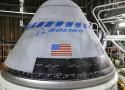
It's unlikely Boeing can fly all six of its Starliner missions before retirement of the ISS in 2030. //
Ten years ago next month, NASA announced that Boeing, one of the agency's most experienced contractors, won the lion's share of government money available to end the agency's sole reliance on Russia to ferry its astronauts to and from low-Earth orbit.
At the time, Boeing won $4.2 billion from NASA to complete the development of the Starliner spacecraft and fly a minimum of two, and potentially up to six, operational crew flights to rotate crews between Earth and the International Space Station (ISS). SpaceX won a $2.6 billion contract for essentially the same scope of work.
A decade later, the Starliner program finds itself at a crossroads after Boeing learned it will not complete the spacecraft's first Crew Flight Test with astronauts onboard. NASA formally decided Saturday that Butch Wilmore and Suni Williams, who launched on the Starliner capsule on June 5, will instead return to Earth in a SpaceX Crew Dragon spacecraft. Put simply, NASA isn't confident enough in Boeing's spacecraft after it suffered multiple thruster failures and helium leaks on the way to the ISS. //
On Saturday, senior NASA leaders decided it wasn't worth the risk. The two astronauts, who originally planned for an eight-day stay at the station, will now spend eight months on the orbiting research lab until they come back to Earth with SpaceX. //
So why did NASA and Boeing engineers reach different conclusions? "I think we’re looking at the data, and we view the data and the uncertainty that’s there differently than Boeing does," said Jim Free, NASA's associate administrator and the agency's most senior civil servant. "It’s not a matter of trust. It’s our technical expertise and our experience that we have to balance. We balance risk across everything, not just Starliner."
The people at the top of NASA's decision-making tree have either flown in space before or had front-row seats to the calamitous decision NASA made in 2003 to not seek more data on the condition of Space Shuttle Columbia's left wing after the impact of a block of foam from the shuttle's fuel tank during launch. //
Now, it seems that culture may truly have changed. With SpaceX's Dragon spacecraft available to give Wilmore and Williams a ride home, the decision was relatively straightforward. Ken Bowersox, head of NASA's space operations mission directorate, said the managers polled for their opinion all supported bringing the Starliner spacecraft back to Earth without anyone onboard.
However, NASA and Boeing need to answer for how the Starliner program got to this point. //
SpaceX, which NASA has tapped to rescue the Starliner crew, has now launched eight operational long-duration crew missions to the International Space Station to date, plus an initial piloted test flight of the Dragon spacecraft in 2020 and several more fully private human spaceflight missions. SpaceX has finished all of its work in its initial commercial crew contract with NASA and is now working off of an extended contract to carry the program through 2030, the planned retirement date for the ISS. //
Right now, the prime route is through SpaceX. NASA continues to fly one astronaut on each Russian Soyuz spacecraft in exchange for a seat for a Russian cosmonaut on each SpaceX crew mission. //
Assuming the investigation doesn't uncover any additional problems and NASA and Boeing return Starliner to flight with astronauts in 2026, there will not be enough time left in the space station's remaining life—as it stands today—for Starliner to fly all six of its contracted missions at a rate of one per year. It's difficult to imagine a scenario where NASA elects to fly astronauts to the space station exclusively on Starliner, given SpaceX's track record of success and the fact that NASA is already paying SpaceX for crew missions through the end of this decade.
Notably, NASA has only given Boeing the "Authority To Proceed" for three of the six potential operational Starliner missions. This milestone, known as ATP, is a decision point in contracting lingo where the customer—in this case, NASA—places a firm order for a deliverable. NASA has previously said it awards these task orders about two to three years prior to a mission's launch.
The commercial crew contracts are structured as Indefinite Delivery/Indefinite Quantity (IDIQ) agreements, where NASA can order individual missions from SpaceX and Boeing as needed. If SpaceX keeps performing well and the space station is actually decommissioned in 2030, it may turn out that NASA officials decide they just don't need more than three operational flights of Starliner. //
Lone Striker Smack-Fu Master, in training
7y
62
accdc said:
Thank you Stephen, and Eric, for your fantastic coverage of this issue.Here’s what I (as a layman with little technical expertise) don’t get:
How does SpaceX make it look so easy, and Boeing make it look so, well, ridiculous?
SpaceX designs, manufactures and integrates most components themselves. In Boeing's case, the thruster manufacturer is Aerojet. In order to make changes or redesign the components, there is a huge bureaucratic barrier in place. They have to jump through extraordinary hoops, not only engineers but also procurement, legal, and any number of departments. In SpaceX's case, it's a walk down the corridor to talk to engineers to discuss the problem and design the fix.
Boeing is also in the dark ages in terms of software development (my field.) SpaceX has a more Silicon Valley/Agile software design methodology where you make many, faster, smaller changes and test them extensively with small unit tests all the way through to hardware-in-the-middle testing to ensure things work as intended. Every tiny change gets rigorously tested to ensure there are no defects or regressions. Boeing's ancient software development process was one of the primary factors in their first Orbital Flight Test failure where they nearly lost the vehicle twice due to software bugs with the mission clock and reentry procedures.
Boeing relies partially on paperwork to validate their spacecraft (whether it's contracts with sub-contractors or studies in place of actual testing) and they've lost the engineers and the engineering culture from the early spaceflight era. //
HiWayne! Smack-Fu Master, in training
1y
50
Ten years they’ve been tinkering with Starliner. That’s crazy. The first crewed Mercury flight and Apollo 15 spanned ten years.
Yeah I know, I know. NASA had an insane budget back then, but damn. Boeing had the benefit of half a century of spaceflight experience and they’re struggling this much to get to LEO. //
Dachshund Wise, Aged Ars Veteran
4y
110
accdc said:
Thank you Stephen, and Eric, for your fantastic coverage of this issue.Here’s what I (as a layman with little technical expertise) don’t get:
How does SpaceX make it look so easy, and Boeing make it look so, well, ridiculous?
Having worked for or with these companies as an engineer, the most concise explanation I have is culture.
Boeings culture is not technically focused, nor mission focused. Boeings culture is Boeing focused with a particular emphasis on shareholders. The overwhelming majority of managers I’ve worked with at Boeing view engineers as a plug and play commodity and are woefully ignorant of the general subject matter they manage. Many I know at Boeing have an exceptionally difficult time taking responsibility for mistakes that Boeing makes. Whether it’s commercial planes or crew capsules, it’s somebody else’s fault and Boeing knew best. Hubris is rampant across Boeing. What’s fascinating there is that there isn’t a damn thing worth being proud of in recent years, but the cognitive dissonance remains strong.
SpaceX culture is mission focused. Their managers tend to understand what it is they are managing. Their workforce is rather young, however, they test things and are willing to publicly fail in a way that Boeing and others will not stomach. When SpaceX does fail, they tend to take full responsibility, learn from the issue and solve the problem.
SpaceX is more or less doing what NACA and subsequently NASA did in their infancy. It’s nothing new, but it’s a major difference as compared to what NASA and its ecosystem have evolved to since those early years. //
Malmesbury Wise, Aged Ars Veteran
3m
341
TLStetler said:
A big part of the problem is Boeing put too many thrusters in too small a space and operated them at a duty cycle which caused everything to overheat. Said overheating caused vapor lock in the propellant lines, and Teflon seals to soften and swell.On the other hand, if you've seen images of Dragon with the aeroshell off the thrusters are distributed spatially, not crowded together. Plumbing and control lines are not near the throats of said thrusters.
This is not even rocket science, any decent Hot Rodder knows not to place propellant/fuel lines etc. in a "hot box."
The problems are inherent in the development methods and company structures.
SpaceX insources - mostly because of cost, but also control. There are, deliberately, few barriers between the engineers working on various parts of the system.
The Boeing/Aerojet relationship is a key counter example - because of a arguments over money they started treating each other as the enemy.
Boeing is attempting to design to perfection, then test. If anything goes wrong at the test stage, they are actually in interactive hardware development. Without the hardware, or low cost basis to do the large number of physical tests required. SpaceX assumed they are in iterative development from the start.

During the initial hours of the spaceflight, the crew will seek to fly in a highly elliptical orbit, reaching an altitude as high as 1,400 km (870 miles) above the planet's surface. This will be the highest Earth-orbit mission ever flown by humans and the farthest any person has flown from Earth since the Apollo Moon landings more than half a century ago. This will expose the crew to a not insignificant amount of radiation, and they will collect biological data to assess harms. //
Isaacman's interest in performing the first private spacewalk accelerated, by years, SpaceX's development of these spacesuits. This really is just the first generation of the suit, and SpaceX is likely to continue iterating toward a spacesuit that has its own portable life support system (PLSS). This is the "backpack" on a traditional spacesuit that allows NASA astronauts to perform spacewalks untethered to the International Space Station.
The general idea is that, as the Starship vehicle makes the surface of the Moon and eventually Mars more accessible to more people, future generations of these lower-cost spacesuits will enable exploration and settlement. That journey, in some sense, begins with this mission's brief spacewalks, with Isaacman and Gillis tethered to the Dragon vehicle for life support. //
This is the first of three "Polaris" missions that Isaacman is scheduled to fly with SpaceX. The plan for the second Polaris mission, also to fly on a Dragon spacecraft, has yet to be determined. But it may well employ a second-generation spacesuit based on learnings from this spaceflight. The third flight, unlikely to occur before at least 2030, will be an orbital launch aboard the company's Starship vehicle—making Isaacman and his crew the first to fly on that rocket.
ridley
So to be able to use their spacesuits they need to fit a square peg into a round hole?
Best give Mr Lovell a call. //
Avoiding standard docking and space suit adapters seems like a good way of wasting money and time
The thing that most surprises me about this whole mess is why NASA would ever consider that having a different design of docking adapter and space suit for each type of American vehicle that is to dock with the ISS was a good idea..
That the Soviet G2S vehicles would use different docking adapters and space suit connectors is expected: the two parts of the original ISS design were always intended to use differing docking ports and space suit connectors from the get-go.
However, it beggars belief that NASA would not have specfied a common set of docking adapters for all American spacecraft as well as common space suit interface(s), if only to save costs and re-implementation effort by basing these interfaces on than the well-tested Shuttle docking and space suit connectors. AFAIK those never caused problems throughout their useful life. //
Re: Avoiding standard space suit adapters seems like a good way of wasting money and time
No, giving money to SpaceX was seen as a good way of wasting money and time.
REMEMBER: when this all started, Boeing was the shoo-in, and that goofy SpaceX startup was the complete waste of time and money.
Nobody expected SpaceX to actually ever reach Station.
It never entered anyone's mind that SpaceX would eventually have to rescue a Boeing crew.
The American docking adapters ARE standard.
https://www.internationaldockingstandard.com/
https://www.nasa.gov/missions/station/meet-the-international-docking-adapter/
American spacecraft, INCLUDING Shuttle, either dock to this, or are berthed by the robot arm to a standard pressure door, which allows larger cargo. //
Re: other good ways of wasting money and time
To ensure SLS block 1 would launch by 2016 congress decided to use an upper stage (Interim Cryogenic Propulsion Stage) based on Centaur which has been flying since the 60s. The wimpy ICPS massively restricts SLS capabilities so a new Exploration Upper Stage was ordered for SLS block 1B. SLS is assembled on a mobile launch platform in the vertical assembly building and the rocket and platform are carried out together to the launch site by the crawler/transporter. The MLP includes a tower to fill the core stage and upper stage with propellants. The solid rocket boosters have grown an extra segment each since the space shuttle so the combined mass of SLS and MLP are now sufficient damage the crawler transporter's tracks and they path the travel to the launch site. EUS is longer than ICPS so the propellant connections are at a different height. A whole new MLP is required otherwise SLS block 1B would be delayed because modifications to MLP1 would not be able to start until after Artemis III.
Clearly this situation is untenable. What if MLP2 was completed before EUS? Boeing would look bad for delaying Artemis IV. The solution was simple: do not decide what height the propellant connections will be at until the last possible minute. Bechtel cannot start design of MLP2 without that. Moving the connections also moves the fans that blow hydrogen leaks away before the concentration gets big enough for an explosion. Designing the MLP for a choice of connection heights is also tricky. The platform must be optimized for mass so it does not go much further over the limits of the crawler transporter.
If Boeing and SpaceX had to agree on a flight suit connector US astronauts would now have a choice of rides to the ISS: Soyuz or Shenzou.
Believe it or not there is a worse solution. NASA could decide the shape of the flight suit connectors. Congress would then have an opportunity to help like they did with SLS. Giving Boeing and SpaceX the freedom to work independently of congress (and each other) saves a huge amount of time and money. It also means a flight suit design issue does not ground both crew transport systems at the same time.
After nearly every flight, the upper stage of this rocket breaks apart in orbit. //
A new debris field of nearly 1,000 objects would be a significant addition to the approximately 46,000 objects Space Command tracks in Earth orbit. According to statistics compiled by Jonathan McDowell, an astrophysicist who monitors global launch and spaceflight activity, this would rank in the top five of all debris-generation events since the dawn of the Space Age.
The Thousand Sails constellation aims to provide global internet access. It is one of two planned Chinese systems to challenge U.S. projects including Starlink. Thousand Sails is also intended to secure finite orbital slots and frequencies, and provide national internet coverage and data security. //
The Long March 6A rocket used for Tuesday’s launch combines liquid propellant core stages with solid rocket boosters. The launcher can carry 4,500 kg to a 700-km sun-synchronous orbit. The rocket’s upper stage appears to have suffered debris issues in orbit. //
Like Starlink, China's Qianfan satellites have an easy-to-pack flat-panel design.

A sharp decline in sunspot activity in the 17th century has long puzzled astronomers. //
We realized that this [Kepler's] sunspot drawing should be able to tell us the location of the sunspot and indicate the solar cycle phase in 1607 as long as we managed to narrow down the observation point and time and reconstruct the tilt of the heliographic coordinates—meaning the positions of features on the Sun's surface—at that point in time.” //
German astronomer Gustav Spörer noted the steep decline in 1887 and 1889 papers, and his British colleagues, Edward and Annie Maunder, expanded on that work to study how the latitudes of sunspots changed over time. That period became known as the "Maunder Minimum." Spörer also came up with "Spörer's law," which holds that spots at the start of a cycle appear at higher latitudes in the Sun's northern hemisphere, moving to successively lower latitudes in the southern hemisphere as the cycle runs its course until a new cycle of sunspots begins in the higher latitudes.
But precisely how the solar cycle transitioned to the Maunder Minimum has been far from clear. //
"It is fascinating to see historical figures’ legacy records convey crucial scientific implications to modern scientists even centuries later," said co-author Sabrina Bechet of the Royal Observatory of Belgium. "I doubt if they could have imagined their records would benefit the scientific community much later, well after their deaths. We still have a lot to learn from these historical figures, apart from the history of science itself. In the case of Kepler, we are standing on the shoulders of a scientific giant."

DDopson Ars Tribunus Militum
22y
2,038
Subscriptor
ROOT1803 said:
Serious question: With this much material floating around in orbit, would re-purposing it be something that is feasible? Or is it just irredeemably junk for the most part?
It's infeasible to recover and utilize.
This came up in a previous thread, where I said:
...
On orbit recycling aspirationally saves some launch mass, the cheaper half of the equation, but it forces you to engineer a vast array of complicated system elements for the recovery process and then use in-space manufacturing and assembly processes that will certainly never be cheaper than their terrestrial equivalents where we can walk over to the machine in our shirt-sleeves and clear out a broken milling bit, call the parts warehouse down the road, and have a replacement bit installed same afternoon. The economic network effects are very very difficult to overcome, far harder than any one of the individual engineering problems. //
HuntingManatees Wise, Aged Ars Veteran
11m
100
andygates said:
The problem is that the stuff isn't particularly special, it's just big empty beer cans. The cost is in getting it up there. And it'd be more straightforward (and less expensive) to bring it down than to tugboat the stuff to a space junkyard.Actual orbital mechanics are left as an exercise for the Kerbals.
I actually spent an unhealthy amount of time in KSP trying to retrieve space junk using a series of giant folding claw mechanisms that would -- in theory -- latch onto dead satellites and then burn for reentry.
This resulted in two or three successful de-orbiting missions, but I gave up after I caught myself tasking my Kerbals with sending up fresh claw ships to retrieve previously-launched claw ships that had run out of fuel.

Astronauts on the ISS tend to favor spicy foods and top other foods with things like tabasco or shrimp cocktail sauce with horseradish. “Based on anecdotal reports, they have expressed that food in space tastes less flavorful. This is the way to compensate for this,” said Grace Loke, a food scientist at the RMIT University in Melbourne, Australia.
Loke’s team did a study to take a closer look at those anecdotal reports and test if our perception of flavor really changes in an ISS-like environment. It likely does, but only some flavors are affected.

Boeing won't start flying operational crew missions with Starliner until a year from now. //
The astronauts who rode Boeing's Starliner spacecraft to the International Space Station last month still don't know when they will return to Earth.
Astronauts Butch Wilmore and Suni Williams have been in space for 51 days, six weeks longer than originally planned, as engineers on the groundwork through problems with Starliner's propulsion system.
The problems are twofold. The spacecraft's reaction control thrusters overheated, and some of them shut off as Starliner approached the space station June 6. A separate, although perhaps related, problem involves helium leaks in the craft's propulsion system. //
MHStrawn Ars Scholae Palatinae
11y
1,142
Subscriptor
Emon said:
The competent engineers and managers were driven out long ago, or they bailed because they were sick of the nonsense.
They're probably working at a variety of competitors or other companies in and around aerospace.
Brain drain is real and Boeing's useless manchild execs either don't understand, don't care, or more likely, both.
So much this.
Boeing going from a company run by engineers whose purpose was to build safe, reliable aircraft to a company run by MBAs whose purpose is to maximize shareholder value was one of the worst developments of the last 50 years in the aerospace industry.

Our beloved NTP protocol appears to work in a deep space environment (as tested in a simulation with a 4 hour RTT):