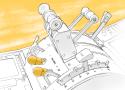
The report focused on the moments after the takeoff, showing the aircraft’s two fuel control switches moved to the ‘cutoff’ position in quick succession. This action cut off fuel supply to the engines, immediately causing the aircraft to lose all thrust.
The switches are on the centre console of the cockpit, just below the engine thrust levers. They are used to control fuel flow to the engines—primarily during engine start-up and shutdown on the ground, or to shut down an engine in the event of an engine failure during flight. //
The fuel control switches are equipped with a spring-loaded locking mechanism that keeps them in position and prevents unintended movement. You would have to pull the switch up before moving it from run to cutoff, or vice versa.
Aviation experts say a pilot would not have been able to move the fuel switches accidentally. Once moved, the effect would be immediate, cutting off engine power.


Take the stress out of packing with these top tips

Warned that ChatGPT and Copilot had already lost, it stopped boasting and packed up its pawns

As a retired nuke plant employee I take it as kind of an insult to read the utilities caused this Dense-pack problem to save a few bucks. After 47 yrs of commercial operation Davis Besse is still waiting on the Federal Government to come and get even one of THEIR spent fuel assemblies. //
mjd
Aug 16
Here's a link to proof the the US Government owns the Spent Fuel and even has to pay the utilities to store it. It's a breach of contract for the government not to take their Spent Fuel and proven in a court of law: https://www.buildsmartbradley.com/2024/08/united-states-ordered-to-pay-breach-of-contract-damages-to-nuclear-operator-in-spent-fuel-dispute/

A 2025-07-12 WSJ article called the Linear No Threshold (LNT) radiation the model, the model that assumes "there is no safe level of exposure to radiation". LNT makes no such claim. LNT converts a dose rate profile into a cancer incidence prediction. That's it. LNT like many other possible models predicts a positive cancer incidence for any dose rate profile whose cumulative dose is positive. //
A far better definition of LNT is: the model that assumes radiation damage to our DNA is unrepairable. Harm just keeps building up. Therefore, the only thing that counts is total dose. How quickly or slowly that dose is incurred is irrelevant.
The no repair assumption was proposed about 100 years ago, at a time when we knew nothing about DNA. We did not even know it existed. We now know a providential Nature has equipped us with a remarkably effective DNA repair system. She had to do this to protect our DNA from our own oxygen based metabolism which produces double strand breaks of the DNA helix at least 25,000 times more rapidly than average background radiation. This repair system can be overwhelmed if the dose rate is high enough; but such dose rates will almost never be encountered by the public in a nuclear power plant release.
LNT denies well established, indisputable biology. In 2018 [2015], Nobel prizes were awarded to three scientists that have been in the forefront of figuring out just how the repair processes work.

So, what Musk is doing is brilliant... but also kind of evil. It's especially odd for a guy who has, on many occasions, raised the alarm about our birth rates falling to dangerous levels. However, he seems to think this will only encourage our birth rates to advance. I don't see how he thinks that unless there's something up his sleeve he hasn't told us that would completely counteract how AI companions affect our brains. //
Weminuche45 Brandon Morse
11 hours ago edited
Everyone will get whatever they relate best to delivered to them, whether they ask for it or know know it or not. Christian prophet, Roman philosopher, Jungian analyst, sassy girl, wise learned old man, brat. comedian, saintly mother figure, loud-mouthed feminist, Karl Marx. Adoph Hitler, Marilyn Monroe, Joy Reid, Jim Carey, Buddha, Yoda, John Wayne, whatever someone relates to and responds to best, that's what they will be served without asking or even knowing themselves. AI will figure it out and give you that.

Do I think Biden was making all the decisions on those pardons? I highly doubt it. But the way the power is allocated, there is no requirement for written approval. If Biden says he approved them verbally, and that's what he maintains, then there's nothing else to be done here. So it's a scandal worth exposing, but don't get your hopes up that anything is going to be found null and void. That's not going to happen. //
The pardons were sketchy, but they are not null and void, and they won't be found null and void. Unfortunately, as long as Biden himself denies he was duped, there is no mechanism by which to overturn the pardons. That power is given directly to the executive in the U.S. Constitution, and the legislative and judicial branches have no ability to challenge pardons or even change how the process works in the future.

neils @midwestneil
·
Turns out you can just hack any train in the USA and take control over the brakes. This is CVE-2025-1727 and it took me 12 years to get this published. This vulnerability is still not patched. Here's the story:
wetw0rk @wetw0rk7
Perhaps one of the most badass CVE's I've ever seen from @midwestneil 💪😤
https://cisa.gov/news-events/ics-advisories/icsa-25-191-10
12:25 PM · Jul 11, 2025
Back when it was first implemented in the late 1980s, it was illegal for anyone else to use the frequencies allocated for this system. So, the system only used the BCH checksum for packet creation. Unfortunately, anyone with an SDR could mimic these packets, allowing them to send false signals to the EoT module and its corresponding Head-of-Train (HoT) partner. This would not have been an urgent issue if the EoT had only sent telemetry data. However, the HoT can also issue a brake command to the EoT through this system. Thus, anyone with the hardware (available for less than $500) and know-how can easily issue a brake command without the train driver’s knowledge, potentially compromising the safety of the transport operation.
What’s frustrating for Neils is that the AAR refused to acknowledge the vulnerability back in 2012, saying that it was just a theoretical issue and that they’d only believe it if it happened in real life. Unfortunately, the Federal Railway Authority (FRA) lacks a test track facility, and the AAR has not permitted any testing due to security concerns on their property. It has got to the point that the security researcher published their findings in the Boston Review, only to be refuted by the AAR in Fortune magazine. //
By 2024, the issue still hasn’t been resolved — the AAR’s Director of Information Security said that it wasn’t really a major issue and that the vulnerable devices are already reaching their end of life. Because the AAR continued to ignore the warnings, the CISA had no choice but to officially publish an advisory to warn the public about it. This has got the AAR moving forward, with the group announcing an update last April. However, implementation is going at a snail’s pace, with 2027 being the target as the earliest year of deployment.

India's Aircraft Accident Investigation Bureau (AAIB) found that fuel switches had flipped to cutoff position—a move typically done only after landing—just 50 seconds into the flight as the aircraft climbed to 625 feet. The cockpit voice recorder captured one pilot asking the other why he cut off the fuel, with his colleague replying that he hadn't. The switches flipped a second apart, roughly the time it would take to shift one and then the other manually. //
Both fuel switches were found in the run position with indications that both engines were attempting to relight before the crash.

One of the changes that will be welcomed by many users, but business and enterprise users in particular, is the arrival of a new way to remove all unwanted Microsoft apps in one fell swoop. Via Group Policy, the new Remove Default Microsoft Store Packages policy helps to debloat Windows 11 in a flash. //
Currently available in the preview builds of Windows 11 on the Dev Channel, the Remove Default Microsoft Store Packages simplifies and accelerates the process. With the latest Dev build install, head to Computer Configuration > Administrative Templates > Windows Components > App Package Deployment and you’ll find a Remove Default Microsoft Store packages from the system setting. //
There is a beautifully detailed breakdown of how the policy works over on Patch My PC, where there is also the suggestion that eager tinkerers can experiment with hacking the list of supported apps. https://patchmypc.com/blog/remove-default-microsoft-store-packages/
Bill says:
July 13, 2025 at 6:30 pm
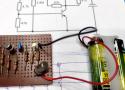
For many years the go-to for timebase generation was the unijunction transistor. You can make a nice sawtooth generator relaxation oscillator with just a battery, UJT, three resistors and one capacitor. The linearity of the ramp is quite good.
Here’s an example: https://www.tutorialspoint.com/pulse_circuits/pulse_circuits_ujt_as_relaxation_oscillator.htm

Not everything belongs in one place
Maybe decentralization isn’t bad after all?
Air-gapped backups are underrated
Never underestimate those portable drives
Sync is not backup. Backup is not an archive
I wish I had understood this earlier
My current hybrid model has a cloud for its convenience, making things easier to share with anyone, not on my local network. NAS is in the middle, taking up the primary storage duties of keeping my files in sync across devices, ensuring everything important is backed up, and helping me access my files swiftly. And finally, my collection of hard drives lets me keep my archives safe. //
https://www.xda-developers.com/why-i-went-hybrid-with-nas/?post=628a-45d3-94a48a0b6521#thread-posts
Tom
Well, to each their own.
Personally, I start with my personal PC: OS is on a 2 TB NVMe, with separate NVMe drives for games and software, plus an 8 TB HDD. Nextcloud syncs fully to that HDD. My full profile (Desktop, Downloads, Documents, etc.) is mirrored to a Nextcloud folder using MirrorFolder.
So:
Copy 1 = C drive
Copy 2 = 8 TB HDD
Copy 3–4 = Server-side DrivePool (two 20 TB HDDs, full duplication)
Copy 5 = Carbonite backup of DrivePool
My C drive is image-backed daily (incremental, with full every 5 days, keeping the last 10). Those go to a 4 TB external, then Kopia on the server backs them up again. Only the full (5th-day) images are sent to Carbonite.
Photo backups reach PhotoPrism either via the photo folder on C that's bi-directionally mirrored to the photo prism folder (scanned with a python script using the API), or from Android via PhotoSync/Syncthing. These folders live on the same 20 TB DrivePool (duplicated and backed up). Audiobookshelf, Komga, etc., also live there.
Plex Media sits on two separate DrivePools (via QNAP TL-D800S DAS units with miniSAS). No duplication—about 100 TB—so Backblaze handles that.
Why both Carbonite and Backblaze? I want Nextcloud and critical items uploaded immediately, not delayed behind TBs of media. I use NetLimiter to cap combined upload to ~75%, letting it auto-balance bandwidth between the two.
That’s it. Fully backed, accessible via reverse proxies. No Google needed—Google Photos? See Immich and PhotoPrism.

The McDonnell Douglas MD-80 was the last American-built aircraft to feature an analog cockpit. The aircraft entered commercial service with Swissair in October 1980, and became a mainstay of short-haul aviation across the world. The US-based manufacturer went on to build a total of 1,191 MD-80s, several of which are still in service today.

-
Rest. Fatigue can cause eye floaters and other visual disturbances. Resting your eyes and getting enough sleep can minimize strain and reduce floaters.
-
Harsh light exposure. Wearing protective sunglasses, limiting screen time, dimming indoor lights, and eliminating glare sources can help reduce eye strain and floaters.
pineapples have been linked to a decrease in floaters because of an enzyme called bromelain. It can digest proteins like collagen, which is what floaters are made of.

Notably, traveling east is often harder on the body than traveling west, as Kopp often experienced herself, because it forces the body to sleep earlier than it’s accustomed to; conversely, traveling west is generally easier to adapt to.
Kopp’s approach, while it hasn’t been formally studied, does align with some emerging research on circadian biology. Fasting during travel and delaying the first meal until arrival may help shift the body’s “food clock,” a secondary circadian system that responds to eating times. And studies suggest meal timing can influence how quickly the body adjusts to a new time zone: Some experts recommend eating only light meals during flights, but then doing activities in your local time zone like eating and sleeping as soon as you arrive, to help reset internal rhythms.
A decade ago, an employee stole 25 priceless documents from the Netherlands’ National Archives in the Hague. The trove included 16th-century records of clandestine government affairs, a 15th-century letter from a knight and documents from the Dutch East India Company.
Officials weren’t aware the documents had been stolen until recently, when they were returned by the Amsterdam police and art detective Arthur Brand, who is known for recovering lost and stolen artworks and artifacts. //
Officials at the archives knew that the documents were missing, but they assumed they had simply been misplaced. “We manage more than [90 miles] of archives, over 15 million photographs and 300,000 maps and drawings,” a spokesperson for the National Archives tells NL Times. “With such numbers, it is impossible to have a complete inventory of all the documents.”

When is an AI system intelligent enough to be called artificial general intelligence (AGI)? According to one definition reportedly agreed upon by Microsoft and OpenAI, the answer lies in economics: When AI generates $100 billion in profits. This arbitrary profit-based benchmark for AGI perfectly captures the definitional chaos plaguing the AI industry.
In fact, it may be impossible to create a universal definition of AGI, but few people with money on the line will admit it.
One-level load shedding is integrated into the Multicluster-Box. The load-shedding contactor is controlled directly by the master of the main cluster via communication with the Multicluster-Box. If you install an additional load-shedding contactor in a multicluster system, it is controlled with a multifunction relay in the master of extension cluster 1. Additional load-shedding contactors cannot be controlled by the main cluster.
The battery protection mode protects the battery.
If the state of charge (SOC) of the battery falls below the thresholds, battery protection mode is activated. In battery protection mode, the Sunny Island switches to energy-saving mode or switches itself off. The battery protection mode has 3 levels. 1 state of charge threshold can be set for each level. Level 1 and 2 of the battery protection mode have specific start and end times and are therefore dependent on the time of day ( > Setting Time-Dependent Functions).

SmartBox® solves 6 challenges faced by schools in developing countries:
- Lack of Internet - The SmartBox® provides students a vast collection of content sent wirelessly to the Chromebooks.
- Limited Electricity - Runs on battery power for 12-16 hours; recharges in 5 hours with generator or solar system.
- Textbook Shortage - Students have access to a myriad of books, videos and learning resources.
- Teacher Shortage - Students can learn in the absence of a qualified teacher, and teachers can also learn!
- Messy Wiring Runs - Gone are the days of the traditional computer lab with its tangle of cords.
- Security - Can be securely locked and stored each evening.
Case Study: Liberia
In three years the SmartBox® helped take Sinoe County from #11 to #1 on the West African Examination Council (WAEC) exam. In 2014, Sinoe 12th graders had a 23% passing rate. In 2017, they jumped to 88% to top all 15 counties in Liberia. The SmartBox® is currently being used in 30 Liberian schools and orphanages in nine counties. Thousands of students have learned to use the computer, and have gained proficiency in math, the sciences, and other subject areas.