
The Genesee Valley Greenway State Park is a 90-mile open space corridor that follows the route of the Genesee Valley Canal (1840-1878) and the Pennsylvania Railroad Rochester Branch (1882-1963) from the Erie Canalway Trail in Rochester's Genesee Valley Park to the Village of Cuba in Allegany County. The Greenway will eventually extend to Hinsdale in Cattaraugus County.
It includes a public, multi-use trail and natural and historic resources. The majority of the trail is an old railway bed that is a straight, level surface consisting of cinders, gravel, and mowed grass. The Greenway passes through woodlands, wetlands, river and stream valleys, rolling farmlands, steep gorges, and historic villages in sixteen towns located in Monroe, Livingston, Wyoming, Allegany, and Cattaraugus counties.


From roadside convenience stores to lonely landscapes, travellers are discovering little-known slices of Americana away from the host cities.
In the build-up to this summer's Fifa World Cup, much of the attention was on the host cities and stadiums where the matches would be held. But after two weeks, something I never expected is happening: social media is flooded with feel-good videos of fans discovering the US that exists between skylines. //
These stories of human connection have made me and many other Americans emotional during this World Cup. They are examples of our country at its best, and they are coming exactly when I and so many other Americans need them the most.
"Many US citizens have been feeling down on their country, and sad that their nation is seen in a negative light overseas," Russell told me. "With the negative news in the run-up to the World Cup… seeing people actually enjoying the US and its people feels more intensely joyful."
She's right: after consuming so many of these social media posts and videos, I find myself overwhelmed with a sense of national pride that I haven't experienced for some time.
On Thursday mornings, Michael Scurr flips through pages . . . very, very carefully. He volunteers at the United Kingdom’s National Archives. In May, he made a discovery. He found an original copy of the Declaration of Independence!
At the time, Mr. Scurr was sifting through letters. A Royal Navy captain wrote them. Mr. Scurr found a report. It told of Brits capturing an American ship called Dalton. That took place on Christmas Eve in 1776.
Attached to the report? Something labeled as “another paper.” Mr. Scurr gingerly unfolded the document. Then he spotted the word “Declaration” printed across the top. He stopped.
“I thought, oh, right, OK, this is definitely a Declaration of Independence,” he says. “How exciting is this?”
Researchers agree. Before this find, people thought only 10 early copies existed. Now Mr. Scurr has upped that number to 11. The Founders signed the original document on July 4, 1776. This copy was printed days later. The document spread the news. Thirteen American colonies were breaking away from Great Britain.
So, yes, it’s old. But it’s important for another reason too. The ship on which it was captured was sent by the brand-new Continental Congress. John Hancock signed the ship’s orders. (John Hancock also famously signed the Declaration in BIG letters.)
A samurai, several AIs, and one Japanese guy trying to understand America.
NOBUNAGA is a Japanese comedy and storytelling project. It follows a small, confused, dignified samurai who has somehow wandered into modern American life, and is doing his best.
He is not here to judge America. He is here to misunderstand it beautifully //
The stories are written in Japanese by a guy in Japan. He writes them at his desk, mostly at night, mostly while drinking convenience-store coffee that he secretly considers superior to American gas-station coffee, although he would never say so to the samurai's face.
They are then translated into English with the help of a small army of AI tools — for nuance, for rhythm, for the small jokes that do not survive the jump between languages. The English you read here is collaborative: human taste, machine assistance, many drafts, no shortcuts.
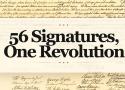
The hand-written parchment copy of the Declaration of Independence showing historic script lines and signatures.
✦ ✦ ✦
56 SIGNATURES,
ONE REVOLUTION
✦ ✦ ✦
On July 4, 1776, representatives from the 13 colonies gathered in Philadelphia to declare independence from Great Britain. The Continental Congress had voted two days earlier to make the break and to write a Declaration of Independence.
John Hancock signed the Declaration first on that Fourth of July. Many of the others signed over the ensuing days and weeks. Their signatures — 56 names added to the official parchment copy — transformed a revolutionary decision into a public pledge.
These are the stories of the people behind the signatures.
United States
of America
Old Glory: The History of Our Nation’s Flag is an illustrated American flag history poster that follows the growth of the United States through the changing designs of its national and colonial banners. This educational poster presents notable flags from the 13 Colonies through the present 50-star U.S. flag.
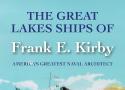
The Great Lakes Ships of Frank E. Kirby: America’s Greatest Naval Architect,” by Richard Gebhart, Michigan State University Press, May 2026, 231 pages, $59.95 (Hardcover), $29.10 (Paperback), $29.95 (E-book)
From the 1870s through the 1890s most of the world’s ships not built in British shipyards were built on the North American Great Lakes, a vast interconnected yet isolated inland sea system. Of these Lakes vessels built during that period and for the first two decades of the 20th century, many, including the best designs came from the mind of naval architect Frank E. Kirby.
“The Great Lakes Ships of Frank E. Kirby: America’s Greatest Naval Architect,” by Richard Gebhart, is a biography of the man and a history of his ships. It charts his career, and follows the course of the shipyards he ran and the ships he built.
Covering most of America’s history, here are 10 single-volume books discussing the most important eras in US history.
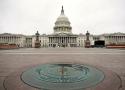
If you’ve ever been to the Lincoln Memorial in Washington, D.C., you’ll know it’s a majestic site, with the 19-foot-tall Georgia white marble statue of Honest Abe overlooking the Reflecting Pool and then further off, the Washington Monument and the U.S. Capitol.
Something you presumably didn’t see on your visit, however, is a massive 50,000-square-foot foundation built to keep the whole thing from sinking into the swamps of D.C. It’s called the Undercroft, and it’s been a tightly held secret for decades. In June, the Department of the Interior will invite the public to see the hidden vault, Secretary Doug Burgum announced Sunday:

WASHINGTON — Thousands of Americans on Sunday converged on the National Mall to mark the country’s 250th birthday with a prayer festival featuring religious music and speeches by leaders from across faiths.
In February, President Trump declared May 17 a national day of prayer and a time “to rededicate America as one nation under God” in a move that energized evangelicals.
“This is a recognition of the deeply embedded history and religious and moral tradition of the country,” House Speaker Mike Johnson (R-La.) told “Fox News Sunday” about Sunday’s massive religious gathering in DC. //
The May 17 date for the national prayer days traces its origins to America’s early days.
Shortly before the signing of the Declaration of Independence, the colonial Congress declared May 17, 1776, a national day of fasting and prayer
From Supreme Court Justice Neil Gorsuch and bestselling author Janie Nitze! Explore the courage and sacrifice of some of the heroes of the American Revolution and the stories behind the document that started it all—The Declaration of Independence.
In the spring of 1776, the streets of Philadelphia buzzed with the sounds of revolution. Talk of war and rumors of spies swirled in the air. Noisy debates spilled out of taverns. The State House bell tolled urgently, calling men to meetings and momentarily drowning out the normal hum of the port city.
Dive into the stories of ordinary people willing to do extraordinary things, from iconic figures like Thomas Jefferson, George Washington, Ben Franklin, and Paul Revere, to lesser-known revolutionaries such as Caesar Rodney, Thomas Paine, and Mary Katherine Goddard. These great men and women risked all they had—their property, freedom, and ultimately their lives—to secure a better life for their children and grandchildren. Packed with firsthand accounts and vivid depictions of the patriots’ struggle for freedom, Justice Gorsuch’s and Janie Nitze’s debut children’s book thoughtfully investigates the foundations of our country, centering the human experience at the heart of it all.
Celebrate America’s 250th birthday with the Heroes of 1776, a celebration of the ideals upon which this country stands, told with humanity in only the way Justice Gorsuch and Janie Nitze can. //
Carolyn
5 out of 5 stars
Be prepared to be moved by this book!
Reviewed in the United States on May 6, 2026
Format: Hardcover
Verified Purchase
I ordered this book because I heard Justice Gorsuch promoting the book in a TV interview. I liked what he said, and I thought it might be a good gift for my younger relatives. I’m cautious about gifting books that I haven’t read, especially for children. So upon its arrival, I sat down to read it and I was so moved that it caught me off guard. I studied American history and the creation of the Declaration of Independance in high school and in college. I’ve seen the movies. I’ve watched the documentaries. I’ve even gone to DC and viewed the document. I know the story, or at least I thought I did. But not like this. This story made it real, because, to use the authors’ words, “At the heart of it all were ordinary people willing to do extraordinary things and risk all they had to secure a better life for themselves, their children, and generations to come.“ They didn’t teach this part of the story in school. I never knew how extraordinary these ordinary people were. I have a new appreciation for the Declaration of Independence and for the men and women who sacrificed so much to create this experiment, we call America. This book is not just for children. It is for everyone of any age. Order a copy or a few. You, can thank me later.
It's that sharp decline in young people's knowledge of how and why America was founded, and our form of government, that prompted Supreme Court Justice Neil Gorsuch to write "Heroes of 1776: The Story of the Declaration." The book is aimed at both school-aged kids and adults. During a recent interview promoting the book, Gorsuch gave some startling figures:
"Only about 13% of kids today in eighth grade are proficient in American history — [and just] 22% in civics. Six out of 10 adults would fail our citizenship test." //
Gorsuch added that much of his inspiration for the book came from former Justice Sandra Day O'Connor, who founded a civics non-profit after her time on the nation's highest court. Gorsuch said of O'Connor and her work,
"As she was leaving the court, she reflected that civic education in this country is a problem. And for a lot of reasons, it's simply not being taught anymore."
Gorsuch offered up some other disturbing facts. In 2019, only one-third of Americans could name all three branches of government. He stated that this was concerning, given the fact that all three branches "interact" and "check" one another against overreach. //
We know why American history and civics are no longer taught in public schools. The agenda of the teachers' unions is not for students to be knowledgeable in history and civics, but in climate change, transgender issues, and why America is inherently a racist nation. They know that if kids are taught about history or civics, it will be that much harder to indoctrinate them on left-wing ideology and hate the country.
ALSO READ: How Much Confidence Do Americans Have in the Supreme Court? A New Poll Says Not Much
Gorsuch said that history and civics education isn't a left- or right-issue for him and his fellow justices. He added, "If you polled the nine of us in our conference room, one thing we could all agree on is the importance of learning American history."
That agreement among the justices on Americans' knowledge of history and civics is encouraging. Neil Gorsuch summed it up, saying, "Because how else are you going to carry this thing forward? Somebody has to run the zoo." //
TheBlaze @theblaze
·
Justice Neil Gorsuch: “We’re a creedal nation. What unites us is not a religion, not a race, it’s a belief in those ideas in the Declaration of Independence.”
7:37 PM · May 6, 2026

Someday there is going to be a movie made about this rescue mission in Iran.
But man, what a morale booster for our military to know that the Secretary of War and Commander-in-Chief will blow up $300 million worth of our own military aircraft to rescue one US soldier.
No man left behind!
God bless our troops!
Military personnel matter to President Trump. At $300 million a troop the 1.3 million people in uniform means they are worth 390 trillion dollars (a million times a million is a trillion).
To Joe Biden, they were worth nothing.
He left 13 behind to die in Afghanistan and he looked at his watch repeatedly when their bodies came home.
But for a moment, look at our military’s rescue through the eyes of the enemy.
Iran had two men downed inside Iran and somehow its military was unable to find them, while the military from a nation thousands of miles away rescued them. It was like a groundball going through a fielder’s legs and costing his team a World Series game.
The rescue feels like victory because it is.
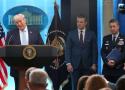
"Now, these are not routine operations. They were high-risk, high-stakes missions conducted in the heart of enemy territory.
"This was not just barely into Iran. This was deep into Iran, involving coordinated strikes to suppress threats, deception tactics to protect our teams, and full synchronization across air, ground, and special operations.
"The Iranians are still asking themselves right now, how did the Americans do this?"
Of the first mission, Hegseth said:
"The first mission, the first of two, was an audacious daylight thunder run right up the middle.
"It was authorized in less than two hours from that pilot going down, when we knew where he was, and it was authorized in the middle of the night because anybody that’s worked for this man knows he’s up in the middle of the night." //
"I looked up at my screen when the final mission was complete inside our SCIF, our secure facility.
"And we have a running VTC, a running coordination cell, and the top of it read 45 hours and 56 minutes.
"For 45 hours and 56 minutes, we held that call open for coordination.
"From the moment our pilots went down, our mission was unblinking.
"The call never dropped.
"The meeting never stopped.
"The planning never ceased."
the x algorithm just surfaced a bunch of pro-america posts from japan, reminding us of what we've known for a while: the japanese really are america's best friends //
“The largest cultural exchange in history just dropped,” remarked X’s Head of Product Nikita Bier on Sunday, referring to the onslaught of translated Japanese content that flooded the X timeline last week.
Alysa Liu is an American figure skater whose family fled China and faced harassment and persecution by Chinese authorities. She won gold. You might have missed it. The American press corps chose, instead, to praise Eileen Gu, an American skier with family ties to the Chinese communist party. Gu skied for and was paid by China. The press elevated her over American athletes until shifting to hate our hockey team.
The Indians who sold Manhattan were bilked, all right, but they didn’t mind—the land wasn’t theirs anyway //
By now it is probably too late to do anything about it, but the unsettling fact remains that the so-called sale of Manhattan Island to the Dutch in 1626 was a totally illegal deal; a group of Brooklyn Indians perpetrated the swindle, and they had no more right to sell Manhattan Island than the present mayor of White Plains would have to declare war on France. When the Manhattan Indians found out about it they were understandably furious, but by that time the Dutch had too strong a foothold to be dislodged—by the Indians, at any rate—and the eventual arrival of one-way avenues and the Hamburg Heaven Crystal Room was only a matter of time.
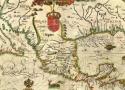
In the Age of Discovery, maps held closely guarded secrets for the kings, adventurers, and merchants who first acquired them.
he New York Post is counting down to America’s 250th birthday with a look back at the nation’s — and the paper’s — history. We’re revisiting 250 notable covers and articles from our archives, starting with the very first paper Alexander Hamilton published on Nov. 16, 1801, when it was known as the New-York Evening Post.
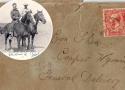
“…while cleaning up the construction mess, out of the corner of my eye there lied a small blue envelope that had most [likely] been dropped into the wall as the house was being built almost 100 years prior! It was a letter sent from a sister in Bantry, Ireland, to a man named Con Shea here in Casper, Wyoming.”
“It was a letter thanking Mr. Shea for a present he had sent to his family back home in Ireland,” Smith told the Daily Mail. “There was also some catching up and keeping him abreast of the goings on back there in Ireland.”
Smith did some research to learn more about the man who built the home, who “…had immigrated to the US, and had become a very successful sheep herder here in Wyoming,” Smith explained to the outlet.