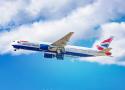
For over 50 years, every commercial flight crossing the North Atlantic eastbound through Canadian airspace would contact Gander Oceanic Control at least 30 minutes before reaching the coast to negotiate a three-part clearance covering route, speed, and altitude. Without that explicit radio or datalink handshake, pilots faced an immediate halt in domestic airspace or an entry into a holding pattern over Newfoundland. That mandatory pre-entry clearance has now disappeared in favor of a new approach to crossing this airspace.


A KLM flight to Curaçao became an 11-hour flight to nowhere after a power bank reportedly belonging to the airline’s former CEO exploded while being charged onboard.

In 2001, Capt. Steve Scheibner was an American Airlines first officer based out of Boston. On September 10 of that year, while serving reserve duty for his airline, he put his name in for the next morning’s American Airlines Flight 11 from Boston's Logan International Airport to LAX.
He was so sure he'd picked up the route that packed his bag and waited for the confirmation of his assignment.
“I waited for the phone call, and the phone never rang, which is not completely unusual,” Scheibner recalled. “It’s not the norm, but it’s not completely out of the question either. In fact, I didn’t even think about it for a while.”
The confirmation never came because, at the last minute, a more senior pilot, Capt. Tom McGuinness, took the flight instead. //
Scheibner has spoken many times in the years since – way before he had a YouTube channel – about what it was like to realize how close he had come to being part of the 9/11 attack.
“Why does God take one and leave another?" he asked. "It’s not because I’m a better person or God wanted to do more with me than he wanted to with Tom. I think in God’s providence, that’s obviously His choice."
In the 25 years since 9/11, Capt. Steve has lived with renewed purpose. “I need to act like I’m living on borrowed time because I am. I can look and see my smoking hole. And it was on national TV,” he said.
“There’s an obligation that comes with that. I’ve got to live my days with a sense of urgency. I have to make sure I get the most out of them. And not the most for me. We live in a world where everybody’s out to kind of get the most for them.”
Captain Steeeve

The accident is especially notable because 9S-AJO was among the last DC-8s still flying commercially. The approximately 56-year-old aircraft was Trans Air Cargo Service’s only active aircraft, according to fleet databases.
The jet was originally built as a DC-8-63, part of the stretched “Super 60” series. It was later converted to the DC-8-73 standard with quieter and more fuel-efficient CFM56 turbofan engines.
Only a small number of DC-8s remained operational worldwide before the Kinshasa accident. Another DC-8-73 freighter, registered OB-2231P, has been operated by Peru-based Skybus Jet Cargo. //
Douglas and McDonnell Douglas built 556 DC-8s before production ended in 1972. Although the type disappeared from scheduled passenger service decades ago, several re-engined examples continued flying as freighters, research aircraft and humanitarian transports.
NASA retired its DC-8 flying laboratory in 2024, while Samaritan’s Purse retired the last US-registered operational DC-8 in 2025.
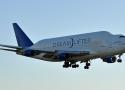
From extra engines to wild-looking fuselages to gigantic radar dishes, here are ten of the strangest Boeings ever made.
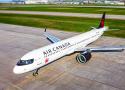
Replacing a widebody jet on a premier long-haul corridor with a single-aisle aircraft sounds like a masterclass in fuel efficiency, but Air Canada quietly abandoned that exact strategy before the first passenger even boarded. When schedule filings initially showed the carrier deploying its brand-new Airbus A321XLR on AC852 between Toronto Pearson(YYZ) and London Heathrow(LHR), it appeared to begin the evolution with which North American network carriers would manage top-tier transatlantic trunk routes. Within months, however, Air Canada pulled the narrowbody from the schedule, restoring twin-aisle Boeing 777 and 787 Dreamlinerservice to protect high-density seat inventory and premium belly-freight capacity.
Airline Passengers and Batteries
Frequently Asked Questions
Fate Is the Hunter is a 1961 memoir by aviation writer Ernest K. Gann. It describes his years working as a pilot from the 1930s to 1950s, starting at American Airlines in Douglas DC-2s and DC-3s when civilian air transport was in its infancy, moving onto wartime flying in C-54s, C-87s, and Lockheed Lodestars, and finally at Matson Navigation's short-lived upstart airline and various post-World War II "nonscheduled" airlines in Douglas DC-4s.
This course is everything you need to prepare for your written test and earn your pilot certificate, with online ground school, FAA test prep, and real-world training - all in one easy-to-use package. -- $299
We have the best tools in the industry to help you pass all three tests required to get your Private Pilot certificate (FAA knowledge test, checkride oral and checkride flight). In fact, we guarantee that you'll pass all three tests or you're entitled to a full refund. No one else is willing to make that guarantee, that's how confident we are in this course.
This is the unique story of observing a total solar eclipse for no less than 74 consecutive minutes. On the summer morning of June 30, 1973, the Sun rises on the Canary Islands. But it is strangely indented by the Moon. The eclipse of the century has just begun. From the west, the lunar shadow rushes to the African coast at a velocity of over 2000 kilometers per hour. Astronomers on the ground will enjoy seven short minutes of total eclipse to study the solar corona - too short for Pierre Lena and seven scientists who board the Concorde 001 prototype, an extraordinary plane to become the first commercial supersonic aircraft. With André Turcat as chief pilot and a crew of five, at 17000 m altitude, the aircraft remains in the lunar shadow for 74 minutes, a record time of scientific observations not yet beaten and allowing for exceptional measurements. ////
Epub, PDF
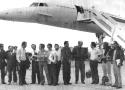
Fitted with telescopes, the plane did our longest imaging of the Sun’s corona. //
The Concorde Prototype 001 at the National Air and Space Museum of France in Le Bourget, with a map of Africa painted on it. The map depicts the aircraft’s path in the shadow of the total solar eclipse of June 30, 1973. //
“In 1970, the Concorde 001 prototype flew supersonic for the first time,” Léna told Ars. “The newspapers were full of these results. By 1972, I thought it was worth trying to approach André Turcat, the chief of test flights at Aerospatiale in Toulouse, and ask him about the possibility of using the 001 prototype to follow the June 1973 eclipse. He was very interested.”
With his plan accepted, Léna began organizing experiments for the historic flight. Flying at nearly 17 km above the Earth’s surface had many benefits. “Flying very high in the stratosphere had several advantages, including no humidity, which meant an excellent infrared transmission of the solar light.” //
With the shadow moving east at a slightly higher speed than the Concorde’s Mach 2.2, the scientists had 80 minutes of observation time in the totality before the aircraft fell behind the eclipse’s shadow. However, due to headwinds, that was reduced to 74 minutes, which was and still continues to be an astonishing achievement. “No one has achieved even half of it during the past 53 years,” Léna said.
Following this remarkable eclipse chase, the Concorde 001 landed in the Chadian capital of N’Djamena (then Fort-Lamy). “After we landed, a partial solar eclipse went on for an hour and a half or so. There were people (celebrating) on the streets with music as they were very happy to see us. It was a very special moment in my life,” Léna said.
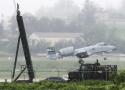
Introduced Monday as H.R. 9780 by Rep. Abe Hamadeh, R-Ariz., the BRRRRT Act (Bolstering Recognition, Resurgence, Retention, and Remembrance of the Thunderbolt) gets its name from the bone-rattling “BRRRRT!” sound the jet’s 30mm Gatling gun makes when fired. //
The current National Defense Authorization Act (NDAA) has some provisions for keeping some A-10s flying as well. But that doesn't sound as cool as the BRRRRT Act.
This bill will probably end up going nowhere, sadly. The A-10s will stick around a little while longer, but the Air Force has stopped training Warthog drivers, and depot maintenance operations on the A-10 are wrapping up. That's too bad. There's still a place in the modern battle space for a dedicated, low-and-slow, dedicated close air-support airplane, and the A-10's a very, very good one.
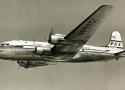
The flight lasted less than nine minutes, the right two engines losing power in quick succession as the Douglas DC-4 made its initial climb from San Juan, Puerto Rico, en route to New York.
The pilot of the Pan American Clipper Endeavor had no choice but to ditch the plane at sea. All 69 of the passengers and crew members survived the initial crash on April 11, 1952, only for panic and confusion to hit in the precious few minutes after the water landing.
The plane’s tail section broke off and the fuselage sank, an accident that claimed 52 lives and became a catalyst for airline safety briefings and procedures for generations to come. //
Josh Gates, a host of “Expedition Unknown,” said, “Every time you step onboard an airplane today, you are safer because of what happened to ‘Clipper Endeavor’ and her passengers three-quarters of a century ago.”
The completion of the acquisition expands Iridium’s role in the aviation ecosystem by combining Aireon’s space-based air traffic surveillance and aviation intelligence services with Iridium’s global satellite communications network and resilient PNT capabilities.
Roberts Flight Information Region (Roberts FIR), located off the west coast of Africa, has selected Aireon’s space-based automatic dependent surveillance-broadcast (ADS-B) data to navigate and surveil aircraft in the combined upper airspace of its three member States, joining a growing number of African countries opting for the revolutionary product.
The Roberts FIR, which is headquartered in Liberia, is a tripartite organization responsible for the control and safety of air navigation in the combined upper airspace of Guinea, Liberia and Sierra Leone, with a total size of 770,777 square km. Each Member state manages its portion of the airspace from the ground to 3000 ft. Mean Sea Level (MSL).

In the wake of recent success with air-to-air schlieren photography using the speckled desert floor as a background, researchers at NASA’s Armstrong Flight Research Center, Edwards, California, are now looking to the heavens for backgrounds upon which to capture images of supersonic shock waves using ground-based cameras. A bright light source and/or speckled background – such as the sun or moon – is necessary for visualizing aerodynamic flow phenomena generated by aircraft or other objects passing between the observer’s camera and the backdrop. This patent-pending method, made possible by improved image processing technology, is called Background-Oriented Schlieren using Celestial Objects, or BOSCO.
Flow visualization is one of the fundamental tools of aeronautics research, and schlieren photography has been used for many years to visualize air density gradients caused by aerodynamic flow. Traditionally, this method has required complex and precisely aligned optics as well as a bright light source. Refracted light rays revealed the intensity of air density gradients around the test object, usually a model in a wind tunnel. Capturing schlieren images of a full-scale aircraft in flight was even more challenging due to the need for precise alignment of the plane with the camera and the sun.
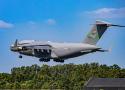
The Boeing C-17 Globemaster III of the United States Air Force has a rare modification that allows it to do a unique feat in the world of aviation. The enormous tactical quadjet can switch to reverse thrust on all four of its Pratt & Whitney turbofan engines from high altitude and drop 25,000 feet down to 'the deck' on a tactical descent into a combat zone to make deliveries to troops on the ground. This unique ability allows it to stay at high altitude, where it is safe from many anti-aircraft threats until the very last moment, and then pass through the hazardous low-level as quickly as possible.
When pilots pull the throttles back to idle and engage the reversers, the engine airflow is deflected upward and forward. This creates intense aerodynamic drag without stalling the wings. The C-17's deliveries sometimes include basic supplies, and the fast drop is a precaution to avoid being targeted, but on other missions it could be delivering a main battle tank to the front line and potentially coming under direct fire. The engines enable jaw-dropping descent rates of up to 15,000 feet per minute, four to five times steeper than a standard commercial airliner, and keep the C-17 safe in hostile skies.
A compendium of Pilot Rules (Number 30 is Gospel in Fighters).
-
The only three things a wingman should ever say are:
“Two's up. “
“Lead, you're on fire.”
“I'll take the fat chick.” -
In a multi-place aircraft, there are only three things the copilot should ever say:
“Nice landing, Sir.”
“I'll buy the first round.”
“I'll take the fat chick.” -
As a new copilot on a bomber I was told to say these three things and to otherwise keep my mouth shut and not touch anything:
“Clear on the right.”
“Outer (marker) on the double (indicator).”
“I'll eat the chicken.” (Crew meals consisted of one steak and one chicken to avoid possible food poisoning of the cockpit crew). -
As an aviator in flight you can do anything you want. As long as it's right. And we'll let you know if it's right after you land. //
-
As a pilot only two bad things can happen to you and one of them will:
One day you will walk out to the aircraft knowing that it is your last flight in an airplane.
One day you will walk out to the airplane not knowing that it is your last flight in an airplane. -
Any flight over water in a single engine airplane will absolutely guarantee abnormal engine noises and vibrations.
-
There are Rules and there are Laws. The rules are made by men who think that they know better how to fly your airplane than you; the Laws (of Physics) were made by God. You can, and sometimes should, suspend the Rules but you can never suspend the Laws. //
-
He who demands everything that his aircraft can give him is a pilot; he that demands one iota more is a fool. //
-
It is solely the pilot's responsibility to never let any other thing touch his aircraft. //
-
The aircraft G-limits are only there in case there is another flight by that particular airplane. If subsequent flights do not appear likely, there are no G-limits.
the passenger version of the Boeing 747-8, also known as the 747-8I for 'Intercontinental,' has a fuel capacity of 63,034 gallons (238,610 liters). According to Boeing, these aircraft have a range (based on a load of 410 passengers) of 8,900 miles (14,320 km). Dividing the latter by the former, we get a figure of just 0.142 miles per gallon.
The figure for the Boeing Business Jets (BBJ) version of the 747-8 is slightly more favorable. Indeed, based on an assumed capacity of just 100 VIP passengers, this private jet has a range of 10,213 miles (16,437 km), resulting in a figure of 0.162 miles per gallon. As for the 747-8F, which carries cargo, its range of 4,908 miles (7,899 km) and fuel capacity of 59,734 gallons (226,095 liters) give it a figure of 0.082 miles per gallon. But are these low figures as bad as they seem at face value? //
the 747-100, Boeing's data shows that this version of the iconic quadjet could typically fly for up to 5,320 miles (8,560 km). When this range is offset against the 747-100's maximum fuel capacity of 48,445 gallons (183,380 liters), we get a figure of 0.11 miles per gallon. As such, the 747-8's score on this front has improved by more than 29% from the oldest to the newest model. //
when we multiply the 747-8's figure of 0.142 miles per gallon by its capacity, for this purpose, of 410 guests, we get a much healthier figure of 58.22 passenger miles per gallon. Of course, a full five-seater car would only need to achieve around 11.65 miles per gallon to get a higher passenger miles per gallon figure, but, in reality, cars often only transport their driver. As such, in this regard, a fully loaded 747 can be more efficient than certain cars in the event of solo occupancy. //
Boeing 747 Production
Sub-Family
Number Produced
747-100
205
747SP
45
747-200
393
747-300
81
747-400
694
747-8
155
First impressions disproportionately shape how passengers rate an entire flight. With self-service kiosks, online check-in, and biometric boarding gates reducing human touchpoints, the gate agent and the flight attendant at the door are now among the very few staff members a customer interacts with directly.
Net Promoter Score, a metric that airlines track closely, is heavily influenced by these early micro interactions. A warm welcome at the door costs the airline nothing yet sets a positive tone for the entire journey. A cold or absent greeting does the opposite and primes the passenger to view every subsequent service touchpoint negatively.
The hospitality industry follows the same principle. Most hotel guests form a subconscious judgement about their stay within five minutes of arrival, based largely on how the front desk staff receives them. Aviation operates under identical psychological dynamics. //
A greeting at the door is not a complicated training problem. It is the clearest available signal of whether an airline’s service culture is functioning, and right now at American, that signal is flashing red.