
when we multiply the 747-8's figure of 0.142 miles per gallon by its capacity, for this purpose, of 410 guests, we get a much healthier figure of 58.22 passenger miles per gallon. Of course, a full five-seater car would only need to achieve around 11.65 miles per gallon to get a higher passenger miles per gallon figure, but, in reality, cars often only transport their driver.


NTSB released images showing a UPS plane's engine separation during a Louisville crash.
The Nov. 4 crash killed 14 and left a half-mile debris field.
NTSB found fatigue cracks in engine hardware; investigation continues with final report pending.
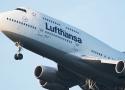
Boeing aircraft, including the 747, 757, 767, and 777, all take on a sleeker, forward-stretching and beak-like shape at the front, while the Airbus planes, such as the A320, A330, A340, A350, and A380 families, have a rounder front profile with a smooth curve from top to bottom. This difference isn't just cosmetic or a preferred choice in design — it's the product of decades of engineering philosophy and aerodynamics history.
Boeing, since 1916, has continued to follow its engineering legacy of pointed noses borrowed from the earliest B17 and 747 aircraft. This was during a time when wind tunnel experimentation was big among the aircraft engineers who believed that a tapered, pointier nose helps reduce drag and cut through wind faster. This design had also become Boeing's signature look and straying away from it would've meant compromising the brand's identity.
Airbus, on the other hand, was born much later in the 1970s, in an era where aerodynamics history had evolved and computer modeling introduced a new idea that at subsonic speeds below Mach 1, a smaller, rounder nose shape actually helps reduce drag and smooth airflow. As a result of this new understanding, Boeing began embracing the compact, dolphin style that now defines its fleet with the arrival of the 787. //
At subsonic speeds, the shape of the aircraft matters less than it does at supersonic or transonic speeds, where a needle-like nose is needed to cut through pressure fronts to avoid the harsh drag that builds at higher Mach levels. Thus, computational modeling prescribed a shorter, rounder shape for lesser skin friction and to minimize the total wetted surface area to facilitate the movement of air particles around it. This is why Airbus has kept its round, bubble shape that is refined for laminar flow, and Boeing is following suit.
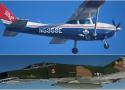
In a couple of ways, a Cessna is more difficult to fly than a fighter jet! The first has to do with mass. A typical Phantom configuration tips the scales at about 50,000 pounds. It takes about 36,000 pounds of afterburning thrust to get it going fast enough (175 knots) to generate enough lift to overcome the 50,000 pounds of gravitational resistance; chewing up about 2,000 feet of concrete. Once airborne, it was an incredibly stable platform because of that mass; trimmed up, it pretty much flew itself—-minimally affected by wind, speed changes, or even turbulence. Speed up? Push the throttle forward. Climb? Pull back on the stick. Turn? Push the stick right or left. Roll out? Push the stick in the opposite direction from starting the turn. Easy Peasy!
‘My son’s Cessna 182 has a maximum weight of 2,950 pounds driven by a 230 horsepower gasoline engine. It takes about the same 2,000 feet of runway to overcome gravity, but at around 55 knots (63 MPH). In order to takeoff at that speed, it has a massive airfoil. Combined with its light weight, it’s affected by every gust of wind, every change in speed, and every change in temperature. Level flight requires continuous trimming (sans auto pilot). Speed up? Throttle up, adjust prop (RPM), manifold pressure, fuel mixture, carburetor heating, cowl flaps, pitch trim. Continue to adjust all of the above according to variations in EGT (Exhaust Gas Temperature), cylinder head temperature, carburetor temperature; hoping to get minimum fuel flow as you don’t have a gauge.
NASA and The Ohio State University have created a brand-new metal called GRX-810, a printable superalloy engineered to withstand extreme heat inside jet and rocket engines. It is being called one of the most significant breakthroughs in high-temperature materials in recent years. NASA says GRX-810 is twice as strong as the best 3D printed superalloys available today, more than a thousand times more durable at high temperatures, and twice as resistant to oxidation. The team demonstrated it using laser 3D printing and believes it could lead to stronger and longer-lasting parts for airplanes, spacecraft, and high-performance engines.
GRX-810 is what materials scientists refer to as an oxide dispersion strengthened alloy. In essence, it is a nickel, cobalt, and chromium-based metal reinforced with tiny ceramic particles. These nano-oxides, specifically yttrium oxide (Y₂O₃), make up about one percent of the alloy by weight. NASA coats the metal powder with these nanoscale oxides before printing, and then fuses the powder together layer by layer using laser powder bed fusion.
As the part solidifies, the oxide particles remain locked inside the metal matrix like rebar in concrete. This reinforcement stops the metal from deforming or cracking when exposed to both high heat and heavy load. The alloy’s recipe involves nine different metallic elements along with the nano-oxides, and this combination was optimized through computational alloy design rather than trial and error.
A Concorde flew so high over the Red Sea that the mighty US Navy got scared and rushed F-14 Tomcats to intercept it. So fast was the jet that only when a veteran pilot chasing it took out his camera and zoomed, he realized their blazing target was the supersonic airliner //
“As we swung our nose in the direction of the vector we got, I got an immediate lock on an extremely fast and high-flying aircraft,” recalled David “Hey Joe” Parsons, the Radar Intercept Officer in the rear seat. The AWG-9 radar displayed a large lead cue, something you only see when the target is moving extraordinarily fast at altitude. The Tomcat began to climb. //
The Television Camera System should have provided a magnified visual, but the angle and altitude difference made the picture blur into haze. Parsons reached down into his flight bag and pulled out his personal 300 mm camera lens. He spotted a thin white contrail far above them. He steadied the lens, focused, and the shape came into clarity. “As I twisted the lens, the beautiful silhouette of the Concorde came into focus.” There was no threat. Only grace. //
Contrary to popular imagination, the Tomcat did not chase the Concorde speed-for-speed. An F-14 does not drag race a Mach 2 airliner. Instead, it turns toward the point the radar predicts the target will be, accelerates, climbs, and allows closure rate to do the work. For a moment, two icons of aviation existed in the same piece of sky, one built to defend, the other built to outrun time.

The North Atlantic is a busy chunk of airspace. Each day, thousands of aircraft cross the Atlantic Ocean between Europe and North America. We want to tell you a little more about what it is like to fly over it though. //
The NAT HLA is from FL285-FL420 inclusive and it is divided up into 6 different FIRs (Flight Information Regions)/OCAs (Oceanic Control Areas). Shanwick looks after the UK/ Ireland section, Gander looks after the Canadian side, Reykjavik has the North, Bodø has the really north (east) part and down south you have New York Oceanic and Santa Maria on each side. There is also a small bit controlled by Nuuk. You can see these on Fightradar24 if you activate the ATC boundaries layer in Settings.
Within the NAT HLA, you have the organized track system which is defined each morning and evening based on where the best jet streams are. There are usually 5 or 6 tracks published, with the westbound ones utilized during the day, and the eastbound by night. The peak flow of traffic heading westbound cross 030° west between 1130 and 1900 UTC, and eastbound it is at its heaviest between 0100-0800 UTC.
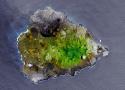
In my USAF C-141 flying years, I often flew NASA support missions to Ascension Island. It’s a joint RAF/USAF base deep in the South Atlantic. It’s a spit of an island whose landscape looks like the Moon — pockmarked volcanic rock and beaches, an undulating runway often populated with sheep or cattle, a mountain peak reaching into the clouds named “Green Mountain” — with some locals and some military/NASA personnel. It’s a beautiful little island with some amazing history. We’d typically fly from Charleston AFB, SC, to Patrick AFB, FL, then on to Antigua for gas (and a cheeseburger), and then the long flight south to the remote island. We called it “the world’s longest straight in.” After takeoff, you flew the same course all the way to the runway. Often late at night.
When the Emir of Qatar’s Boeing 747-8 BBJ touched down in Palma at the end of June 2025, it brought with it a rare sight and a logistical challenge. The aircraft, often called a flying palace, is one of the largest and most extravagant private jets ever built. Its arrival marked the beginning of the Qatari royal family’s annual summer stay in Spain, a tradition that combines opulence with routine.
On June 30, 1973, a supersonic jet screamed across the African sky at 58,000 feet, chasing darkness at 1,450 miles per hour. Inside Concorde 001, seven scientists peer through holes cut in the roof, watching the longest solar eclipse in human history unfold. //
Over Africa, the Moon’s shadow raced across Earth at over 1,300 miles per hour. Ground observers got seven minutes before the shadow moved on. But Concorde at Mach 2.2 could actually outrun the shadow, staying locked in totality for as long as fuel lasted. //
Height mattered as much as speed. At 58,000 feet, the aircraft flew above weather, water vapor, and atmospheric turbulence that would blur ground observations. The combination of speed, altitude, and precise navigation created a stable observatory hurtling through space faster than a rifle bullet.
Supersonic cruise generated fierce aerodynamic heating, raising the skin to temperatures that would alarm passengers on any other jet. At the nose, engineers recorded figures as high as 261°F (127°C). The wing leading edges often reached about 212°F (100–105°C), while most of the fuselage settled between 194 and 203°F (90–95°C). //
At those temperatures, the entire 202-foot Concorde stretched by 7 to 12 inches. That expansion was most visible to the crew at the seam beside the engineer’s station, where the caps went in. //
The ritual of sealing a cap in the fuselage became most famous during the retirement era. On British Airways Concorde G-BOAG’s delivery flight to Seattle in 2003, flight engineer Trevor Norcott slipped his BA cap into the expansion gap while supersonic over Canada. As he later explained, “The Hat was meant as a permanent link between the aircraft and the crews.” Hours later, as the jet cooled on the ramp in Seattle, the seam clamped down, locking the cap inside. To this day, visitors walking past G-BOAG at the Museum of Flight unknowingly pass a hidden time capsule wedged between metal panels.
A rare shot shows the Concorde taking off with the NASA 905 carrying the Space Shuttle
Pepsi paid millions to paint a Concorde in its iconic blue livery. But the passengers who paid first class fares to fly the iconic jet got a much slower and shortened ride as the blue paint heated the jet so much it was allowed to fly at Mach 2 speed for a mere 10 minutes. //
In the spring of 1996, one of the most ambitious and unusual marketing projects in aviation history took to the skies. Air France’s Concorde F-BTSD, known as “Sierra Delta,” was temporarily repainted in a vivid cobalt-blue Pepsi livery as part of Pepsi’s global “Project Blue” rebrand. The aircraft, instantly recognizable for its sleek, needle-like shape, now carried the bold Pepsi logo across its fuselage and tail. For several weeks, it toured major cities in Europe and the Middle East, hosting media and VIP flights. It was a spectacular sight and a daring collaboration between engineering prestige and consumer branding. Yet behind the beauty of the blue jet lay a technical limitation that few outside the project knew: this Concorde could not safely reach its full Mach 2 cruising speed. //
Dark colors absorb far more heat than they reflect, and when tested on Concorde’s aluminum skin, this quickly became a problem. The engineers at Air France Industries and Aérospatiale calculated that sustained flight at Mach 2 with the blue paint would raise surface temperatures dangerously close to the structural tolerance of the fuselage, as pointed out by Avions Legendaires. https://www.avionslegendaires.net/2025/10/actu/quand-le-concorde-se-muait-en-avion-sandwich-pour-pepsi/ //
To further protect the aircraft, a clever compromise was made. Only the fuselage received the dark blue finish, while the wings remained white. This was not a matter of design balance but thermal management, as the wings housed fuel tanks that acted as heat sinks during high-speed flight. Even with this precaution, engineers observed that the blue-painted panels heated up faster and cooled down more slowly than expected. The short-lived experiment confirmed once again that Concorde’s reflective white finish was essential for safe operation at its top speed. ///
So why did the SR-71 work better with black paint, but the Concorde had to have white paint to avoid overheating? Is it the difference between the titanium skin vs the aluminum skin and at the higher temperature of the SR-71, black paint is more effective at radiating heat and the white paint of the Concorde is more effective at reflecting heat at the lower temps?
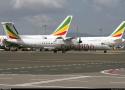
From humble beginnings just after the second World War to the largest airline in Africa, Ethiopian Airlines now connects more people with more aircraft throughout Africa and beyond than ever before. //
On December 21st, 1945, almost 80 years ago, Ethiopian Air Lines (EAL) was founded, beginning operations on April 8th, 1946, with its first flight Addis Ababa – Asmara (Eritrea) – Cairo (Egypt) and vice versa provided by Douglas C-47 Skytrains. During its early days, this was its only route, performed on a weekly basis.
Ethiopian Air Lines, managed by the Ethiopian government and Trans World Airlines (TWA), expanded its operations in Northeast Africa and Central Africa, launching its first long-haul routes in the 1950s. With the arrival of the first jet aircraft in the 1960s and 1970s, Ethiopian further developed its network, adding new services to Asia, Europe, and the Middle East.

The mysterious impact of a United Airlines aircraft in flight last week has sparked plenty of theories as to its cause, from space debris to high-flying birds.
However the question of what happened to flight 1093, and its severely damaged front window, appears to be answered in the form of a weather balloon.
“I think this was a WindBorne balloon,” Kai Marshland, co-founder of the weather prediction company WindBorne Systems, told Ars in an email on Monday evening. “We learned about UA1093 and the potential that it was related to one of our balloons at 11 pm PT on Sunday and immediately looked into it. At 6 am PT, we sent our preliminary investigation to both NTSB and FAA, and are working with both of them to investigate further.”
WindBorne is a six-year old company that seeks to both collect weather observations with its fleet of small, affordable weather balloons as well as use that atmospheric data for its proprietary artificial intelligence weather models.
The highest altitude recorded for a bird is 11,300 m (37,000 ft) for a Rüppell's vulture (Gyps rueppellii), which collided with a commercial aircraft over Abidjan, Ivory Coast on 29 November 1973. The impact damaged one of the aircraft's engines, causing it to shut down, but the plane landed safely without further incident. Sufficient feather remains of the bird were recovered to allow the American Museum of Natural History to make a positive identification of this high-flier, which is rarely seen above 6,000 m (20,000 ft).

On November, 29 1973 a bird strike occurred at an altitude of 11,300 m over Abidjan. The engine was shutdown during the collision, and was not restarted.
Altitude
The altitude is that recorded by the pilot shortly after the impact, which damaged one of the aircraft’s engines and caused it to be shut down. The plane landed safely at Abijan without further incident.
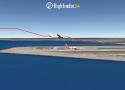
When dealing with such small tolerances between aircraft, it is important to keep in mind the limitations of ADS-B data. ADS-B data is reported in 25 foot increments, so a reported value of 50 feet is 50 feet ± 25 feet. The following values should then be taken with those qualifications in mind.
The altitude reported by the Nouvelair flight as it passed over the easyJet A320 was 50 feet. Both the Nouvelair and easyJet flights were operated by Airbus A320-214s. The A320 has a tail height of 38 feet, 7 inches.
15107 —
Submitted 7 days ago
Tom Heaverlo 4 days ago
It's a legit livery. Check out: https://www.youtube.com/watch?v=6u_sXrTsYik
Jorge NoronhaPhoto Uploader about 13 hours ago
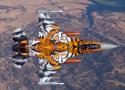
It's the livery made for the 2025 Tiger Meet in Portugal, this is a Portuguese F 16

Lockheed F-22 Raptor (02036)
Submitted 7 days ago
Raptor Demo Team
Captain Nick "Laz" Le Tourneau