On 12 September,1983, the Rev. William Still, Gilcomston South Church, Aberdeen, universally recognized as the senior parish minister, both in years and influence, among evangelicals in the Church of Scotland, gave the following address to some fifty ministers at an In-Service course of his denomination, convened at St Andrews. The address was published in The Banner of Truth magazine in 1984, and was drawn to the attention of the men at the 2010 US Ministers’ Conference in Grantham, PA, by Craig Troxel, one of the speakers, who comments:
When I first read this article it helped to forge in my mind an all-important distinction. When it comes to the stewardship of the Gospel, there are two basic choices before the Church of Christ. Either the Church will be content to apply itself to God’s ordinary means and trust him for their extraordinary ends; or, the Church will pursue extraordinary means and content itself with ordinary ends. In his reflection of four decades of ministry William Still describes the extraordinary fruit that God brought about through one congregation’s simple devotion to God’s appointed means of grace: Word, sacrament and prayer. In a day when there are so many voices calling for the church to do ‘something more,’ here is a plea for the church to pursue ‘its own native activity’ in the power of the Spirit. One need not claim membership in the Stillite clan to feel a deep kinship with our brother and his (still) timely word. //
He says that he found, that apart from the Early Fathers and the Reformers, any such systematic teaching and preaching of the Scriptures was short-lived, and even the Puritans, who certainly covered the Scriptures in depth, used textual rather than systematic expository preaching. One is not saying that our practice has not been done by preachers throughout history and even today, but I think you will agree that it is far from the accepted form.
However, the abundant fruit of this form of ministry, which I have documented in a book called The Work of the Pastor, is such that only a lunatic would have abandoned it despite all that was said against it. //
Now, I wonder if any are saying, ‘How incredibly narrow this is as an example of congregational life! Such intense spirituality!’ Perhaps you think you could not stand it, let alone your congregation! Well, all I can say is that from that fount of praise, prayer and Bible Study every conceivable kind of outreach goes on into the wider church and the community. //
I take the opposite view, having seen the dissipation and dilution of effort by such all-inclusive activities on the part of the different denominations I have been in. I felt that my time as Pastor could best be employed by concentrating almost wholly on feeding the sheep and tending the lambs in their spiritual growth through a corporate life of prayer and the ministry of the Word. Then let the congregation go out – and encourage them to do so – with an absolutely free commission to be leaven throughout the community and to live their life out there amongst the people as the good Lord guided. //
You see, you could get crowds to come to pie suppers You see, you could get crowds to come to pie suppers and dances in the hall, but precious few to church on Sunday, until things were so bad that old J. T. Cox – the compiler of our Church Law Book, who was Presbytery Clerk back then – twice tried to close our congregation down because it could not pay its way. Serve it right, too!
I hope you see what I am saying: let the church be the church, and let it not incorporate into its fundamental constitution anything but its own native activity, and let all the rest be as much in the nature of an unofficial activity and outreach as possible. //
I was saying that in our experience the whole future of young folk attending church – to put it no higher than mere attendance, although I can put it higher – right up to early adulthood, has hung on getting them to attend regularly, preferably in the family pew, during childhood. To say that we cannot do this in our modern age is surely the most pathetic admission of failure in our elementary responsibility as Christian parents. //
But instead of arguing with people that the Bible is the authoritative Word of God and presenting a wealth of apologetics, as many conservatives have spent their time doing, one has felt that the way to press people into the kingdom, especially thinking young people, is to preach the Word and teach it, and let it do its own work by the Holy Spirit in their consciences, ‘precept upon precept, line upon line’ (although I know that these phrases were perhaps first used by Isaiah for a different purpose). I mean preaching in a dogmatic way, not in the aggressive sense of the word but in the positive sense of it. And it is axiomatic and essential that we must present the truth with that backing of prayer and that dependence upon the Holy Spirit (in both the study of the Word and in the declaration of it) which releases the latent power of the Word to reach not only the minds, but the consciences, hearts and wills of the hearers. Our purpose must be nothing less than life transformation and, consequently, the calling of many into the Lord’s service. //
William Still (1911-1997) was the Minister of Gilcomston South Church of Scotland, Aberdeen, from 1945 until his death. This article was previously published in The Banner of Truth magazine, No. 244 (January 1984),


SUMMARY
The author reaches 1,800 years back into history, looking at the oldest, handwritten editions of the letters of Paul. Actual photographs of the manuscripts are included in this article.
Casting lots is not what most people think it is. It is not rolling the dice. Casting lots were actually white, smooth stones put into a cup, but there was usually one stone that was black, thus the expression today of being “black balled.” When they cast lots, each person took a stone out after they were shaken up and the one who received the black one was the guilty party. If it was disputes that were being settled, the same process was involved and the guilty party got the black stone. For decisions about priestly duties or dividing up land they would frequently have a symbol or name for the tribe or priest that was mixed together with the others, and whichever lot came out at a particular time, a decision was based upon that. There was no chance for the lot being cast for the wrong person or the wrong tribe because God is sovereign even over the lots.
Truly, “The lot is cast into the lap, but the decision is the Lord’s alone” (Prov 16:33), but the most important question is, “Have you trusted in Christ?” There is no other way to heaven than through Jesus Christ (John 6:44). The path to hell is broad and wide, but there is only one, narrow path to heaven (Acts 4:12). You have to make a decision because to make no decision is to choose to reject Jesus Christ, and that will not go well for you the moment after you die, and no one knows when that will be. We all have an appointment for our death (Heb 9:27). At that moment, it will be too late to do anything about your eternal state. Like the rich man in the story of Lazarus and the Rich Man, you cannot cross over, nor can you go back and warn your family or friends (Luke 16:19-31). The fact is you will be there for all eternity, and when 10 billion years have passed, you will not have knocked off one second of your eternal punishment. Your eternity is been permanently cast if you reject Christ. Choose today who you will follow. Tomorrow may be too late.
Marriage is never fair deal -- you are building something eternal
Indeed, the sin of Adam is a “felix culpa” (a “happy fault”) because, through it, God — in His benevolent care for us — caused an even greater good to come from it: the incarnation, the sacrifice of Christ on the cross, His resurrection, our salvation, and the redemption of the world.
Christian philosopher Alvin Plantinga writes in his felix culpa theodicy, “Perhaps God sees that the best worlds he can actualize are ones that include the unthinkably great good of divine incarnation and atonement. Suppose he therefore actualizes a … world that includes incarnation and atonement, and in which human beings fall into sin, evil and consequent suffering.”
In his encyclical Salvifici Doloris, Pope John Paul II reflected upon the possibility of redemptive suffering. That is, the possibility that God can — and does — redeem our suffering for good. “One can say that with the Passion of Christ all human suffering has found itself in a new situation,” he writes. “In the Cross of Christ not only is the Redemption accomplished through suffering, but also human suffering itself has been redeemed.”
In other words, through Christ — and because of Christ’s sacrifice — our very suffering can also be redeemed and provided with new purpose and meaning. Moreland and Craig make a similar point, writing, “the chief purpose of life is not happiness, but the knowledge of God.”
“Many evils occur in life that may be utterly pointless with respect to the goal of producing human happiness,” they observe, “but they may not be pointless with respect to producing a deeper knowledge of God.”
A Christian response to the problem of evil acknowledges it is possible that God permits evil and suffering because He can bring about a greater good from it. //
Only Christianity addresses the problem of evil with an entirely unique answer among the world’s religions: God Himself — in the person of Christ — came to suffer with us, for us, and because of us.
Reflecting upon this fact, Christian philosopher Marilyn Adams writes, “[God] is not content to be immutable and impassible, to watch his writhing creation with the eye of cool reason. He unites himself to a human consciousness and takes the suffering to himself.” Only in Christianity does God enter His creation, live among His creatures, and ultimately bleed and die on behalf of and at the hands of His creation. Because He loves His creation. Because He loves us.
That, indeed, is a God we can trust in.
WITNESSES
(45-80 MINUTES)
Eight men, who rubbed shoulders with Jesus, tell stories of their encounters with him. Ranging from wildly funny to dramatically intense, these stories show a “fleshed out” Jesus, who made a curious call on these mens’ lives. Performed in contemporary dress, with very contemporary language, this show introduces the audience, in a fresh way, to Jesus, without “church language or pews”. In the blink of an eye, with very simple costume changes, Curt becomes eight different men, with eight different perspectives on Jesus. //
God-Views
(40-60 minutes)
What is God really like? This show asks that question. And … it’s funny. Very funny. In it, Curt presents, in caricature form, six different comic misconceptions of the nature of God. God as a Sheriff, a Butler, an old Geezer, a Mechanic, a Cosmic Party Animal, and … God-in-a-box. He concludes with one of two stories (or sometimes both!) … a tender re-telling of the Prodigal Son story, showing the Father heart of God, or a very funny “redneck parable,” showing, in no uncertain terms, the picture of a gracious God.
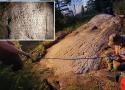
Archaeologists finally broke the cipher on 255 strange symbols etched into a Canadian rock over 200 years ago — and it’s the Lord’s Prayer… in Swedish.
Discovered in 2018 after a tree fell near Wawa, Ontario (just a stone’s throw from Michigan), the bizarre runes had stumped many — until Ryan Primrose from Ontario’s archaeology squad swooped in with the scoop.
After seven years of trying to decipher what the unusual carving symbolized, Primose finally learned that the etched symbols are part of an alphabet that was used in Scandinavia.
And the symbols translated to a 1611 Swedish version of The Lord’s Prayer, according to the Canadian Broadcasting Corporation.
No other fancy artifacts showed up nearby, so Primrose figured the area where this carved rock lay most likely was treated as an outdoor chapel.

The space agency’s astronomical models suggest that a lunar eclipse turned the moon red over Jerusalem on Friday, April 3, 33 AD — a date many scholars tie to Jesus’ death. //
The eclipse theory, originally floated by Oxford University researchers Colin Humphreys and W. Graeme Waddington, https://www.asa3.org/ASA/PSCF/1985/JASA3-85Humphreys.html

Combining radiocarbon dating and a new AI program called Enoch yields surprising results.

Rome carved borders in stone. Priests built walls from law and fear. Prophets thundered from mountaintops, hoping the ground would open.
But Jesus moved differently. He never staked a claim on land. He never petitioned for favor. He never drew a boundary he would not cross.
He spoke of a kingdom that cannot be mapped. A reign that begins between two heartbeats. A fire hidden under cold ash.
They wanted a king with banners and cavalry. He offered a seed pressed into dirt.

Read and study God's Word with Bible study software that has in-depth resources such as commentaries, Greek and Hebrew word tools, concordances, and more. //
Searchable Online Bible with Study Resources
Blue Letter Bible is a free, searchable online Bible program providing access to many different Bible translations including: KJV, NKJV, NLT, ESV, NASB20, NASB95 and many others. In addition, in-depth study tools are provided on the site with access to commentaries, encyclopedias, dictionaries, and other theological resources. Browse the site to see all of the Bible study tools available.

The authority of Scripture is a key issue for the Christian Church in this and every age. Those who profess faith in Jesus Christ as Lord and Savior are called to show the reality of their discipleship by humbly and faithfully obeying God’s written Word. To stray from Scripture in faith or conduct is disloyalty to our Master. Recognition of the total truth and trustworthiness of Holy Scripture is essential to a full grasp and adequate confession of its authority.

Our statement of faith, mission, and resources are grounded in the historical, conservative Christian faith.
-
We affirm the Bible to be the inspired, inerrant, and the only infallible and authoritative Word of God. We affirm the Chicago Statement on Biblical Inerrancy.
-
We affirm that there is one God, eternally existent in three distinct persons: Father, Son, and Holy Spirit.
-
We affirm the deity of our Lord Jesus Christ, His virgin birth, His sinless life, His miracles, His vicarious and atoning death through His shed blood, His bodily resurrection, His ascension to the right hand of the Father, and His personal return in power and glory.
-
We affirm that for the salvation of lost and sinful people, regeneration by the Holy Spirit is absolutely essential.
-
We affirm the present ministry of the Holy Spirit by whose indwelling the Christian is enabled to live a godly life.
-
We affirm the resurrection of both the saved and the lost: they that are saved unto the resurrection of life and they that are lost unto the resurrection of damnation.
-
We affirm the spiritual unity of believers in our Lord Jesus Christ.

Zechariah 3:2 New International Version
The LORD said to Satan, "The LORD rebuke you, Satan! The LORD, who has chosen Jerusalem, rebuke you! Is not this man a burning stick snatched from the fire?" //
When trying to identify the source of an NT citation of the OT it is important to consider the Greek OT, from which most NT citations of the OT employ. Please add Zech 3:2 from BES [Brenton's English Septuagint] to your scriptures in your question. blueletterbible.org/bes/zec/3/2/s_914002 //
A:
This is a contentious question and has been much debated even from the time of Origen. According to Origen, the account of Michael disputing with Satan over the body of Moses, is attributed to material contained in the Testament of Moses [also known as, "The Apocalypse of Moses", or, "The Assumption of Moses"]. However, about one third of the text of the Testament of Moses is now missing and there is no mention of such an incident in the text that remains.
Modern critical scholarship (with which I only rarely agree) suggest that this part of Jude is a midrash of Zech 3 and material from the Testament of Moses [eg, https://en.wikipedia.org/wiki/Assumption_of_Moses ]. Certainly, Jude quotes often from both the OT pseudepigrapha, eg, Jude 14, 15 quotes 1 Enoch 1:9.
The idea of the LORD rebuking people is a regular theme in the OT, for example: [....]
Why was there a dispute about the body of Moses? And how did this dispute arise, if it happened? What (if anything) is known about this? //
A:
Origen claims that the Letter of Jude picked up the story of Michael and the devil arguing over the body of Moses from a Jewish text called the Ascension of Moses. //
References to this apocryphal story are found in early Christian literature.
The text we have which is titled the Ascension of Moses, however, does not contain this particular event. It may be that our text is missing the section containing the story of the dispute over Moses' body, or we may have misidentified which text we have.
Richard Bauckham, arguing that the various references to the story are independent of the Letter of Jude, attempts to reconstruct the story's key points... //
Joshua accompanied Moses up Mount Nebo, where God showed Moses the land of promise. Moses then sent Joshua back to the people to inform them of Moses' death, and Moses died. God sent the archangel Michael to remove the body of Moses to another place and bury it there, but Samma'el, the devil, opposed him, disputing Moses' right to honorable burial. The text may also have said that he wished to take the body to the people for them to make it an object of worship. Michael and the devil therefore engaged in a dispute over the body. The devil brought against Moses a charge of murder, because he smote the Egyptian and hid his body in the sand. But this accusation was no better than slander (βλασφημία) against Moses, and Michael not tolerating this slander, said to the devil, "May the Lord rebuke you, devil!" At that the devil took flight, and Michael removed the body to the place commanded by God, where he buried it with his own hands. Thus no one saw the burial of Moses.
The base form of the story seems influenced by Zechariah 3.

As first reported by the BBC, a sharp uptick of men have been attending a Russian Orthodox Church Outside Russia (or ROCOR) in Georgetown, Texas, led by Father Moses McPherson. //
After watching McPherson's YouTube channel for a bit, I can see why many people would gravitate toward him, especially men. McPherson seems to reject modernist takes on gender roles and encourages young people to get married, settle down, and have children. In one short, he holds up a pregnancy test and encourages couples to get a positive one. He also calls masturbation "pathetic and unmanly".
A lot of McPherson's positions seem to be blunt, unwavering, and unapologetic, and I think that's what is attracting a lot of men right now. They feel like they can be proud of their masculinity in the way that God sees it, and this ROCOR growth seems to show that men aren't just seeking that kind of welcome; they want to foster it and find fellowship in that kind of scene.
Modern society makes it clear that masculinity is unwelcome and distasteful, and men are often made out to be the bad guy no matter what the scenario entails, yet at this faith, men are held in higher esteem. They're obviously still held highly accountable for their actions, but this accountability comes with love and encouragement, not blame and derision.
I asked my small group a follow-up question: “If 10 minutes of watching porn per day has shaped your brain, what do you think 10 minutes in the Bible could do?” While it wasn’t the mic-drop moment I imagined, a flicker of hope shone on their faces as they began to consider the surprising reality.
Porn shaped us. But the Bible can shape us even more forcefully. //
Gen Z was raised on instant gratification. Everything we want—entertainment, information, food, clothing, and even social validation—is available with a click. We’ve grown up on dopamine media and all its fabricated highs, cheap thrills, and immediate results.
So when a young man opens his Bible, reads a chapter, and walks away with no dopamine burst or goose bumps, it’s easy to think, What’s the point? When the Bible’s formative power takes years to accomplish what algorithms do in moments, it’s easy to think, This isn’t doing anything. He’s left with a simmering frustration toward God, reminiscent of a spoiled child: “It’s my spiritual growth, and I want it now!”
Ironically, it’s his struggle with pornography that reveals the truth he doubts: Small habits shape you in profound ways. Ten minutes of daily porn forms thought patterns, shifted desires, altered speech, and changed relationships. It turns people into objects, intimacy into performance, and satisfaction into orgasm.
What if, in the same way, 10 minutes a day in God’s Word—replacing 10 minutes of porn—could reverse that? Not instantly. Not overnight. But slowly, surely, powerfully. What if every time you thought about clicking on porn you opened the Bible instead? What if 10 minutes of Scripture each day began to reshape you—making holiness the default instead of lust? What if, day by day, your thoughts started to align more with Christ’s? Your desires shifted toward purity? Your hopes restored?
The good news is that this is precisely how God designed us. This is how spiritual growth works. //
And you’re right—reading the Bible alone isn’t enough. But it’s a solid foundation. And it arms you with the truth, habits, and hope you need to fight back.
The Bible teaches you to surround yourself with a community that holds you accountable (Heb. 10:24–25). It teaches you to confess your sins (James 5:16). It teaches you to approach the throne of grace with confidence (Heb. 4:16). It teaches you to pray without ceasing (1 Thess. 5:17). It teaches you to fix your mind on things above (Col. 3:2). It teaches you God’s unbreakable love (Rom. 8:38–39). Scripture doesn’t just inform us once; it reminds us daily.
Breaking free from sin isn’t about a single life-changing moment. It’s about the daily decision to keep fighting. //
Porn teaches your neural pathways to escape into fantasy whenever you feel stressed, anxious, or bored. The Bible teaches your neural pathways to take refuge in God, your salvation and strength (Ps. 46:1).
Porn cultivates your neural pathways to default to lust. To take rather than give. The Bible cultivates your neural pathways to default to chaste self-control. To love rather than consume (Gal. 5:22–23). //
What if the battle against porn isn’t just about breaking a bad habit but about building a better one? Because here’s the truth: If you commit to daily Scripture, the Holy Spirit will forge new neural pathways. Slowly but surely, you’ll begin to see the difference. The escape you once sought in porn will start to pale in comparison to the rest you find in God. Sinful desires won’t just be resisted—they’ll be replaced. Over time, dark desires will be expelled by holy longing.
Scripture becomes the anchor steadying you when temptation hits, grounding you when shame creeps in, and holding you fast when everything else tries to pull you under. It’s not the whole fight, but it’s where the fight begins.
The Bible is the only Book that gives us any indication of the true nature of sin, and where it came from.
The Philosophy of Sin, 1107 R
Bible Timeline Chart with World History
Easily See Over 6,000 Years of Biblical and World History Together!
Unique Circular Format – more in less space. How does all this information fit on a 37″ x 45″ poster – compared to the 15 or 20 feet of a straight timeline?
For some time now, there has been a controversy in Christiandom as regards the authenticity of the book of Enoch.
A lot of people are of the view that if the book really mattered, it would have been meant for the people that existed before Christ because the book was more than 300 years old when Jesus Christ was on earth.
Jesus Quotes Book of Enoch