This is the unique story of observing a total solar eclipse for no less than 74 consecutive minutes. On the summer morning of June 30, 1973, the Sun rises on the Canary Islands. But it is strangely indented by the Moon. The eclipse of the century has just begun. From the west, the lunar shadow rushes to the African coast at a velocity of over 2000 kilometers per hour. Astronomers on the ground will enjoy seven short minutes of total eclipse to study the solar corona - too short for Pierre Lena and seven scientists who board the Concorde 001 prototype, an extraordinary plane to become the first commercial supersonic aircraft. With André Turcat as chief pilot and a crew of five, at 17000 m altitude, the aircraft remains in the lunar shadow for 74 minutes, a record time of scientific observations not yet beaten and allowing for exceptional measurements. ////
Epub, PDF


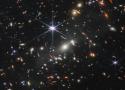
In a recent paper in Nature, a team of scientists led by Kimihiko Nakajima, an astronomer at the Kanazawa University, Japan, used the James Webb Space Telescope to observe an ultra-faint galaxy called LAP1-B as it existed roughly 800 million years after the Big Bang. It’s the most chemically primitive galaxy we’ve ever seen.
The magnifying glass
The LAP1-B is 13 billion light-years away from Earth. To observe an object that faint and distant, even the huge, gold-coated beryllium mirrors of JWST were not enough on their own. We spotted it due to a massive cluster of galaxies called the MACS J046, which warps the spacetime between us and the LAP1-B.
“The galaxy was strongly magnified through the gravitational lensing effect,” Nakajima said. Specifically, the spacetime warped by the MACS J046 clusters magnifies light traveling from LAP1-B toward Earth by roughly 100-fold. //
This analysis revealed a profound shortage of elements heavier than hydrogen and helium. The gas-phase oxygen-to-hydrogen ratio stood at just 0.4 percent of what we find in our Sun.
Another detail in the spectrum indicated the type of radiation that made the gas glow. The team detected emission lines from triply ionized carbon—a state where a carbon atom has lost half of its six electrons. Stripping multiple electrons away from carbon atoms requires extreme-ultraviolet photons, with energies exceeding 47.9 electronvolts. Standard stars, even the massive ones we see in our galactic vicinity, are not hot enough to produce radiation this intense.
The stars that could get this hot, Nakajima’s team suggests, were the very first that ignited in the Universe. These were made exclusively of hydrogen and helium forged in the Big Bang and lacked heavy elements to help them cool as they formed. “Such stars should be formed from primordial gas,” Nakajima said. //
The stars we see today, including our Sun, are Population I stars. The older generation, found in the halo of our galaxy, are Population II stars, which have far lower levels of elements heavier than helium. Population III stars were the first to appear in the cosmos, and they’re theorized to be violent monsters with masses hundreds of times higher than the Sun squeezed into surprisingly small volumes. They burned extremely hot and died young in supernova explosions. Nakajima’s team has likely found traces of these explosions in LAP1-B.
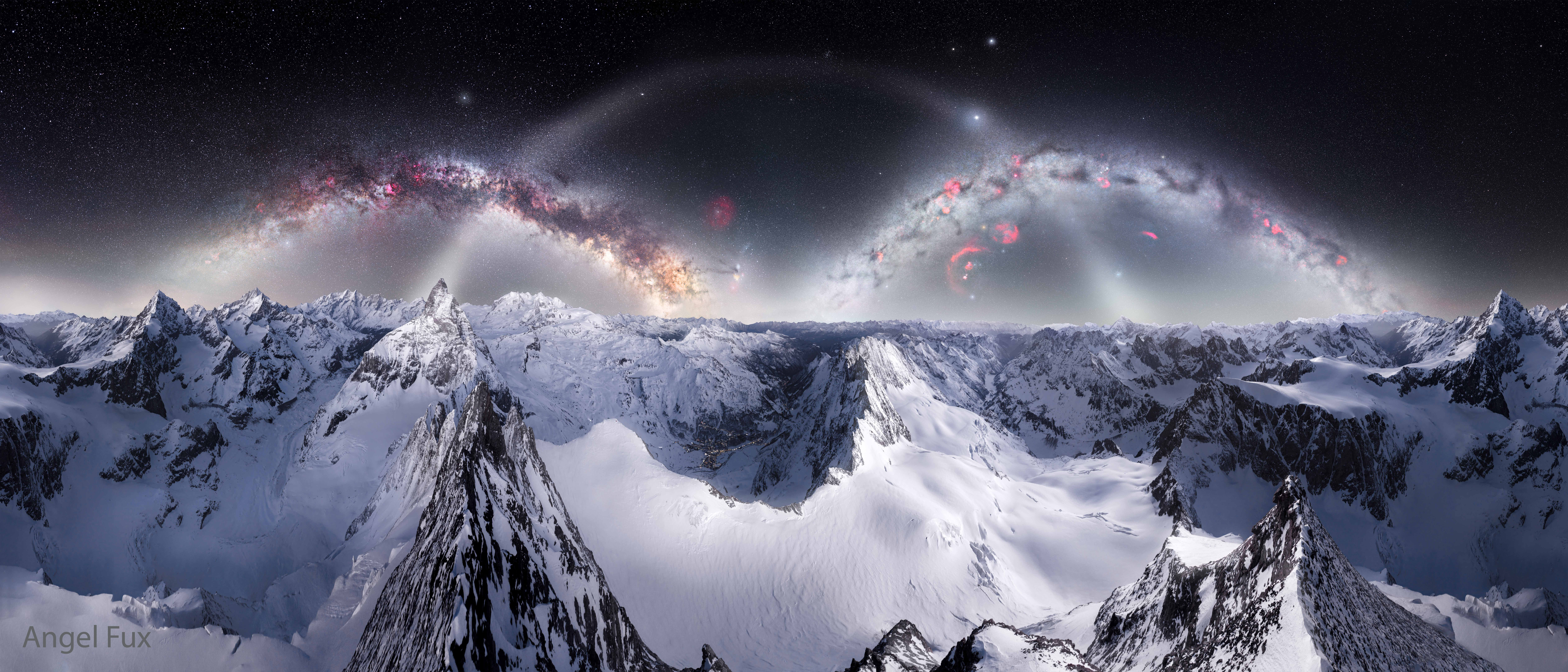

Three Sky Arches over Snowy Alps
Image Credit & Copyright: Angel Fux
Explanation: Why are there three arches across the sky instead of two? Last month, after being dropped off by a helicopter at a high mountain peak in the Alps near the Swiss Italian border, an adventurous astrophotographer expected two arches of our Milky Way galaxy to be visible during the night. These were the inner arch looking in toward the center of our galaxy on the left, visible just before sunrise, and the outer arch on the right visible just after sunset. But there were three arches. The surprised astrophotographer soon realized that the sky was so dark that an entire arc of faint zodiacal light was also noticeable -- sunlight scattered by inner Solar System dust. And it artfully connected the two Milky Way arches!
Artemis II Journey to the Moon
Pictures
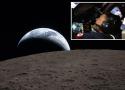
Most of the out-of-this-world photos being beamed home from Artemis II were taken with an old-model Nikon camera that can be bought for about $1,000.
NASA traded in the legendary Hasselblad model it used on Apollo missions years ago for the Nikon D5 DSLR — a classic digital single-lens-reflex camera first released in 2016.
The Nikon was carefully selected for its proven track record as a workhorse space camera, as well as its extraordinary ability to pick up detail even in extreme darkness, Nikon’s top NASA consultant told The Post on Tuesday.
He said the Nikon D5 has been used successfully in space since 2017 — and “is still producing amazing images for them.”
One of the camera’s top-selling points for Artemis II was its incredible low-light capabilities, Corrado said.
The camera is able to shoot at an ISO — or light-sensitivity rating — of up to 3.2 million. //
“After this mission, it should be Z9. They won’t go back to the D5 after this,” he said. “Once they fully test and continue to test, the Z9 will be the camera going to the moon.”
Artemis II brought a total 32 cameras onboard for their 10-day mission.
Fifteen were mounted on the spacecraft, and 17 were handheld cameras the crew operated while peering out the cabin windows during their historic flyby of the lunar far side.
“The five experiments all succeeded, but none of them revolutionized our understanding of the corona,” he says in a disarmingly honest way about the flight’s immediate impact. “They all played their role in the normal progression of scientific knowledge, but there were no extraordinary results, it has to be said.” //
Léna doubts their incredible flight will ever be repeated. Today, space-based satellites that can watch the sun 24/7 and create permanent artificial eclipses have revolutionized our understanding of the nearest star to Earth—although observing eclipses on Earth is still useful for astronomy. //
“At the time, our knowledge of the solar corona was very very limited,” explains Léna. “Today we have far less need for eclipse flights from a scientific point of view because we can put missions like SOHO in space, which is doing essentially what we were aboard Concorde. Our observation methods have changed a lot, so I doubt if today we’d redo a mission like that.”
It’s often said that scientific inquiry leads to innovation, but the Concorde experiment is a reminder that sometimes innovation offers wild, unexpected dividends to science. Today, the exact plane that chased the eclipse in 1973 sits as a permanent exhibit at Le Bourget Air and Space Museum, complete with the special roof portholes and the eclipse mission logo on its fuselage. Léna, John Beckman and other engineers and astronomers were present for the 2013 unveiling, along with the late pilot André Turcat
This serene view from the coast of Sweden looks across the Baltic sea and compresses time, presenting the passage of one night in a single photograph. From sunset to sunrise, moonlight illuminates the creative sea and skyscape. Fleeting clouds, fixed stars, and flowing northern lights leave their traces in planet Earth's sky. To construct the timelapse image, 3296 video frames were recorded on the night of a nearly full moon between 7:04pm and 6:35am local time. As time progresses from left to right, a single column of pixels was taken from the corresponding individual frame and combined in sequence into a single digital image 3296 pixels wide.
Recorded during 2017, timelapse sequences from the International Space Station are compiled in this serene video of planet Earth at Night. Fans of low Earth orbit can start by enjoying the view as green and red aurora borealis slather up the sky. The night scene tracks from northwest to southeast across North America, toward the Gulf of Mexico and the Florida coast. A second sequence follows European city lights, crosses the Mediterranean Sea, and passes over a bright Nile river in northern Africa.
Just two weeks ago, dark skies over the desert in northern Iran held this alluring celestial vista. The dramatic digital mosaic finds the Moon and Mars alongside the Milky Way's dusty rifts, stars, and nebulae. Captured through a series of exposures to cover a range in brightness, that night's otherwise Full Moon is immersed in Earth's shadow. It actually appears fainter and redder than the Red Planet itself during the widely watched total lunar eclipse. For cosmic tourists, the skyscape also includes the Lagoon (M8) and Trifid (M20) nebulae and planet Saturn shining against the Milky Way's pale starlight.
What's that green streak in front of the Andromeda galaxy? A meteor.
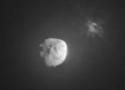
On September 26, 2022, NASA’s Double Asteroid Redirection Test (DART) spacecraft crashed into a binary asteroid system. By intentionally ramming a probe into the 160-meter-wide moonlet named Dimorphos, the smaller of the two asteroids, humanity demonstrated that the kinetic impact method of planetary defense actually works. The immediate result was that Dimorphos’ orbital period around Didymos, its larger parent body, was slashed by 33 minutes.
Of course, altering a moonlet’s local orbit doesn’t seem like enough to safeguard Earth from civilization-ending impacts. But now, as long-term observational data has come in, it seems we accomplished more than that. DART actually changed the trajectory of the entire Didymos binary system, altering its orbit around the Sun. //
Because Dimorphos orbits Didymos, some of the ejecta remained trapped in the system, where it altered the mutual orbit between the two rocks. But a crucial fraction of the ejecta achieved escape velocity from the entire binary system. The momentum carried away by the system-escaping debris is what ultimately contributed to shoving the center of mass of the whole Didymos-Dimorphos pair. “In our case, we found that the beta parameter due to DART impact was around two,” Makadia explained.
The debris blasted completely out of the Didymos system gave the asteroids a push roughly equal to the initial impact of the spacecraft itself. //
The goal of DART was primarily to take our planetary defense out of the realm of computer models and get us some hands-on, practical experience, and Makadia thinks we succeeded in doing that. “Our work proves that hitting the secondary asteroid is a viable path for deflecting a binary system away as long as the push is large enough,” he said. “This wasn’t the goal of DART, but we can always design a bigger spacecraft.”


This is the thermal IR (LWIR) of the total lunar eclipse. A 12" Newtonian has been used as fore-optics. Pseudo color to enhance the details. The pictures shows some younger craters are very bright when the sun is temporarily blocked by the Earth.
MST 20260303 03:35 Partial Lunar Eclipse Thermal Vs. Visible (HDR) Fun to see the dramatic difference on the surface in difference wavelength ranges
Cradled in red-glowing hydrogen gas, stars are being born in Orion. These stellar nurseries lie at the edge of the giant Orion molecular cloud complex, some 1,500 light-years away. This detailed view spans about 12 degrees across the center of the well-known constellation, with the Great Orion Nebula, the closest large star-forming region, visible toward the lower right. The deep mosaic also includes, near the top center, the Flame Nebula and the Horsehead Nebula.
What does the universe look like through infrared goggles? Our eyes can only see visible light, but astronomers want to see more. Today’s APOD shows spiral galaxy IC 5332 as seen by two NASA telescopes: Webb in mid-infrared and Hubble in ultraviolet and visible light. To toggle between the two space-based views just slide your cursor over the image (or follow this link). The Hubble image highlights the spiral arms of the galaxy separated by dark regions, whereas the Webb image reveals a finer, more tangled structure. Interstellar dust scatters and absorbs light from the stars in the galaxy, causing the dark dust lanes in the Hubble image, and then emits heat in infrared light, so dust glows in this Webb image. The Mid-InfraRed Instrument on Webb needs to operate at a chilling temperature of -266ºC (or - 447ºF), otherwise it would detect infrared radiation from the telescope itself. Combining these observations, astronomers connect the “small scale” of gas and stars to the truly large scale of galactic structure and evolution.
Analemma image taken between 2021 and 2022, with images taken at 4 p.m. on a weekly basis, clouds permitting. The analemma was calibrated and overlaid with an image taken over Lake Varese in the late afternoon of the winter solstice in 2021, featuring one of the many swans that flock to the shores of Lake Varese in the foreground. Canon 400D + Sigma zoom lens 10 mm. Happy solstice!
Can you tell that today is a solstice by the tilt of the Earth? Yes. At a solstice, the Earth's terminator -- the dividing line between night and day -- is tilted the most. The featured time-lapse video demonstrates this by displaying an entire year on planet Earth in twelve seconds. From geosynchronous orbit, the Meteosat 9 satellite recorded infrared images of the Earth every day at the same local time. The video started at the September 2010 equinox with the terminator line being vertical: an equinox. As the Earth revolved around the Sun, the terminator was seen to tilt in a way that provides less daily sunlight to the northern hemisphere, causing winter in the north. At the most tilt, winter solstice occurred in the north, and summer solstice in the south. As the year progressed, the March 2011 equinox arrived halfway through the video, followed by the terminator tilting the other way, causing winter in the southern hemisphere -- and summer in the north. The captured year ends again with the September equinox, concluding another of the billions of trips the Earth has taken -- and will take -- around the Sun.
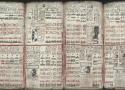
Eclipse tables in the Dresden Codex were based on lunar tables and adjusted for slippage over time. //
The Maya used three primary calendars: a count of days, known as the Long Count; a 260-day astrological calendar called the Tzolk’in; and a 365-day year called the Haab’. Previous scholars have speculated on how awe-inspiring solar or lunar eclipses must have seemed to the Maya, but our understanding of their astronomical knowledge is limited. Most Maya books were burned by Spanish conquistadors and Catholic priests. Only four hieroglyphic codices survive: the Dresden Codex, the Madrid Codex, the Paris Codex, and the Grolier Codex. //
They concluded that the codex’s eclipse tables evolved from a more general table of successive lunar months. The length of a 405-month lunar cycle (11,960 days) aligned much better with a 260-day calendar (46 x 260 =11,960) than with solar or lunar eclipse cycles. This suggests that the Maya daykeepers figured out that 405 new moons almost always came out equivalent to 46 260-day periods, knowledge the Maya used to accurately predict the dates of full and new moons over 405 successive lunar dates.
The daykeepers also realized that solar eclipses seemed to recur on or near the same day in their 260-day calendar and, over time, figured out how to predict days on which a solar eclipse might occur locally. “An eclipse happens only on a new moon,” said Lowry. “The fact that it has to be a new moon means that if you can accurately predict a new moon, you can accurately predict a one-in-seven chance of an eclipse. That’s why it makes sense that the Maya are revising lunar predicting models to have an accurate eclipse, because they don’t have to predict where the moon is relative to the ecliptic.” //
“The traditional interpretation was that you run through the table, eclipse by eclipse, and then you rebuilt the table every iteration,” said Lowry. “We figured out that if you do that, you’re going to miss the eclipses, and we know they didn’t. They made internal adjustments. We think they’d restart the table midway. When you do that, you go from having missed eclipses to having none. You would never miss an eclipse. So it’s not a calculated predictive table, it’s a calculated predictive table plus adjustments based on empirical observations over time.”
“This is the basis of true science, empirically collected, constant revision of expectations, built into a system of understanding planetary bodies, so that you can predict when something happens,” said Lowry.