Cthel Ars Praefectus
6y
11,052
Subscriptor
odikweos said:
Wow. Not even one commenter mentioned the possibility of Chinese competition.
The real story here is exactly when cheap Chinese competition completely erodes the global demand for American launch. It's happened in industry after industry, and the state-owned "company" that handles the matter for PRC just succeeded at its first retrieval last month.
And no one apparently even has this on their radar.
That's because the US outlawed launching anything containing a single US-made component (including software) on a Chinese launch vehicle.
https://spacenews.com/u-s-itar-satellite-export-regimes-effects-still-strong-in-europe/
Massive fines tend to make the business model for launching on a Chinese launch vehicle unviable. //
Mdoug1974 Smack-Fu Master, in training
1y
18
The one and only reason SpaceX holds a monopoly as Gwynne Shotwell has stated many manby times is that all the other launch service providers have failed to provide any competition.
SpaceX cannot be blamed for its competitors failures to bring rockets to market in sufficient numbers to make a challenge.
Shotwell has in so many interviews stated that SpaceX welcoms competition because it will force them to work harder, better and smarter.
Nobody has been even able to start being competion yet. and by the time they do starship will be flying, and maybe Falcon 9 will be slowing down.
SpaceX have to fly F9 until the ISS is shutdown as they are contracted to do so, and starship willnever be cleared to ISS unless somebody(Boeing) re-calculates all the stress and mechanical loading of attaching a fully finished Starship to the ISS.


The company that is almost exclusively responsible for the dramatic increase in launch availability in the 2020s has signaled that it intends to wind down Falcon 9 operations as quickly as possible in favor of the larger Starship rocket. Some might see that as a good thing due to Starship’s enormous payload capacity. But there are growing concerns that SpaceX will largely focus on its own payloads—Starlink v3 satellites and orbital data centers—because of their potential to drive far greater profits. The Starship rocket’s PEZ satellite dispenser, optimized for Starlink, is an indication of the company’s priorities.
In financial documents, it’s clear that SpaceX views commercial launch as a rounding error compared to revenues from its own satellites in space. A majority of the company’s revenue ($4.3 billion out of $7.8 billion) during the second quarter of 2026 came from Starlink, whereas less than 12 percent was due to space services, of which commercial launch is but a fraction. This disparity is only likely to widen.
SpaceX has already moved beyond “peak” Falcon 9 operations. The company flew the rocket 165 times last year, and it will probably fly about 20 fewer missions this year. SpaceX is already making ground system changes to reflect these reductions. //
Whether or not these dates stick, it has become clear to commercial satellite operators that they can no longer reliably plan their future around the workhorse Falcon 9 rocket, creating a huge pain point for the commercial space industry in the United States and other Western countries.
This is because of an inescapable reality: Without SpaceX, the Western launch market would have been completely screwed over the last half-decade. //
The Ariane 6 rocket made its debut flight in July 2024 and has had a nice track record. But with a production goal of ten vehicles a year, the rocket won’t make a meaningful dent in the global need for launch capacity.
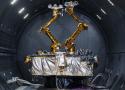
A spacecraft fitted with two flexible robotic arms is on the way to geosynchronous orbit after launching earlier this week on a SpaceX Falcon 9 rocket, kicking off a planned decade-long mission to open new frontiers in satellite servicing.
The Mission Robotic Vehicle, owned and built by Northrop Grumman, rocketed into orbit from Cape Canaveral Space Force Station in Florida on Tuesday. Three small propulsion pods, each functioning as standalone spacecraft, accompanied the MRV aboard the Falcon 9 rocket.
The Falcon 9 deployed all four payloads within about an hour of liftoff. It will take about a year for the satellites to maneuver from their initial elliptical drop-off orbit into a circular orbit more than 22,000 miles (nearly 36,000 kilometers) over the equator. At this altitude, the MRV and the three Mission Extension Pods (MEPs) will travel in lockstep with Earth’s rotation, //
Northrop Grumman’s first three Mission Extension Pods launched on the same rocket as the MRV, but they are flying separately up to geosynchronous orbit using electric propulsion. The pods, each about the size of a dishwasher unit, will loiter there for retrieval by the MRV’s robotic arms. After picking up the first pod, the servicing spacecraft will rendezvous with its first client satellite, lining up precisely with the client to install the pod into its engine compartment. The MEP will latch onto the satellite and take over propulsion for up to eight years, acting as a jetpack, or a smaller version of the MEV, to move the client around geosynchronous orbit as needed. //
This isn’t refueling, but the MRV serves the same end. The Space Force has a separate contract with a company named Astroscale to demonstrate refueling in geosynchronous orbit next year, something no US company has done before. The MRV can also do more than life extension. It can inspect, service, upgrade, or repair satellites that were never designed for it. //
“RSGS has full seven-degree-of-freedom robotic arms, heavily instrumented. The ends of the arms can attach multiple tools as hands, and they also have a good deal of autonomous control,” Shoemaker said. “It’s general-purpose, high-dexterity robotics.”
Ground teams could build and launch more jetpacks to meet up with the MRV in geosynchronous orbit after the spacecraft uses the three pods already in space. Future launches could carry new tools, such as a knife, a cutter, or a robotic screwdriver for more invasive servicing or repairs. And the MRV itself is designed to be refueled in orbit. Northrop Grumman doesn’t plan to immediately build a second MRV, but it will continue upgrading and augmenting the vehicle it just launched. //
These companies and more are taking distinct paths toward satellite servicing, orbital refueling, in-space depots, and what the military likes to call dynamic space operations. But the trend is unmistakable: to fully utilize the domain of space, the throwaway mentality must go.
High above the remote Pacific Ocean, about halfway between Hawaii and the northernmost part of Australia, an air-launched rocket fired into space on Independence Day weekend to kick off a weekslong pursuit of a NASA astronomy satellite perilously close to falling out of orbit.
The endeavor to rescue NASA’s Swift satellite is the first mission of its kind. NASA put out a call for commercial companies less than a year ago to propose how they could rapidly build and launch a small satellite to latch onto the Swift spacecraft and boost its altitude so that it doesn’t come down in a few months.
Katalyst Space Technologies responded with the best offer. NASA awarded the company a contract last September to build and launch a mission to rescue Swift. A little more than nine months later, Katalyst’s nearly half-ton Link satellite is safely in orbit. For anyone who follows the space industry, building, testing, and launching a functioning first-of-its-kind satellite of that size in less than a year is a remarkable achievement; it would usually take several years.

Rocket Lab announced on Monday that it is acquiring the satellite communications company Iridium. The deal, made for cash and shares of Rocket Lab stock, values Iridium at about $8 billion.
The deal pairs the launch company, founded and led by Peter Beck, with a decades-old profitable satellite company whose network of 80 satellites in low-Earth orbit provides telecommunications services.
“We believe this will be one of the most transformative deals in the space industry,” Beck said in a short promotional video announcing the deal. “It’s the ultimate combination for growth.” //
Beck said the deal provides a shortcut for Rocket Lab to enter the “space applications” business—that is, providing space-based services rather than launching the satellites that offer voice, Internet, and other communication services to customers on Earth. This is where the majority of revenue in the space industry lies.
“This is a deal where one plus one equals three,” he said.
On Wednesday, NASA’s Office of the Inspector General prepared a memorandum on the elements of the Artemis Program that NASA was canceling as its focus shifted to the Moon’s surface. These were:
Exploration Upper Stage, an upgrade for the Space Launch System rocket
Universal Stage Adapter, which links the Orion spacecraft to the Exploration Upper Stage
Mobile Launcher 2, a larger launch tower for the upgraded Space Launch System rocket
Habitation and Logistics Outpost, a habitation module for the Lunar Gateway
The memorandum notes that each of these projects has experienced substantial cost increases and numerous delays over the last decade.
“Over the course of their life cycles, the combined contract values for these efforts ballooned from nearly $2.8 billion to $5.9 billion and NASA extended their contracted delivery dates by up to seven years,” states the report by the inspector general. “However, our projections indicate that if NASA allowed work to continue to completion, the systems would have cost more and taken longer than what was on contract.”
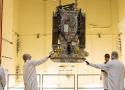
WALLOPS ISLAND, Virginia—Just 10 months ago, NASA asked three companies if they could do something nobody had done before. Could they build and launch a satellite to save a $500 million astronomy mission at risk of crashing back to Earth? What’s more, could they do it in less than a year on a tight budget?
Katalyst Space Technologies, a startup founded in 2020, presented the most compelling solution. “They came back with a response that was technically and programmatically plausible, and then we were like, ‘Yeah, let’s do it,’” said Shawn Domagal-Goldman, director of NASA’s astrophysics division.
That was in August of last year. In September, NASA awarded Katalyst a $30 million contract to build, test, and launch a small satellite to chase down Swift and latch onto it with three robotic arms. Then, Katalyst’s Link servicing spacecraft will boost Swift’s orbit back to a safe operating altitude, allowing it to resume scientific observations. Easier said than done. //
“From a programmatics standpoint, I consider this a success already, just from the fact that we’re even going to try this,” Domagal-Goldman said.
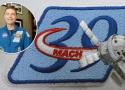
Mission Commander Reid Wiseman, pilot Victor Glover, and mission specialists Christina Koch and Jeremy Hansen (the latter with the Canadian Space Agency) spent 10 days in early April flying by the Moon. Their journey took them farther away from Earth than any humans have gone (52,756 miles [406,771 km]) and then, on the way back on board their Orion spacecraft Integrity, they sped up to about 24,664 miles per hour (39,693 k/ph) reentering the atmosphere.
Only three other people in history have traveled faster. NASA’s Apollo 10 astronauts Thomas Stafford, John Young, and Eugene Cernan set the record for the highest speed attained by a crewed vehicle relative to the Earth’s surface: 24,791 mph (39,897 kph) on May 26, 1969.
Cernan died in 2017, Young in 2018, and Stafford in 2024.
Point Nemo is officially known as “the oceanic pole of inaccessibility,” or the point in the ocean farthest from land. Located at 48°52.6’S 123°23.6’W, the spot is quite literally the middle of nowhere, surrounded by more than 1,000 miles of ocean in every direction.
The closest landmasses to the pole are one of the Pitcairn Islands to the north, one of the Easter Islands to the northeast, and one island off the coast of Antarctica to the south.
There are no human inhabitants anywhere near Point Nemo. And scientists chose to call the location “Nemo” because it is Latin for “no one” and as a reference to Jules Verne’s submarine captain from 20,000 Leagues Under The Sea.
The location is so isolated that the closest people to Nemo are not even on Earth. According to the BBC, astronauts aboard the International Space Station are around 258 miles from the Earth’s surface at any given time. Since the inhabited area closest to Point Nemo is more than 1,000 miles away, the humans in space are far closer to the pole of inaccessibility than those on land. //
As for non-human inhabitants, there aren’t very many of those around Point Nemo either. Point Nemo’s coordinates fall within the South Pacific Gyre, an enormous rotating current that prevents nutrient-rich water from flowing into the area. Without any food sources, sustaining most life in this part of the ocean is impossible.

View and download this historic assembly code for your own space program //
The historic computer software code that took Apollo 11 to the moon has been open-sourced and is available for anyone to read, download, and tinker with. NASA’s Chris Garry made the code available on GitHub as public domain. The published resource is basically in two large codebases, one set of code for the Command Module (Comanche055) and another for the Lunar Module (Luminary099). These modules both had their own Apollo 11 guidance computers (AGC) upon which to run the code, and were instrumental to the success of the remarkable mission – the first human Moon landing in history. //
It is fascinating to see this Apollo 11 code from nearly 60 years ago shared in the context of the ongoing Artemis II lunar mission. Today, we aren’t marveling at the lean and mean machine code that NASA is using to get humans to and from the Moon. Rather, Microsoft Outlook email bugs and a malfunctioning toilet on the Orion spacecraft may have taken the shine off the momentous achievement this latest mission represents.

Robert Goddard, a Massachusetts-born physicist, launched the world’s first liquid-fueled rocket on this date 100 years ago.
It was not an overly impressive flight. The rocket, fueled by gasoline and liquid oxygen, rose just 41 feet into the air, and the flight lasted 2.5 seconds before it struck ice and snow.
Nevertheless, this rocket, named “Nell,” represented a historic achievement that would help launch the modern age of spaceflight. Three decades later, the first objects would begin to ride liquid-fueled rockets into space, followed shortly by humans. A little more than 40 years would pass before humans walked on the Moon.
To mark this historic moment, a few Ars staffers are sharing some of their most memorable launches. Please add yours in the comments below.
This page lists various fan-made tools that can help calculations related to the gameplay of Kerbal Space Program. Unlike addons, they do not directly influence the game, as they are run separately.
Performing a transfer from an orbit of one body directly to an orbit of another one seems like serious business. A few guides published on the forums have a lot of maths and stuff, you may think this is too complicated to figure out.
Well, it is rocket science, but: it's not complicated.
In the basic orbiting tutorial, you were introduced to the concept of orbiting, and basic orbit stabilization, as well as an orbital table to help you along. Now, what if you want an orbit that isn't on that table? What if you want to have an orbit with a specific period? That's where these formulae come in.
In the basic orbiting tutorial, you were introduced to the concept of orbiting, and basic orbit stabilization, as well as an orbital table to help you along. Now, what if you want an orbit that isn't on that table? What if you want to have an orbit with a specific period? That's where these formulae come in.
The blue circle is Kerbin itself, the light blue circle around it is the top of the atmosphere. You can click+drag on the left of Kerbin to set periapsis, or on the right of Kerbin for apoapsis. You can also use the text boxes to enter altitudes and velocities numerically.
You need to specify two values in all: either altitudes of periapsis and apoapsis, velocities at periapsis and apoapsis, or both altitude and velocity at either periapsis or apoapsis. You select the values you want to enter with the Parameters menu, the remainder of the information will be computed from the values you put in. If you enter altitude and a velocity above escape velocity, it'll give you excess velocity at infinity. The apoapsis and periapsis textboxes are altitudes above mean sea level (AMSL), the text report below has both altitudes AMSL and distances from the center of Kerbin. Note that if you specify values that lead to an apoapsis lower than periapsis, the plotted orbit and contents of the text fields will be swapped automatically.
This online tool calculates delta-v and CommNet requirements in KSP (a video game, Kerbal Space Program). It helps KSP players plan and solve complex missions. Just like the game, these calculators are made to be interactive and visual to help new players quickly grasp the mechanics of rocket science.
How to Use: Simply select the body you wish to perform orbital synchronization calculations on from the drop-down list, then pick the resonance you wish to place your craft in. Example: If you wanted a 2:3 resonance, enter 2 into Numerator and 3 into Denominator.
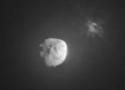
On September 26, 2022, NASA’s Double Asteroid Redirection Test (DART) spacecraft crashed into a binary asteroid system. By intentionally ramming a probe into the 160-meter-wide moonlet named Dimorphos, the smaller of the two asteroids, humanity demonstrated that the kinetic impact method of planetary defense actually works. The immediate result was that Dimorphos’ orbital period around Didymos, its larger parent body, was slashed by 33 minutes.
Of course, altering a moonlet’s local orbit doesn’t seem like enough to safeguard Earth from civilization-ending impacts. But now, as long-term observational data has come in, it seems we accomplished more than that. DART actually changed the trajectory of the entire Didymos binary system, altering its orbit around the Sun. //
Because Dimorphos orbits Didymos, some of the ejecta remained trapped in the system, where it altered the mutual orbit between the two rocks. But a crucial fraction of the ejecta achieved escape velocity from the entire binary system. The momentum carried away by the system-escaping debris is what ultimately contributed to shoving the center of mass of the whole Didymos-Dimorphos pair. “In our case, we found that the beta parameter due to DART impact was around two,” Makadia explained.
The debris blasted completely out of the Didymos system gave the asteroids a push roughly equal to the initial impact of the spacecraft itself. //
The goal of DART was primarily to take our planetary defense out of the realm of computer models and get us some hands-on, practical experience, and Makadia thinks we succeeded in doing that. “Our work proves that hitting the secondary asteroid is a viable path for deflecting a binary system away as long as the push is large enough,” he said. “This wasn’t the goal of DART, but we can always design a bigger spacecraft.”
Statistical Ars Legatus Legionis
15y
54,490
michaeltherobot said:
You clearly know what you are talking about, so could you ELI5 why polar LLO costs more than equatorial LLO? My intuition that they are the same comes from KSP, in which, soon after leaving Earth orbit, you plan a miniscule burn to adjust lunar insertion from coming around the side to coming over the top.
Of course, in both those cases I then have to decelerate hard at perilune to be captured. Perhaps the flight paths NASA is considering have some way to save dV vs my hard deceleration, which don't work for polar orbits?
The added cost comes from the plane change and plane change at high velocity (low orbit) are expensive. You CAN do something similar to what you describe it just takes longer potentially much longer. The higher the perilune the cheaper the plane change becomes but the longer it takes to reach the perilune. You drop yourself into a highly elliptical orbit around the moon at the same plane as the initial orbit. You then ride up to the perlune, raise the plane to 90 degrees and lower the perilune to circular (decelerate hard).
NASA wouldn't consider doing a plane change in Earth orbit because then you can have a free return trajectory which is a risk reduction factor.
So the tradeoff of DeltaV vs time.
Compare this map to the one in the previous post.
https://arstechnica.com/civis/attachments/1772816223709-png.129833/
1772816223709.png
Significant cheaper but it adds a 3.5 day loiter riding up to the vey high perilune to become as cheap as NRHO (including the transit). To have insertion and exit cost that are 2x this you would need the same loiter on the way back. In KSP things like mission duration are quite cheap and excessive risk doesn't matter but yeah same basic concept and math.
To be clear this is really only an issue for an occupied crew vehicle. If you add a 15 day loiter then the phase change becomes essentially free. For prestaging the lander or the tanker to refuel it after a sortie neither would be harmed by a 30 day longer mission. So if LLO was used as a staging point, which I don't think it will, then there would be mission choices by SpaceX and BO on how much LLO loiter vs round trip DeltaV for sending that tanker to meet lander with the prop it needs.